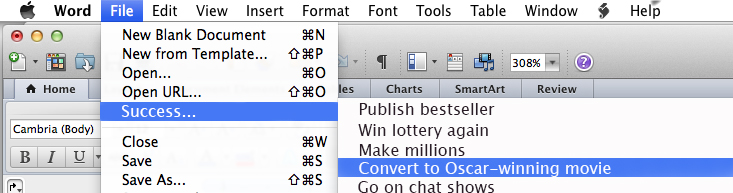
Writing is not a lottery

Word Success menu

I’ve only been thinking about this for two months. Around Christmas time, someone said to me that one has as much chance of writing success as one has of winning the lottery.

My considered, instant, knee-jerk reaction was to say bollocks.

Two months on, having genuinely thought about this a lot, I want to revise that statement and say very bollocks.

He just meant that it was hard to be successful in this and there’s no denying that. But I think comparing it to a lottery is not just wrong, it is ultimately damaging. The wrongness is very easy to point out so let’s do that first. If your numbers regrettably don’t come up on the lottery this Saturday, you don’t get to take those numbers back and rewrite them. You can and people do play the same numbers in the next prize draw so perhaps you could compare that to sending the same manuscript around to many publishers. But, right or wrong, nobody at National Lottery headquarters emails you say that they loved what you did with 3, 7 and 9 but maybe 12, 17 and 43 need a little more work.

Wait, how many numbers do you have to pick in the UK National Lottery? I used to know this stuff: I worked the Wednesday late shift at BBC Ceefax where I’d have to put up the numbers on screen as they were announced. And every Wednesday, the same woman would phone the newsroom to complain that I was too slow – or once that I was too fast. I can’t believe I’ve forgotten. Hang on. I’ll just check.

God in heaven. I am out of touch. There’s now a bewildering (to me, anyway) number of different lotteries and I tell you, looking at the website for it, I can’t work out anything. I’m going to say seven. Okay? Let’s say that you have to pick seven numbers in a lottery draw.

You don’t get to sit there thinking that the seventh number isn’t quite enough, that really you need to add an eighth. Or maybe the other way around, that your third and fourth numbers are a bit of flabby padding, you’d be better taking those out and shortening the piece And that would be because you don’t make anything. You’re not creating anything, you’re just picking. I don’t see any interest or value in the lottery beyond the chance of winning and I don’t really see any chance of winning.

Whereas, when I write something good, it tends to fly. When I don’t, it doesn’t. My writing career has depended primarily on thinking of the opportunity and then writing to fill it. Most of the time, it doesn’t work. And certainly there are rejections that appear random, there are some rejections that actually are random. But the rest of the time, it works. I keep writing, I keep working, I keep writing.

Unlike any lottery or any gambling, the effort I put in to something usually has a direct bearing and a direct consequence on whether it is successful. If you’re a better writer than I am, and there are few people who aren’t, then you might argue that my abilities are more in getting the work to people than in writing anything decent. You could be right. But it’s still writing and it is still directly, palpably tied to my effort. There is no effort you can put into the lottery that will increase or decrease your chances of any one prize draw coming up great for you. (You could enter multiple times and I suppose you could say that there is effort in finding and committing that much cash but on the one hand I would wince at the thought of you wasting money. And on the other, with the odds we’re talking about, i don’t believe there is a statistically significant difference between you buying one or fifty goes at this thing.)

We all have bad times. Yesterday I saw a project that is deeply important to me evaporate in front of my eyes. That was a hard one. Today I was rejected from something else and I’m struggling to remember what it was. Even trivial rejections can add up, though: get enough in a row and you do start questioning your luck.

But that is why I think this comparison between writing and the lottery is actually damaging.

Once you start seeing this as luck, I think you’re screwed. Sorry. I thought a stronger word but this is a family show.

People want to think that writing success is luck because when you get it, luck is easy. When you don’t get it, you’re just unlucky, it’s no reflection on your talent or lack of talent. People get told that successful writers are lucky. I’m going to say to you again that it makes me mad how JK Rowling’s years of huge effort, skill and talent are always reduced to the same two sentences: she was a single-parent mother, she’s now a millionaire. The bit in between was not a swift dollop of luck, it was years of hard work done well. Whatever money she has, she earned it.

People also like to think that writing is luck because it’s easier to see success as a binary thing: it is or it isn’t, you are a success or you’re not. It’s like the relationship ladder: are you dating? is it serious? when’s the date? are you expecting? when’s the divorce? The writing success ladder goes: that’s nice, you play with writing, you’ll be good! can’t you get a proper job? aren’t you published yet? when’s the novel coming out? when’s the film of the novel coming out? I could write a novel! I’m going to try writing when I retire!

Both of those ladders are how other people react to us but they are cutting because we also think the same way: we wonder why we’re not dating yet, we wonder if we can’t write. We wonder that an awful lot. Well, some of us don’t: some of us are certain that we can’t.

But if you do actively think you can write or if you simply do continue to progress and survive in writing as a career, it’s like you have a choice between calling yourself lucky or calling yourself a success. All English and writerly modesty aside, if I did call myself a success here, while talking to you about this, it would feel galling. It would feel like I was trying to compare myself to Rowling. I don’t, not in terms of her talent or her money, but I love what I do, I love that I get to do it, I wouldn’t swap with her or anyone else. So I’d call that success. There’s little reason to expect someone to have heard of me but when they have, that can mean we get to meet and natter. Similarly, if I make money, I get to eat tonight. These are two important things to me. 

But when you reduce it all to success or not success, made it or not made it, lucky or not lucky, you’re creating a wee binary barrier and convincing yourself that only luck will get you across it.

It is not true that writing a great book means you will get rich or that you will get published. It is not true that everyone has a novel inside them. It’s not even close to true that everyone can write.

But the way you find out if you can is to write. And if writing well isn’t guaranteed to get you success, it’s at least something that you can improve at and learn from and grow with. There’s no improvement, learning or growth from picking seven lottery numbers. There’s actually nothing, you get nothing from picking seven lottery numbers. The lottery is all about the ending while writing is about the journey too.

Now, if you told me writing is stupid, I could well agree with you there.

Elite Death Squirrels

I do have something to say in my defence. I was forced to do it by Elite Death Squirrels.

You can’t argue with that, can you? They come in the night, they take what they want, and nobody dares say a word. You’ve never heard of the Death Squirrels. Not even adults have heard of them. That’s how scary they are.

They’re like real squirrels, you know, but they kill. On missions from the government, usually. Their trademark is that they can get where nobody else can – and they never leave a trace. That’s really why they have to kill. It’s like compulsive tidying with them. No trace. No clue. Minimum residual presence.

That’s their term for it. MRP. Minimum Residual Presence. I tell you, these squirrels, they’re trained.

Seeing what I saw, I’m lucky to be here at all.

Look, if I were making this up, wouldn’t I have stolen a proper car? I hid in the ambulance because it was the nearest and because they wouldn’t think to search for me in there.

Yes, of course I stole the uniform. I’d be rubbish at hiding if I hadn’t put this on, wouldn’t I?

And of course I drove it away. How else do you think you escape Elite Death Squirrels? I mean, they’re fast. They really so fast. Wish I had nicked a proper car. You don’t get a lot of acceleration in ambulances. Surprises me, that. Wouldn’t you think that ambulances would have some welly? They should be on Top Gear.

Hang on, sharp bend coming up.

That should shake the last of them.

There!

Did you hear that squeal? Grownups say that’s the brakes but really it’s squirrels falling off the back. You’re not afraid, are you? It’s a well-known fact that you never see Elite Death Squirrels snatching anyone from a moving ambulance.

You’ll be okay.

I’ve done this before. Not with the squirrels, they’re new. I only found out about them recently. But the stories I could tell you of –

wait, there’s something moving.

Hang on, I’m going to floor it. Soon get you there.

What we’re going to do, we’re going to chase that motorbike. With the lights, right there, do you see it? Don’t look! They’ll see you!

It’s called a Rapid Response Team but it’s really a moving Squirrel Control. You can tell. That one who looks like a police officer? That’s really eight squirrels standing on each other’s shoulders. Five more to reach the pedals.

Yes, we could go the other way but they’d spot that right off. They’re clever. I tell you, they’re trained. And they’ve been in worse situations than you can imagine.

No, the thing is, what we’ll do, right, we’ll stick close on their tail. They’ll think we’re part of the team. If they look, can you pretend to be a squirrel? Good girl, that’s the ticket.

No, no, keep that in. It’s helping you. It’s liquid marigolds. Squirrels hate that.

No, you keep it. Thanks. I’ve had, um, marigold aspirin, I’m fine. Yes, when you’re an adult, you take little marigold aspirin daily and it helps. You need a bit more, just because it’s your first time.

Yes, right, well, yes, all adults take marigold aspirin. They just don’t know why. The government knows though, don’t they? Bound to. They command the Elite Death Squirrels. I suspect Squirrel High Command is in Westminster. Got to be. Top secret.

Well, there’s fallout, isn’t there? From the bears.

Squirrels go around killing for the government, you’ve got to have bears. Checks and balances. Squirrels and bears. It’s obvious.

Nearly there.

Yeah, ah, the bears, they’re – well, you know Goldilocks, don’t you? She runs the bears. I think they have a restaurant. But it’s a cover for their covert anti-squirrel operation. Clearly.

Yes, Golidlocks controls the bears and the government runs squirrels. They don’t do it alone. What about when there’s a new government? They can’t take on national debt and a vast squirrel army, not all at once. That’s why they’ve got One Direction.

Took over from the Pied Piper, they did.

That’s what they say, I’m just telling you. I don’t make this stuff up.

Oh, that’s my girl. Very good. Yes, the sign said hospital. We’re going to hide the ambulance there. It’s perfect, isn’t it? They’ll never suspect. You’re not afraid of hospitals, are you? They’re the very safest places in the world. There has never been a squirrel attack on any hospital, ever.

Fact.

Now you’re doubting me? You accept the Elite Death Squirrels but you doubt me about hospitals? How do you think I know all this stuff? I’m a grown-up. I’ve been to hospital for a lot worse than you’ve got and I’ve seen for myself. No squirrels.

Yeah, okay, sometimes you see them outside, patrolling the gardens, looking for their way in but they never find it. Never. Not one squirrel has ever got into a paediatrics ward.

That’s the special name for where we’re going to hide you. Keep you extra safe.

I want you to be very brave now.

When we get you hidden there, I bet the nurses will tuck you up in a bed. Make sure you stay there, it’s very important. I need my spy on the inside. Can you do that?

Well, you’re safe in there, safe from the squirrels, but if you can get a window, keep watching out. Be vigilant.

It means keep concentrating, don’t miss anything.

Very good! That’s exactly right, you are clever. I’m taking a little shortcut. The motorbike squirrels don’t know you can get to the hospital this way. We’ll scoot around them and get you there before they can say gesundheit.

Squirrels say gesundheit.

Everyone knows that.

No, I’m going to lead them away. You be safe inside, I’ll take the ambulance back out to squirrel territory. I’ll be okay.

And look! Look at me, stay with me, stay focused, keep your eyes open, we’re here, just a little longer, kidder.

A little longer.

Here we go. Here we are. The nurses will take you in. You tell them I said you were very brave and you deserve a lollipop.

And we’ll keep the Elite Death Squirrels to ourselves, okay? The doctors don’t know about those. They leave no trace.

Right of Centre

I gave up trying to understand this years ago. Soon I hope to give up trying to excuse it. But for whatever reason it may be, when a piece of work is right – is just somehow right – it makes me cry.

Now, my definition of right is unquestionably going to be different to yours but you know when something is right, too, even if you’re cooler than I am and only rarely blub. I think it’s when I can recognise that an artist has tried to reach something new, that they have succeeded and that I have been brought along by them. Very often it can be at the end of a piece, it’ll be at the point when the artist’s journey is done. It’s happened to me with novels, films, with finely-made one-hour television episodes. There are certain Emily Dickinson and Christina Rossetti lines that I can’t say for sobbing. Actually sobbing.

It has happened just once with a place. New York City. My favourite place in the world. Can’t tell you why, can’t point to a feature or a fact, I just know that I stepped out onto those streets one night and I felt taller. I felt taller with a tear in my eye.

I need you to understand that this isn’t an hourly occurence and that I don’t ever cry because something is sad. It’s rare and powerful, it is vastly more raw and dambusting than just a mawkish weepie on a Sunday afternoon. Something opens me up and reaches in to get a good grasp. Usually it’s unexpected, statistically it’s most often music. The entire Suzanne Vega album Songs in Red and Gray, for instance. I can’t hear that as a set of tracks, it is one piece to me and it all works.

I bring this up because I went to a concert this week and it began with the words “From New York City… Suzanne Vega”. Nobody can tell me why I got a shiver from that, but I did and it was glorious.

But while I’m telling you that she was great and that while I felt only a shiver and slightly damp eyelids, I want to tell you of a time when all this was very bad for me.

It’s pretty bad now, admitting it to you.

But once. Just once. It wasn’t only a tear from something being right. There was just once also a sense of sadness. Maybe it was just the combination of right and sad, but it felt more. It felt like howl-with-rage misery.

And it was over a Suzanne Vega song.

Tired of Sleeping, from her 1990 album, Days of Open Hand.

It’s not like that’s a comedy record but I also wouldn’t have said that it was the darkest 3’47” of the night. Except that it was for me. I cannot convey to you how that song smashed away inside me, I certainly cannot explain why. But everything I’ve confessed about when things are right, I got that with this. Everything I’ve denied about it ever happening when things are sad, I got all that too.

Over and over, actually.

It was so bad, it hurt so very badly, that I asked my wife Angela Gallagher for help. I may be imagining this but I think she held my hand while she listened to the track. She liked it, she recognised how strong it was, but, frankly, it didn’t throw a brick through her skull as it had me.

And do you know what? From that moment on, I have been able to listen to Tired of Sleeping without being upset anywhere near as deeply.

So let this be a lesson. If something is right and something is powerful, I’m keeping it to myself.

UPDATE: There are many versions of Tired of Sleeping now but this is the skull-smashing one. The link is to a fan’s YouTube video and right this moment I’m playing it while writing to you – and so not bothering to watch whatever visuals the fella has added. No offence to him, but I’d recommend that you do the same. Here’s Tired of Sleeping

Inside story – teaching writing to prisoners

Usually when I run writing workshops they're for children, students and teachers. It’s always fun and satisfying because I’ve done it often enough now that I know they’re going to enjoy the material I’ve got for them, I know they are going to write well. But last year I did two workshops in prisons and while I hoped they would be as useful for the prisoners, I went in with entirely selfish reasons. I’ve never been near a prison before and I wanted to see inside that world.

But usually the people on writing workshops have chosen to come and they already have ideas they were working on. This time I was going in with Geese Theatre and we were working toward the Clink and Arts Alliance project Write to Be Heard. It's a National Prison Radio project with the aim of getting prisoners to write and specifically to write for radio. I'm a radio man, you don't have to sell me on writing for radio but there was an extra element here in that writing to be heard is different from writing to be printed. Prisoners who struggled with grammar or English – everything was to be in English and anyway my own three languages are English, American and Australian – would hopefully feel less pressured to get the commas right.

I was scared. I’ll admit that freely: I need my commas. And prisons. All those big, imposing walls. You see so many prison dramas and I’ve even written one: my very first Doctor Who radio drama had Peter Davison locked up in solitary in an alien prison. The high security, the heavy doors: it’s an imposing and a frightening world.

It's also a world. You're not stepping into a community per se, it is a world entire of itself. The air is different. You're much more conscious of the open sky above you because of the closed walls on all sides. You never find out what any person did to get locked up but you know every person did something. And you haven't. They are all at a different place from you and you want to understand it, but you vividly don't want to experience it.

Plus, it's a criminal offense to bring a mobile phone into a prison so my iPhone security blanket had to stay outside in the car.

Once you're through all the walls and the doors and the dogs and the guards and the forms and the photographing, though, you're working in a room that could be anywhere. I did two prisons in two days, back to back, and the first one was like working in my old sixth form. Apart from the prison guard watching all the time, there were low-slung seats, school-quality tables, plenty of room. It was a low-security prison where everyone I met was in the last stages of their sentences so they were very much looking to the outside world.

It meant I got writing from them that was one moment introspective, the next quite liberated. One moment unexpectedly happy and one moment very piercingly dark and personal.

The second group was in a higher-security prison. Even more serious walls and, this time, retina scans. The group I got was made up of primarily young offenders who were in on drug-related crimes. Some had been there a long time and none of them leaving soon so you knew there would be a bit of a different mood.

Unfortunately, there was also a mistake. For whatever reason, these men hadn't heard of the project, they didn't actually know they were going to be doing any writing. They came along expecting to watch some kind of performance.

Okay. So I have fifteen men, some deeply troubled, all scary, none wanting to be in prison of course but also none choosing to be there because they wanted to write.

Whatever you're picturing now, add in that we were today in a pair of portacabins bolted together. With myself, these men, Geese Theatre people and prison staff, we all had to take turns breathing in and out.

But also picture this. In moments, I had that room in silence.

Everybody writing. Really concentrating, very serious.

And then I had them all performing their work. Everybody talking, really concentrating, really laughing.

I write to be read. I forget that writing can do such big things as focus us and release us, that it can take us away from ourselves and push us deep into ourselves too.

Plus, very many of the men I met went on to enter the Write to Be Heard project. I can't be more specific: I can't tell you names, what prisons they were, I can't really tell you how well they did in the project. But in a counted-them-out-and-counted-them-back kind of way, let me tell you that when I heard the results, I was proud of them.

I've been wanting to tell you that and in fact about all of this for six months or more but it's only now that I'm allowed to talk about it publicly. Which is good because I get to tell you but it's great because there many of us writers did very many days in a huge number of prisons and I'm hoping to hear from everybody else now too.

Thanks to Clinks.org and Arts Alliance for having me and to all at Geese Theatre who I'd heard of but truly did not appreciate how much they do in prisons and for prisoners. And to Writing West Midlands whose Room 204 project got me the gig.

How 1984 wasn’t much like 1984 and still isn’t

mac1984

(Image from Mac-History.net)

It’s thirty years since Tommy Cooper died on live TV. It’s the thirtieth anniversary of Colin Baker’s first trip in the TARDIS and of Virgin Atlantic’s inaugural flight. Also, importantly, it’s three decades since some sports thing. But of all the things that happened in 1984, I’m feeling compelled to talk to you about just one –

– no, two.

Officially this is also the 30th anniversary of Cyndi Lauper’s debut album, She’s So Unusual. I remember that so well: I remember the feel of the vinyl in my hands, I remember that it was an unusual impulse buy of an artist I’d only vaguely heard of. I remember that it was the first album that felt like a single body of work to me instead of a series of songs. And I remember that was because it seemed so strikingly clear that Side 1 was terrific – Money Changes Everything, Girls Just Want to Have Fun and Time after Time were all there – and that Side 2 wasn’t.

You don’t remember when albums had sides. I hate you. Give me my biscuits back. For my part, I don’t remember exactly when I bought it but the album came out in 1983 so it bothers me that it’s this year that a 30th Anniversary edition is being released. I’m wondering if they’ll sell me the first half.

But I know I’ll buy it, I know the odds are that I’ll buy it online and I know for a fact – because I’ve just done it – that I called up the original album right now on iTunes. Curiously, it’s the only Cyndi Lauper album that I don’t have complete. It’s not as if I stopped ripping the CD half way either. I’ve a patchwork of songs from it. Definitely going to buy the thirtieth, then.

So it’s 05:46 and Girls Just Want to Have Fun is in my headphones, I’m writing to you in Evernote, my email inbox is teetering, my calendar is throbbing and my OmniFocus To Do list is wiping its brow. Every part of that sentence, bar the stupidly early time, is tied up with my Mac.

And that’s the one thirtieth anniversary I really am compelled to write to you about.

It’s actually thirty years to the day that the Macintosh was launched. It would be perhaps five years before I used one but the Mac that launched in 1984 directly changed me: it stopped me being interested in computers. I know I’m talking to you about machines and that at least software tends to come up a lot with us, but that really is what it did: after I used a Mac, I wasn’t into computers.

Maybe I never really was into them – I’m certainly not as technically minded as so very many people I know – but I think I enjoyed the puzzle of them. I definitely enjoyed all the fiddling with all the settings and the options. That day at school, right at the end of the last term, when I found out if you bash your head onto the keyboard in despair it would restart the RML 380Z and save you the usual twenty minute wait while a tape loaded. (“Oh, yes, I meant to tell you,” said the teacher.) The way that I learnt to swear while just trying to fit a bigger hard drive into a PC. (I got it exactly right the first time, motherboard jumpers and all. But it still took me a week of increasingly foul evenings before I got it working by doing exactly the same right thing again.) The satisfaction, even the sheer victory of getting computers to work.

Bollocks to that.

Here was a Mac and it worked. I could write books on it. So I did.

I was still split between Macs and PCs because I got work as features editor on a PC magazine – which is also where I learnt that I am a magazine kinda guy far more than I am a computer one – but nonetheless, when it came time to spend my own money, I bought a Mac. I vividly remember my flat with its Mac and its CD player. (Oh! I played John Barry’s Dances with Wolves soundtrack a lot on that CD player. Hang on – just switched to that on iTunes.)

A few years on, Apple bought me a Mac that had a TV in it. It was a time when Apple was doing badly and apparently its PR firm reckoned it could either spend a lot of money on ads that nobody would write about or they could just buy Macs for a lot of journalists and hope it would have an impact.

It had an impact. I had that Mac throughout the rest of my time living in London. I remember watching Alan Plater’s Doggin’ Around on it. Sitting in my narrow flat, eating my then healthy and obsessively favourite meal of French bread pizza, waffles and sweetcorn, watching that TV. You must’ve been able to record TV on it because I clearly remember watching Northern Exposure when the phone rang and then when I continued watching, the sound was vastly poorer. Mono instead of stereo.

I remember later using a review PowerBook Mac, I think the first with a colour screen, and seeing that screen permanently die in front of me just as I finished writing something. Saving that document, copying it to a floppy disc, gathering up all of my work and copying it off to many floppies – all without being able to see anything at all on the screen. Oh! Another PowerBook Mac, another day: being late delivering an article to Macworld and, knowing the editor would be at the same press launch I had to cover for PC Direct, writing the whole article on a PowerBook on the Tube train on my way. Handing him a floppy.

I don’t miss floppies, I’m not compelled to write to you about floppies.

But I am clearly compelled to write about the Mac today. I’m curious how the one thing I would tell you about these machines is that they get out of my way so that I can get on with writing books, talking to people and watching Alan Plater dramas, yet even as I can forget the computer entirely, I remember that I am forgetting it. I heard an argument once that said Android phones are always so bad that you are driven to upgrade where Apple wants you to like your iPhone so much that you upgrade to get more of the love or whatever. I don’t know enough about Android to judge that: Android phones seem to me to be great for fiddling with and that’s very nice. But I think there’s something to it.

I could not tell you the name or manufacturer or any single thing about the PC that I spent a week inside fitting that bloody hard drive. Nothing. The image of tiny jumper settings is burnt into my retina and I could probably work out from a calendar which version of Windows it had. But I’m not going to.

Whereas I can tell you with impossible fondness that my first Mac back in the 1980s was a Mac SE running System 6.

Ironically, the books I wrote on it were all computer manuals. I remember the boss of the technical author department regretting having bought Macs. “Seriously?” I said.

“Yes.”

I think the man was just bored with his job because he explained that it was because PCs were different. That’s all. He wanted a change. Hadn’t tried Windows, didn’t know anything but that they were different to Macs.

Can’t fault him for technical accuracy, then, and it is entirely coincidental that I left shortly afterwards.


There are no rules in scriptwriting but if you break them, it doesn’t work

So I was doing this thing. I'm not sure whether to call it a talk, a workshop or just a coffee out with a lot of very fine people, but I thought it was going really well. I was having a ball. And then I was asked a stumper: could I recommend any books on how to structure a theatre play.

Not one single clue in my head.

Blank.

Um.

It's easy to go off thinking we all mean the same thing by the word structure and, well, not, so let me say what it is to me. It's the shape of the story. And the sequence. It's more than just having a beginning, a middle and an end. It's more that “man walks into a bar – ow” is a joke but “Ow – a man has walked into a bar” is not.

The trouble is that structure just happens while I write. It's not what I struggle with. So I turned to Facebook and asked all the writers in the house what books they recommend.

The short answer is this:

Anna Lawrence Pietroni says: “How Plays Work” by David Edgar*

Laurence Inman says: “The Crafty Art of Playmaking” by Alan Aykbourne

And Lindsay Stanberry-Flynn just lobbed in “The Screenwriter’s Roadmap by Neil Landau

*Incidentally, I am slightly embarrassed by the first of those: I know David and I've read his book. I should've tripped that off the tongue last night, complete with Amazon link.

But the longer answer is that poet Nina Lewis said come on then, show us what you do if you think you're hard enough. (She said it far more nicely, but.) I'm going to try. I don't know how this is going to work so there might be some irony for us in finding that actually I couldn't automatically structure this. But I also promise that you're still welcome to a biscuit if you choose instead to go read David Edgar.

It won't be a chocolate biscuit, I'll tell you that.

It also won't be a long explanation. Because for me structure comes from character. You're trying to look deeply into these characters and that tends to be done at a really key point in their life. A definition of a film used to be that it was about the biggest single point or event for the main character. Television used to be more pragmatic and have an eye toward bringing them back for another episode next week. These days those have blurred as films spawn sequels and television is braver about smashing its characters.

But it's always an important moment in their lives and whether that's something that comes from within themselves as they grow or, more usually, it's an external event or another person affecting them, that's a structure to me. You see them before this moment so that we understand who they are, then we see the moment, then we see how changed they are. We see whether or not they survive.

I am trying to get deeper into my characters. I don't care about plot so much: I suppose I do and I've been told I've got a plotting kind of brain. But if you don't make me believe your characters, I won't care for them and it doesn't matter to me how fantastic or how brilliantly structured your plot is, I'm gone.

The deeper you get, the more interesting a character is and there comes a point where they stop being a list of attributes and characteristics and instead become people. When that happens, when they become people and you are believing them, the things that affect these characters can be physically small yet have shrapnel impact. You don't need the important moment to be all that important, it doesn't have to be Mission: Impossible, it can be very quiet and small. I think I lean toward the bigger moments because characters reveal so much of themselves in peril and under pressure but I also do it because I'm a coward. It's definitely easier to write big events than small moments but it's those feathers that engross me.

I do also have a stand-by habit for deciding what happens next to a character and it does work, it does automatically give me a structure, but it does tend toward the bigger kind of event. But it's just this: find out what the single most important thing is to that character and then stab them in the back with it. The surgeon obsessed with protecting her hands gets them caught in a car door. (I just winced. Did you? Sorry.) Someone who drives for a living and could tell you the [INSERT SOMETHING REALLY MINUTE AND TECHNICAL] about cars loses his sight.

Both of these are incidents or events and so are plot but to me they are destroying what has come before and requiring me – and most importantly my characters – to go somewhere new. Somewhere uncomfortable, for preference.

And that's structure. The End.

Except.

Two more things. One possibly annoying, one perhaps more useful.

The annoying one is that maybe I do have a plotty kind of brain because regularly, routinely, I will be writing the end of a story and I'll need something, I'll need for something to have been set up way back at the start of the script – and it was. Something I wrote without consciously planting a seed for later, has grown into a tree for me by the end. I actually think it's that I just use everything, that there is never a spare burr or a genuinely offhand remark from a character, that I cannot help but tie off everything in some way. And actually I think you can argue that's a failing in me. I don't construct and I don't plot but it becomes too constructed and too plotted. Nonetheless, when I'm there at the end and I realise I've already given myself all the material I need, it feels fantastic. Feels less like I'm conjuring this stuff, more that I'm just watching and listening to my characters and what they're doing.

The more useful thing. Cheat.

When I do Doctor Who audios, they two hours of drama and you'd think that stretches out in front of you both excitingly and slightly terrifyingly. But those two hours are always done in four episodes, keepng to the classic Doctor Who format. Episode 1 obviously has to draw you in and set up the story. Episode 2 makes things much worse for the characters. Episode 3 sees the baddies have the best of times: they're winning in episode 3. And episode 4 obviously has to solve the day.

More, episodes 1 through 3 have to end on a cliffhanger. Each typically has to be bigger than the one before, but they must be there and that means you have to find three big moments. You find them, you have to place them at particular points, you have to build up to them and then in the next episode you have to resolve them.

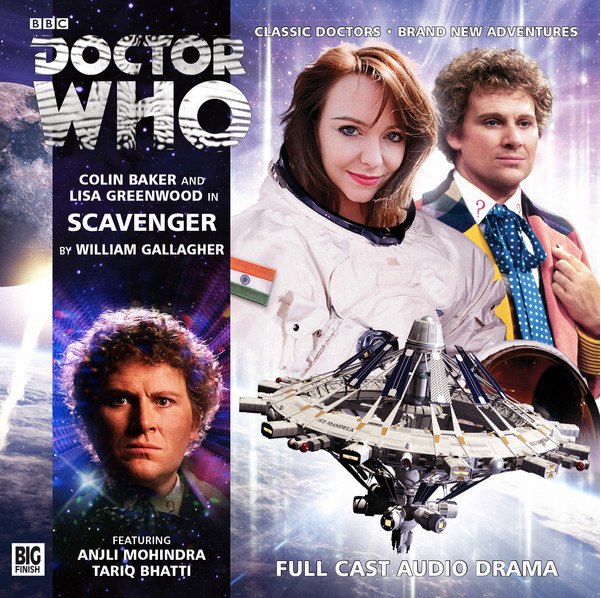
You can hear how it works for me on any of my Doctor Who dramas including the next one, Doctor Who: Scavenger. That's a Colin Baker and Lisa Greenwood tale which is out in March. But you know already that it will have a structure and a shape because it just does.

Ideas are the easy bit of writing

I was on BBC Radio WM this week, answering listeners' questions about writing. The Adrian Goldberg Show was featuring my book about productivity for creative writers, The Blank Screen. Lots of the callers were writing novels, many had finished non-fiction books, I got to speak about how you go on to get published. But there was one fella who was particularly interested in scriptwriting, as I am, and just as he was hanging up at the end, he said something I only barely managed to get any response to.

He said this: “of course I wouldn't give [TV companies] all my ideas and the scriptwriter would have to write them up then.”

And what I managed to say before he was gone and the next caller was on, was this: “Ideas are ten a penny, it's what you do with them that counts and so you have to write it all.”

I worry that he will have taken away from this that I meant you have to write all your ideas.

I did.

Whether it's a script or a novel, don't ever think you'll hold this or that idea back to the next episode or the next book. Do it now. Maybe it won't fit, maybe it'll turn out to be a rubbish idea and you'll chuck it away, but use everything you've got because scriptwriting takes everything you've got. And anyway, if it's then tougher to find ideas for the next piece, you'll just have to work harder on the search and you'll get better material for doing so.

But actually, that wasn't what was on my mind when I garbled that. It also took me an hour to twig that he thinks scriptwriters just write up people's great ideas, that this part is the trivial bit after you've had this great creative thought. So like a typical writer, having said something he may have misunderstood and having taken an hour to notice what he really meant, I've been thinking what I could've told him, what smart line I could've thrown back. And here I am, writing down the smart line.

It doesn't seem that smart now I come to tell you. It seems a bit fatuously obvious, really. If you want to write, why wouldn't you want to write? Because we think writing is easy right up until the point when we try to do it and then we start thinking how nice it would be if someone else would do the writing bit.

Look, I'm a writer, of course I'm going to say that writing is hard. But look at the panic in my face when I say it: I'm not trying to sound great, I'm asking you why I do this stupid thing and why did I ever think I could? Like any other writer in the world, I'm also asking you whether I can – as in, am I really allowed to do this, don't I have to get a proper job? – and I'm asking you whether I can – as in, am I capable of writing? I don't know, I never know, I don't think I can know. (I also said this on BBC WM: “Look at me, I'm rubbish but I keep going.” Nobody seemed to disagree. Bastards.)

If you start writing because you think it's easy, fine. You'll find out. If you go into writing because it will make you millions, fine. Also, good luck with that.

I'm all for the end result. I think you have to get published, you have to be produced, I think that is as much a part of writing as anything else. But the reason I'm a writer is for the writing. The shovel work of doing this.

There are harder jobs.

But there are also easier ones.

I just don't think there are better ones.

The year in biscuits and blogs

Seriously, this is just you and me. So I can tell you that this is the first Self Distract blog that you’ll see here. (Wait. What about the eleventy-billion previous Self Distract entries you can see? They were all first written and published on my old Blogger site.) From this week on, Self Distract is here on williamgallagher.com/selfdistract.

You will not see a single difference. Well, not unless you look up at the website address. Or if you look across at all the other lovely things on this new williamgallagher.com site. There’s a lot to see and that’s really why I’m doing this. After eight years on Blogger.com, I’m moving Self Distract to join in with all the other stuff I do online and make one single, big, new, williamgallagher.com.

I’ll talk to you about this. Probably at length. But since it is you, let me just say that the impetus was that my productivity for creative writers book, The Blank Screen, has been such a success for me that it has spawned a workshop that is touring various literary festivals, universities and possibly even prisons. That’s definitely a topic for another time. The Blank Screen has had such a response that it feels it’s tapped in to something good, something that I can usefully do. So as of today, there is now a Blank Screen blog that has news on productivity software deals, lots of stolen advice from clever people, and a lot of my own experience polished up and made to sound smart.

And also since it’s you, I’m going to tell you that I’ve been secretly running that Blank Screen blog for about a month. You can now see everything: some eighty-odd posts if you really had the time and a lot of tea. The Blank Screen is a news blog with a lot of entries; Self Distract is where we can chat.

It feels very strange moving Self Distract. It’s like we have to find a new coffee shop. In some ways it’s also very strange officially launching the new williamgallagher.com. Exciting but strange. And a bit scary, if I’m honest. And when am I not honest with you? You’ve got that I-can-tell-you-anything face.

At one point during the testing of the new williamgallagher.com site, I had to put it live. Had to. Couldn’t complete the testing without it. I put it live in a secret place, didn’t tell you, didn’t tell anyone, and within a few days I’d somehow gained followers to it. That was immensely, just immensely invigorating and validating. So much so that I have this terrible feeling that the new site is a huge success so long as it stays secret.

It’s a shame I’m such a blabber. Now I’ve taken a deep breath and told you, I’m heading out into the big, wide world to tell everyone.

But while I would love for you get something from the new site, I need our little spot for chatting. And while I suppose I should shut up and let you explore the new place if you will, what I want to chat to you about is the whole of last year. When I’m asked how many people read this blog, it’s easy. One. But when I lift up the lid and see what Google tells me, well, okay, you’ve been telling a lot of people about us. Again.

You’ve told enough people that I can see an actual top ten list of the most popular things we spoke about in 2013.

And it goes thisaway:

10. INT. DESCRIPTIONS – OVERUSED (30 May 2013)
This one got picked up by the Writers’ Guild. It’s a piece about how scriptwriters sometimes think they’re really writing novels so instead of saying “Brad Chap (30, witty, criminal)” they write a hundred words about his tortured backstory that we will never see and producers will never finish reading. It was also particularly personal to me because it includes a lesson I was taught by the late Alan Plater.

9. How to start writing on bad days (27 June 2013)
This became a really key section in my book The Blank Screen: Productivity for Creative Writers. Even in this slightly shorter, earlier version, it was all about those times when either you are overwhelmed with how much you have to do or, frankly, you’re having such a crappy day that writing anything is an impossible mountain. If you ask me, on days like that, you’re never going to read a piece about coping with days like that so it begins with a very quick, even brutal, do this and do that section. And then suggests that you read on when you’re having a better day.

8. The most successful thing I’ve ever written (8 March 2013)
It isn’t The Blank Screen, though that is heading up the charts gorgeously quickly. It isn’t my Beiderbecke book, it isn’t Doctor Who. It isn’t actually fiction. Nor is it non-fiction. It’s not even journalism. Instead, it is a Microsoft Word macro that I wrote for myself to solve a problem and it went viral across BBC Worldwide and out in to other companies. No one needs it any more so I really wrote this entry to remind myself what it was and what I did but I’m surprised how many people enjoyed it – and how many had written similar macros themselves.

7. Star Trek: Don’t Give Away the Goods Too Soon (6 June 2013)
I did some work in prisons in 2013 and during the various steps of the process to get the work and get clearance to do it, I got to meet Patrice Lawrence of Clinks.org. She’s very nice but freaked me out a bit when the first thing she said was “Hello, you’re right about Star Trek Into Darkness”. You mean people can see us?

I adored the 2009 movie: it was such an exciting ride that when Into Darkness came out, I actually took the afternoon off to go see it in a Giant Screen in 3D. Big mistake. But a fascinating one because aside from the film’s biggest problem – it is a remake of an old movie and rather relies on you knowing the original for it to have any emotional punch – there were some interesting writing decisions. You completely understand why they made them, yet you also see how chopping off this multi-million-dollar scene or the other would have improved the movie.

6. Self Distract book – get off your backside and write (3 October 2013)
I regret the title now because I use Self Distract here with you and I also later made it the title of another book: “Self Distract – from Doctor Who fan to Radio Times and Big Finish“. I need a new title.

But this one was possibly the biggest news of 2013 for me: it was about how my The Blank Screen book was officially on sale. It really went on sale at the Birmingham Literature Festival a few days later but I’d got my author copies then. This post was also about how I’d been particularly productive writing a book about productive writers: how an idle idea on a bus trip had become a whole book fewer than a hundred days later.

You wrecked my productivity that day: I posted this entry to you and intended to head off on a job but instead spent the entire Friday talking on twitter and Facebook about the blog and the book. I had a blast.

5. Dear diary… (11 October 2013)
I really see this as a couple of entries in one. The main point of it was that the night before I’d run my first Blank Screen workshop so naturally I was buzzing but also one of the attendees told me a great idea that I am stealing and having for my very own. You’ll need to read the post to see what it is but I promise it’s a good idea.

But I was also in a bit of a general buzzing tizzy because I’d also just begun leading a Writing Squad in Burton on Trent. I still do that and it’s now got about a dozen school-age kids and write together once a month. Love it. I especially love it because when I was in school, I was positively discouraged from writing as a career. To see talent being encouraged and to get to contribute, it’s a privilege and a joy and a so-there-see to my old school. Writing West Midlands organises many such squads: read more about them all here.

And if that But wasn’t enough, I had another one. But I was also in a bit of a tizzy because around this time I’d written I’m calling from the Trib… which was one of those blog entries where something just burst out of me and I had to tell you even though I reckoned you had better things to do. It was about how I had become a writer because of a TV show called Lou Grant and I actually named the people who had created that, who had therefore made me the man I am. Before the month was out, two of those people had got in touch with me. April Smith and Seth Freeman, two names so much a part of my growing up that I can close my eyes and see their names written in the font they were on the show’s credits. Do have a peek at that one: it meant a lot to me, it apparently meant quite a bit to them, and that fact meant a lot to me too. (And check out April’s own website: she’s now a prolific novelist and has a new book out now.)

4. Pencils vs keyboards – 2B or not 2B (4 April 2013)
This was half a muse about handwriting and notebooks but really half a piece about a little thing I did, a little piece of handwriting I did. Take a look at that post for the secret thing that I did and which I only told you about. And then let me tell you that the fella has yet to notice. (If you don’t happen to nip off to read what that is all about, let me reassure you now that what I did was a nice thing. And that it was designed so that if he finds it at all, it won’t be for some time.)

3. Dollars to doughnuts: the end of BBC Television Centre (22 March 2013)
I’m still too upset to talk about that closure. But I had to tell you, I had to open up to you, and I did there. Can’t read it now. Too upsetting.

2. I wish I’d written Veronica Mars (15 March 2013)
I do. I always have done, right from when I first got hooked on that show and right from when it seemed I spent each year’s holiday with my fingers crossed that this TV show would get renewed for another season. And certainly right from when I was crushed because it didn’t. Three seasons and out, that was what we had. But I wrote about this then because, miraculously, the show is coming back. Veronica Mars is now famously a movie that was funded by Kickstarter and one reason to boom at you about it then was that I wanted you to contribute to the movie just as I did. That reminds me: I swear I didn’t ask for any Kickstarter reward. Initially I specified that I didn’t want anything at all, I only wanted my money to go toward getting the film made. Then I thought about it and realised that the movie might not get a big release here in the UK, so I upped my original contribution and asked for a digital download.

But I still didn’t ask for anything else. So it was a surprise when a teeny-tiny Veronica Mars teeshirt arrived in the post. You will never see me wear it. My teeshirt days are gone. But if I had a meeting with you in the last two months and it was an especially cold day, you may have been in the same room as the garment and a couple of others on top of it.

Incidentally, I wrote that about Veronica Mars in March 2013 and it turns out that the film will be released in March 2014.

1. Lie to me (15 November 2013)
Head and shoulders over anything else I wrote in Self Distract in 2013, this was about lying. Specifically: if you are running a drama and you tell me spoilers about it, I want you to be lying to me. Lie to me a lot, lie to me good. The alternative is that I know everything in advance – like you do with soaps – and there are no gasps. It was a general point about how much is revealed in advance and how much that hurts dramas, but it was prompted by a particular Doctor Who issue: a story point that was quite small but if you didn’t know it in advance, was rather delightfully huge and happy.

Also, by the way, I’m lying.

That blog entry wasn’t the most popular of the year.

Not by a long way.

The actual, real, honest-to-goodness top one was actually Have you been telling people about us? from 3 January 2013. It was the one where I told you about the most popular blog posts of 2012. I can’t decide if that’s a good or a bad thing, but I know it’s remarkable to see the figures.

I hope all of those lovely people join you and me in Self Distract’s new 2014 home of williamgallagher.com.

Thanks for reading. Also, happy new year.

The end of shiny discs

You might not be able to tell. I still have shelves upon shelves of DVDs and for Christmas we got the sixth season of The Big Bang Theory, we got the complete A Very Peculiar Practice and we have the Crackerjack Silents. All on shiny disc.

(Just as an aside, The Big Bang Theory disc comes with Ultraviolet, which should let you get a download version of the series too. But instead Ultraviolet is the quite hilarious work of companies who don’t like working with Apple’s iTunes Store yet seemingly can’t quite work with each other, either. And definitely don’t like working for you or I. It’s only hilarious in retrospect. Last year I spent an evening trying to get the fifth season Big Bang Theory’s Ultraviolet to do anything. Eventually I emailed all the companies and asked them to please use a grown-up system in future. Clearly, I have influence.)

But last night, Angela fancied watching Groundhog Day – and I couldn’t find it.

I’ve actually got it on DVD twice as some anniversary edition came out some time with some extras on it or something, and I couldn’t find either of them. The film is on my Mac and it looks slappingly better on that 27in iMac screen than it ever did on our ancient TV, but that’s in my office. I’m sure I’ve watched Groundhog Day on my iPad; I think I’ve even watched on our TV set via my iPad. I used to stream a lot from my Mac to my iPad and then over a cable to the really ancient TV set.

It’s a CRT television. It may have been the last CRT television set ever sold in the world. I knew that salesman looked extra happy when we were leaving.

But I can’t stream to it any more as the cable won’t fit newer iPads.

So all the bits are in place to mean I never need to play a DVD again and yet they aren’t all in the right place, aren’t all in the right row, all the time. My once quite substantial DVD collection has been pruned away over the years but still there are times when I need the disc and so that’s what I grab off the shelf.

Until last night.

We watched another movie we found during the hunt but it felt like the end of DVD for me. Which is a bigger deal than average because DVD became a very validating part of my career. Somewhere around 1999 I persuaded BBC Ceefax to take a column about weekly DVD releases and that became the most popular page in the entertainment section. I think I then did it for BBC News Online too or perhaps they just took those Ceefax pages. But for some years, that’s where you’d see my byline every week: Ceefax and BBC News.

I enjoyed it so much that when I stopped working for them, I took the column away with me and made it into a podcast. I still remember the drive home from London to Birmingham in which I thought of it. I’d read an article about this newfangled podcasting lark by Andy Inhatkho and, sitting at Oxford Service Station, I thought I’ll do that.

For five years and I don’t know how many episodes, I wrote and presented and produced UK DVD Review on iTunes from 2005. Doubtlessly because I was one of the earliest podcasters, it charted. UK DVD Review was in the top ten of all podcasts, in all categories and genres, across the entire world.

It wasn’t entirely a statistical chance of my being early. There really were listeners around the world. I actually was big in Japan. The second greatest time in each year was my Christmas special when I’d pick my top ten DVDs and then the next week would get everyone else’s. At least ten listeners on the phone, on the show, it was an utter blast and the sole reason I stopped was because that blast took a hell of a lot of time to produce.

I’ve often thought about returning to it and I get a gorgeous shiver whenever someone asks me – the idea that they would even remember it after all these years, it’s fantastic – but I’ve also been aware that it does take so much time. I couldn’t guarantee to have that time every week and coming back only to fade away again didn’t appeal.

Now, though, I think the choice has been taken from me because DVDs are going away. I know they’ve been declining for years, I know there is a very good argument that download movies lack extras like commentaries – and I love, utterly adoringly love a good commentary – and I know that Blu-ray is doing okay. But I’ve not bought a Blu-ray player. I’d have to get a newer TV set in order to physically connect one in.

And if I did that, I think I’d be far more likely to buy an Apple TV so that I could stream direct from my Mac again. So I could buy TV shows from iTunes directly on it. I don’t think Apple TV is a fraction as useful here in the UK as it is in the States where you can get various and many channels on it, but it’s far higher up my wish list than a Blu-ray player is.

I’ll miss DVDs. But last night was the first time I actually missed having a specific DVD.

The Christmas Eve Lagrange Point

There is this thing called a lagrange point. Usually when it’s mentioned it is specifically the one of these that lies between the Earth and its Moon. You know that the Earth is big and its Moon is comparatively quite small so one of them is hefting a bit of a gravity tug where the other, not so much.

But they do both tug and there is this one point between the two bodies where the big pull of the Earth is exactly and precisely matched by the little pull of the Moon.

If you’re in that point, it’s as if there is no pull at all, not in either direction. And I imagine this to be a peaceful place. Floating. All the pressures and all the gravity and all the worries and problems are still there, every last one of them, but you are somehow at peace.

Welcome to my ideal Christmas Eve.

I don’t know why I like Christmas Eve better than Christmas, I don’t know how I can call it a peaceful time and somehow associate that with not working when I am of course working. But I do like it best and I do call it a peaceful time.

I do call it a lagrange point.

And I hope you get these too.