Have a production meeting for one

In The Blank Screen book, I argue that there are two types of meeting. I think I was wrong: I think there is or at least there could be a third type and that it is useful. To be clear, the two types were:

  • Pitch meetings where it’s all about you and your work
  • Day job meetings where it’s all about the day job

The first type is the one you want as a writer or any creative person. They are important you work to get as many of those as you can and to make each of them count. The second type is ditchwater-dull sort you are forced to have in your day job and I spend a lot of time in the book covering how you can get out of them and, since you usually can’t, what exactly you can do to make them faster and make them work and keep yourself awake.

You have to meet. But you don’t always have to meet and when you have ten people in a room doing bugger-all and getting nowhere slow, that is a gigantic waste of ten people’s time. I reckon the poster-boy worst example of this kind of thing is what I would often see at the BBC: everybody would gather for a meeting whose sole and entire purpose was for whoever ran it to tell his or her bosses that they had run this meeting.

All of this stands, all of this is true, but I forgot another type of BBC gathering: the production meeting. Sometimes called an editorial meeting. Believe it or not, I still think of them as the budget meeting – there is not one single element of them that is to do with money but that’s what these were called in Lou Grant, the show that made me a writer. (Budget Meeting was the US newspaper term for an editorial meeting and I imagine it comes from how you have a certain amount of space in a newspaper and you are budgeting this much room for that story, that much for this. Certainly these Lou Grant meetings regularly included background detail such as questions about giving this much space on the front page and continuing a story inside.)

These meetings are not about your writing work but they can be. And they are so useful that I’m embarrassed I didn’t mention them. Especially as I think you can use them yourself, you can conjure up a kind of production meeting for yourself.

Production meetings have certain things that are always the same. They are regular, for one thing. Newsrooms and news programmes tend to have them at least daily, almost invariably first thing. They are always focused on the same thing: BBC’s The One Show doubtlessly has a production meeting focused on that day’s edition. Anything that doesn’t belong or can’t go in today’s edition, doesn’t get discussed. Or probably not, anyway.

Then you have specific resources: this many people who can do this much in that time. Anything they can’t do, you don’t do – or you look for outside help, you schedule it all in some way that it becomes manageable over time.

Next, every person in the meeting brings ideas. That sounds so wishy-washy but production meeting ideas are not one-line blue-sky wouldn’t-it-be-nice-to-feature-daffodils-somehow things. They are one-line ideas that have every detail behind them that it would take to get that idea on the screen or on the page. You throw in your idea, if it isn’t liked or you can’t adapt it to one that is, it’s out. If it is or you can, you contribute exactly how it can be done. Or more likely, you just go off and do it.

Take a look at the BBC’s own requirements for ideas that get pitched at news production meetings. When ideas die, it’s a lot of wasted work. But when they fly, you’re ready to go. And the process works not just because the better ideas rise to the top in these meetings but because working at them this way gets you thinking of better ideas to pitch.

Last, production meetings almost always include some kind of diary discussion. Very broadly, there are two types of ideas discussed at a production meeting: diary items and non-diary items. There is always someone whose job it is to maintain the diary: not of where you and your colleagues are but of what is happening. I’ve worked in entertainment news so a diary I’d know would have things like press previews for this film today, that celebrity is in town Friday, this book is coming out next Thursday.

The BBC maintains the most exhaustive diary of everything that any news programme could want to know but your team knows what to take from that and your team also runs their own. Then non-diary items are everything else. If Coronation Street got cancelled, that would be news and it would never be a diary item: there’s no circumstance in which ITV would let journalists know that it will be cancelling Corrie in three weeks’ time. They could try, but you suspect the story would be written about instantaneously, don’t you?

It happens that this week I have a meeting about one event, I actually have an event, and there are some discussions about at least one other confirmed and one other possible gig for later in the year. My mind’s been going through what I need to bring to the meeting, what I need other people to agree to. And I’ve realised that my mind has been going through exactly what it used to with production meetings.

I miss them. I’ll be honest with you, I miss the rigour of having to come up with ideas, pitch them to a group and then either get them or be assigned some other idea to do my best with.

And it occurs to me that I could, perhaps I should, and probably I shall run some little production meetings of my own. Just for me. God, that sounds lonely and pathetic. But I think it might be useful.

I have diary and non-diary items to get done, for instance. This week should be devoted to the events but actually it can’t be, I have to do other things too so I have issues of resources and time.

I also have the shape of the week. When you work in radio or television you are conscious of time in a slightly different way: you think about the top of the hour, you think about your third-hour guest. You know you have to have a news bulletin at this point, you know you should start the show with a bang and that it would be good to finish with one too. I have the week where I know when my events are so I know what has to come before those, I know what I will have to postpone until afterwards.

And I know all this because my noggin’ just worked it all out while I was talking to you. So thank you for that – and I hope you find production meetings useful for your work too.

In space, no one can hear you snore

astronaut-outer-space-moon-nasa-astronauts-free-208100Astronauts have a bad time sleeping, apparently. Such a bad time that it affects their work. And as I am still doing this ridiculous getting up to work at 5am and collapsing asleep at any time from about 5:05am to midnight, I’m seeing some of these problems myself. If you have similar problems, this may help. If you haven’t, if you sleep like a lamb with an electric blanket, read it as a somewhat dull episode of Star Trek:

…cosmonaut Valentin Lebedev reported in his diary that he had a tendency to make mistakes on days following an unusually late bedtime; on one occasion he took fifty Earth-observation photographs through a closed porthole before realizing his error.

Four Things Astronauts Can Teach You About a Good Night’s Sleep – Barking Up the Wrong Tree

Writer Eric Barker is quoting there from a book called Bold Endeavors: Lessons from Polar and Space Exploration and says first that NASA took some notice – and, second, that the issues that cause these problems are now ones affecting us all. Astronauts no longer have sunrise and sunset, they don’t have day and night or at least they get a lot of them, an awful lot of them, as they whip around the planet. Quoting The Paleo Manifesto: Ancient Wisdom for Lifelong Health:

Today our bodies have become thoroughly confused by the artificial signals of modern life. Light is no longer a cyclical function of the sun, but of always-on indoor lights, TV screens, and computer monitors. Temperature no longer follows a dynamic cycle of cooling at night and warming during the day but sits at a static level set by the thermostat. Human chatter and social interaction used to follow a natural ebb and flow, but now we are more likely to live and sleep in isolation from real people, even while we have 24/7 access to artificial people (faces on TV, voices on the radio). Then, after utterly confusing our circadian rhythm, we try to take back control with stimulants (caffeine, nicotine) and depressants (alcohol, sleeping pills). Is it any wonder that a third of Americans are chronically sleep-deprived?

Barker himself suggests some solutions:

Maintain a consistent schedule, even on weekends. Keep in mind the “free-running” problem. Your body will push later if given the chance.
Take an hour to wind down before bed. Yes, you’re busy. But your time is not more precious than an astronaut’s. So take the time to wind down.

He has more in the full and deliciously link-replete article that will have you off reading in deep corners of the internet.

The Hell of Bank Holidays

They are worse than Sundays and so much more unfair. I don't work in a bank, why must have bank holidays?

And today is Sunday. Just a Sunday. But it's the Sunday before a bank holiday Monday so it feels like another bank holiday.

But I have learnt one thing, one productivity thing. You know all this gardening stuff?

Writing is easier.

Should you write your To Do tasks as question?

No.

So there.

Write your To Dos as if someone else is going to do them. Take the time to put that extra explanatory detail in there – so instead of writing “Phone meeting Anne” on your list, write “Phone Anne to ask her for purchase order number”. The second takes longer to write but you come to the phone tomorrow and you are dialling immediately. The former is shorter but tomorrow you’re going to look at “Phone meeting Anne” and think, what’s that about? Is she phoning me or am I supposed to phone her? And you may well have to stop to think: hang on, which Anne?

I believe this, I do this, it works. Not everyone agrees.

1# Change a relatively boring list to something that can excite you
Since lists in their current state are declarative in nature, I first tackled changing the way I write them.

I found out that we’re more likely to read something if it has a question mark attached to it which led me to change the way I write tasks.

Let’s start with one of the most boring tasks that I know off, doing your laundry.

Instead of writing it like the mundane task it is i.e. as a declaration “- Do the laundry at 8 PM”, write it as a question or even a challenge! This will rub some extra flavor into it “Can you finish the laundry before 8:30 PM?” and will make sure you’ll tackle it.

Asking question stimulates our curiosity; curiosity is an engine that motivates us to explore and discover.

Are We Managing Our To-Do Lists All Wrong? – IQ Tell

Haim Pekel wrote that on the IQ Tell productivity blog which I didn’t see and hadn’t heard of until Lifehacker spotted it yesterday. Lifehacker’s more pro this idea than I am, so do read the full piece on IQ Tell to see what you think.

Eat the frog

Screen Shot 2014-05-03 at 07.45.31

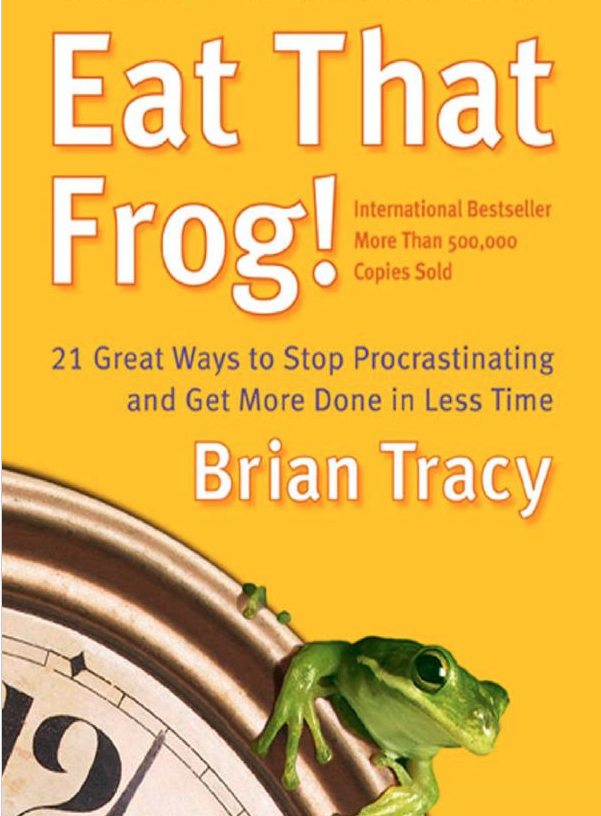
This came up in The Blank Screen workshop I just did at the Stratford Literary Festival: “Eat that frog”.

It’s a phrase and a book title and it means whatever the worst, most horrible task you’ve got to do is, do it now. Do it first. If you eat that frog now, it is done and it is over. If you don’t, it’s going to be on your mind all day and just getting harder and worse and harder and worse all the time.

Author Brian Tracy came up with this and I think he’s right and smart. The full title of his book, though, is Eat That Frog! 21 Great Ways to Stop Procrastinating and Get More Done in Less Time – and I think it’s telling that nobody can remember the other 20. Just the frog-eating one, that’s what we hold in our heads.

Take a look at the book on Amazon where you can read the opening pages and get a feel for whether you’ll like the book or whether just knowing the frog phrase is enough. Click here for Amazon UK and here for Amazon US.


Use location reminders for work you don’t like

It’s not that I don’t like invoicing. It’s that I don’t do it. I’m far more interested in doing the work. Today, for example, I am infinitely more interested in the fact that I’m working with a group of young writers as we create a play. Infinitely.

But it is an unfortunate fact that if one does’t get paid, one stops being able to eat and that stops one being able to do this work. I really want to survive to the play’s performance, so I have to get paid. And being freelance, that means I have to invoice.

I am full of good intentions to do with everything financial. Fortunately, I don’t have to be. I’ve set a location reminder.

I’m working in a library today. When I leave that library, my iPhone will bleep with a reminder that I need to invoice for this work.

That’s all. I may not do it right there and then, but I have a train ride after it so I probably will. I think I may come across as very mercenary, invoicing within ten minutes of finishing a job, but if I don’t do that, I don’t invoice at all, so.

If you have an iPhone, you have location reminders. They are in – and they were introduced to the world in – Apple’s free Reminders app. Every good To Do app since then has taken that idea and so I use the one in my beloved OmniFocus.

Go Fucking Do It

What it is this, Nike on a bad day? Go Fucking Do It is a new productivity – well, I don’t know what to call it. There’s definitely a website but it’s more an ethos. More a gorgeous slice of wickedness. Sign up to this and state what you’re going to do: you’ll write that book, you’ll run this marathon – and then you put a price on it. A forfeit.

Here’s a real example:

I will surprise my girlfriend every day or pay $100

That’s live on the site right now, as are these:

I will run a marathon or pay $50

I will organise my life or pay $50

The key thing, is where the money goes if you fail to do what you vow and instead have to pay up. There is a debate going on about this but I am fully in favour of the cash going to the people who run the website. Some argue that it should go to a charity but that’s nice and this is about making you do your task. If you fail knowing Macmillan Cancer Research is going to get your money, you’re far more likely to fail than you are if it goes to some stranger running a website somewhere.

Despite the ongoing debate,  currently 153 people have gone ahead and registered. They have pledge-vowed a total of $14,718

And it is a great idea with one massive flaw.

The people who are signing up for it don’t appear to be as smart as the website owners.

Take those three examples above.

I will organise my life

When? How exactly will your life be organised? If it’s by buying The Blank Screen book (UK edition, US edition) today, you go right ahead.

I will run a marathon

When?

I will surprise my girlfriend every day

Really? Every day? How long before the surprise is that there is no surprise? Who adjudicates over whether she is actually surprised or not? If you get married, do you have to find a new girlfriend to surprise?

The principle of having to pay money if you fail is like my own Brutal £1 Pot Trick where I made myself get up at 5am by rewarding myself with a pound coin – and throwing away all the pound coins so far if I failed. I never failed.

Take a look at the Go Fucking Do It website to see what you think and if you want to despair about humanity, go check out that debate about where the money should go.

Also, half a hat tip to Lifehacker as that found this for me, though it loses a bit of a tip for spelling it “Go F***ing Do It”.


sfds

That was April 2014

Previously… I used to have someone I would account to for what I’d done in the month and it helped me enormously. Now I’ve got you. As I always said to them, you don’t need to read this but I need to write it. Knowing that I am going to tell you these things means that I do more things. So thanks.

Writing/editing: 56,00 words
Magazine tutorial feature: circa 800 words
Approximately 12,000 words novel
Thirty-minute stage play “Murder at Burton Library”
The Blank Screen: 79 news posts totalling approximately 33,000 words
Self Distract: 4 posts totalling approximately 5,000 words

Presentations/workshops:
2

Pitches:
Successful: 3 (1 accidental, 1 face to face, 1 ongoing)

Press and Publicity:
Stonking review in Doctor Who Monthly: “Seductively gripping”
From Croydon to Gallifrey podcast interview aired
Newspaper coffee shop meeting

Calls:
17 (target was 30)

Attended:
Royal Television Society committee meeting
On The High Road by Chekhov, Rada Theatre
Open Door: Bold Text at the Birmingham Rep
Had my first publisher’s stand at the Birmingham Independent Book Fair
Meet the Agents Writers’ Guild event
Writing West Midlands meeting re Young Writers

Just tell me. (And I’ll just tell you.)

When I’ve got to brief someone or I need to effectively recruit them to work on a project, I will do the news approach of telling them what I need them to know. But most of the time, I am off doing something for them and they are off doing something for me. And in that case, just tell me.

Always tell me, always make sure I know what I need to know. Er, this is making me think I should’ve used “one” instead of “me”. Whoever you’re dealing with, never leave them hanging. Some people need to be told every inch of something, others are happy to let you get on with it – but every single person worries.

Just like you do.

When you’ve delivered a piece of writing to someone, you cannot fail but go in to the Writer’s Trap:

I hit Send forty seconds ago, why haven’t they replied?

Everybody is the same. I got a call last Friday from a fella who’s doing a thing for me and the entire purpose of his call was tell me that he hadn’t done it. I thanked him – and I meant it. He’s not late, he’s doing what he said he would, he just hit a delay and wanted me to know.

I thanked him and I meant it. Eventually he’s going to have to do the thing or I won’t be thanking him so much, but I am completely relaxed about it just because he called to tell me.