How to block ads that bounce you to the App Store

It's the latest thing in advertising and instantly takes the crown for the most irritating. That's a crowded field, what with YouTube ads that play one fifth of a second of the video you want before running a commercial. Or all the popups over YouTube. It's mostly YouTube that's irritating, isn't it? But now we have ads where you read some website on your iPhone or iPad and before you take in a word, you are bounced out of Safari and into the App Store to buy some particular app.

Invariably that seems to be a game one. Usually you can see an ad for that same game on the site but sometimes there doesn't appear to be any connection between the site advertisers and the App Store game.

There is.

What there isn't – necessarily – is collusion with the website. Like you, I presumed that this was the latest type of ad that was being sold by websites to advertisers. But one major site told me that it was done without their knowledge or permission and definitely without any extra money being paid to them. He described it as the advertisers playing silly buggers and it was stopped.

There's your technical workaround, your blocker for these ads. Not a technical thing, not a JavaScript command, not a different browser with blocking extensions and definitely not jailbreaking your phone. Just email the website and tell them this is happening.

It's a bit of an old-fashioned approach, but it can work.

Twelve million people can’t be happy

But hopefully a lot of them are. Microsoft's Office apps for iPad have been downloaded more than 12 million times in the week since launching. That doesn't really mean 12 million people: I downloaded Word and Excel so that's two right there.

Actually, I downloaded Word and Excel, then deleted them – and tonight I just downloaded Word again. None of these are any use unless you pay an annual subscription which is doubtlessly worth it for many but isn't for me. However, you can use the apps to read Microsoft documents. I didn't have any at all the night I downloaded the apps the first time.

But tonight I got one. I'm reading a draft of a book and it happens to have been written in Word. Normally I'd just read it in Mail – that will show you the text perfectly well – or maybe I'd pop it into Pages – which opens Word documents just fine. This time I got Word back, opened it up and it's really good.

The book and Microsoft Word for iPad.

The text is beautifully crisp and well designed, it is a true pleasure reading this document in Word for iPad.

Still not going to subscribe, but now I think I will keep it around. I wonder if we'll ever know how many of the 12 million downloads will stay and how many of those will turn to subscription ones. But you've got to hand it to Microsoft: this is a nice piece of work.

You cannot be Siri-ous

It takes a mensch to say that a rival has done something good. There are few mensches in the world. If you want a productivity slant on this, be a mensch: say when your rival has done something better than you. It’s quicker and you will bamboozle people. It is always more fun bamboozling other people than it is for them to think you’re an idiot.

Because we get it. We know that Apple will never say anything in praise of Samsung. Microsoft will never say anything in praise of Apple. The UK’s Conservatives won’t praise the Labour party; America’s Republicans will never praise Democrats. Which means that on the one hand, we all get it, we all understand this and on the other, there are some amazingly clever people in every one of those organisations who must get it too. Yet still we get smart people in smart companies saying things so stupid that it is like a floodlight on their dangerously petulant world-view.

This comes up today because Microsoft is releasing Cortana. I’m not a gamer so I kept reading that as Cortina, a type of car, but it’s a character name from a game and that’s a good move, I think. But if you want to know what this Cortana actually does, just call it Siri. Cortana is a knock-off of Apple’s voice-control system Siri.

Fine.

Windows Phones should have something like this. Android phones do. And it certainly happens the other way around, it certainly happens that all firms copy all firms: if something works, it goes everywhere.

But.

When Siri was announced in 2011, Microsoft was not a mensch.

Microsoft’s Craig Mundie told Forbes magazine:

“It’s good marketing, but at least as the technological capability, you could argue that Microsoft has had a similar capability in Windows Phones for more than a year, since Windows Phone 7 was introduced.”

Quoted and mocked in Electronista.com, 23 November 2011

Agony. That ‘similar capability’ was an $800m purchase called TellMe which let Windows Phone users – just about – dictate a text message. Mundie looked like a schoolboy arguing his dad is better than your dad and unfortunately Mundie was Microsoft’s chief research officer. (He’s now Senior Advisor to Satya Nadella, Microsoft CEO.)

So here’s your chief research officer either genuinely completely failing to understand a new piece of technology or believing that we won’t understand it and he can get away with saying this. Take your pick: neither is good.

Jean-Louis Gassée – ex-Apple, ex-Be and now oftentimes technology pundit on Twitter, summed it up:

Microsoft Research Chief: We had (something like) Siri before Apple. If true: We’re imbeciles If false: We’re imbeciles.
@gassee on twitter, 9:43pm 23 November 2011

Today, Microsoft is no longer pretending Windows Phone got there first, it’s no longer pretending that its TellMe feature works, it is launching Cortana. And Cortana is naturally better than Siri or Google Now. Microsoft’s dad is now bigger than your dad, so there.

Three years on from the launch of Siri, Microsoft’s new Cortana really ought to be good or there’s no point launching it. First reports are that it has fine new features, that it works. But the launch could’ve gone better. BBC News:

…But other parts of the presentation went less smoothly. The app repeatedly failed to convert the weather forecast from Celsius to Kelvin, and also misunderstood a request to make a phone call.

BBC News Online 2 April 2014

If a rival beats you to something, they have beaten you to it. You can’t change that. It would be nice and I argue that it would be disarmingly smart to acknowledge and even praise it. But you don’t have to.

You just have to choose to not look like an arse over it.

That was March 2014

So last year I earned a place on the Writing West Midlands programme Room 204 and by accident began writing monthly reports for them about what I’d done. It helped me enormously. Now I’m very glad to say that though I’ve finished the official year on Room 204, I am still a part of that programme and continuing to work with them. I’m not just glad, I’m touched.

But the official bits have come to an end and I considered the monthly report to be official. It wasn’t. It was entirely a misunderstanding on my part. But because it proved so useful to me, I’ve been showing it to you. The act of showing it helps me get more done. So as ever – most recently with That was February 2014 – you don’t need to read this but I need to write it.

This was my March:

Writing/editing: approximately 22,585 words
Edited Write On! magazine issue 3
Self Distract: 6 blog posts (including the 300th ever) totalling 7,385 words
Invited on to The Blogging Tour
The Blank Screen: 33 blog posts totalling 14,300 words
Commissioned for a short story project
8 pages copywriting for PR firm

Doctor Who: Scavenger (Big Finish) released to some gorgeous reviews

Pitches:
30 phone calls
Approximately 12 successes
4 rejections

Presentations/workshops: 10

Publicity:
Photoshoot for Writing West Midlands
Interviewed for From Croydon to Gallifrey podcast
Interviewed in Doctor Who Monthly

Attended: Cucumber Theatre Night
Attended: Veronica Mars
Attended: Fiddler on the Roof
Attended: Theatre Cuppa
Attended: TEDxManchester
Attended: The Mother
Attended: Royal Television Society Film & TV Summit representing the Writers’ Guild
Attended RTS summit post-mortem
Attended Guild committee meeting

Other:
Lunch drinks meeting at Comic Con with two Bond girls (why is that a thing? I don’t get it): Catherine Schell and Jenny Hanley

Beta testing software: 2 apps
Asked to judge RTS awards

Joined Creative England crew site

ENDS

What’s so great about OmniFocus part 1: get it in

No enthusing, no evangelising, just straight showing you. I talk about the OmniFocus task software a lot because it means a lot to me and now that a new Mac version is an inch away, one of the barriers to universally recommending it is gone. (There is still the fact that it solely runs on Macs, iPhones and iPads. So Windows, Unix and Android users are out of luck. But I honestly think this means you’re out of luck. OmniFocus is that good.)

Ahead of a video covering this that will be out in time for the official launch of OmniFocus 2 for Mac, here’s the first of a short series.

Before you can do any task, you have to think of it. If you think of it and you can do it right there and then, do it right there and then. But if you can’t, then you need to keep that task. You have to be sure you won’t forget it.

Here’s how you do that in OmniFocus.

Actually, here are the many, many ways you do this in OmniFocus.

1) Type it

In OmniFocus for Mac, iPad or iPhone, just type in your task and hit Save. The iPhone version has a nice button called Save+ which saves the task you’ve just typed and gives you a new blank one to start typing the next one in.

That’s the tiniest of things yet it makes a big difference. You know you’ll whack through entering tasks because of it so you do, you whack through tasks. You don’t think of it as a chore, so you don’t put it off.

There’s a lot of speedy little aspects like this. Most come later when you’re sorting through tasks and thinking about them, but for just straight getting that task out of your head and into a system you know will keep it for you, OmniFocus is very strong.

Screen Shot 2014-04-02 at 08.26.29

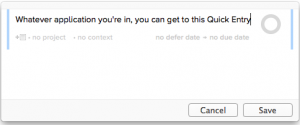
On the Mac version, you can enter a task whatever you’re doing, in whatever application you’re using. Tap a couple of keys and you are entering a task into OmniFocus. Hit return and that task flies off to OmniFocus while you carry on back with your other application.

2) Say itiphone reminder

I probably come up with most of my tasks while I’m driving. So I tell OmniFocus. I say it aloud.

OmniFocus works with Siri so I can say aloud “Remind me to phone Angela when I get home” and it will go into OmniFocus. (And when I get home, ping. Location Reminders are a stunning thing. Apple introduced them in its Reminders app, every decent To Do software has followed along.)

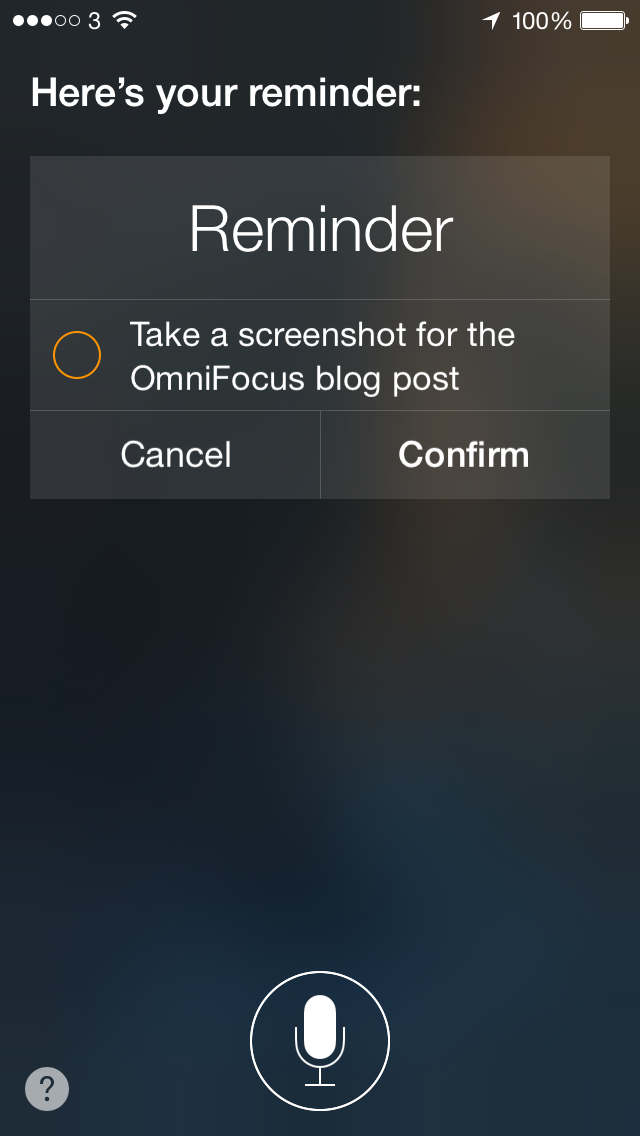
Slight problem. You do this via Siri and so after you’ve said “Remind me to take a screenshot for the OmniFocus blog post”, Siri will say aloud “Here’s your reminder. Shall I create it?” But because I’m driving, I can’t look at the screen to see what it thinks I’ve said. So invariably I say yes.

Usually it’s got it right. Sometimes it is astonishing what it has got right – or strange what it’s got wrong. But once or twice now, I have got home, looked at my OmniFocus reminders list and had not one single chance of figuring out what was so important.

3) Email it

An email comes in with something I need to do. I forward it. Straight into my OmniFocus list. The end.

I’ve just looked into this and it turns out that I have used this feature three times a day since it was introduced in December 2012. That’s 1,411 and I have to tell you that I am astonished it is so few.

Email after email, wallop. Straight in to OmniFocus.

If an email includes several things I have to do, which is common, then I could forward the same email several times. Or I could select a portion of the email, then hit forward – and it only forwards that section. This is a feature of OS X Mail and probably most email services but is especially handy here. Select one task in the middle of the email, press Forward, enter my OmniFocus email address and maybe change the subject heading to something about the task. Send. Gone.

The time it took to say that to you far exceeds how long it takes me to do it. Especially the bit about entering my OmniFocus email address. You get given a secret address, you add it to your Contacts or Address Book, and ever since then I just have to start typing the letters “Om” and Mail fills out the rest for me.


I use all three versions of OmniFocus: Mac, iPhone and iPad. And I use them because they work even better together than apart – and because having the three means I can record or capture any task that enters my butterfly mind. Wherever I am, whatever I’m doing.

Next, I have to actually do some To Dos.

Productivity lessons from Blake’s 7

blakes7logo

In fact this came from Blake himself: Gareth Thomas suggested I do this when I was interviewing him for a forthcoming book about the BBC science fiction series.

Actually, full disclosure, it was more that he couldn’t fathom why I was such an eejit that I wasn’t already doing it.

It’s just this: put your phone calls on speakerphone and tape them.

For all that I said yesterday about finding it hard to make certain types of calls, I have made a fairly constant stream of them throughout my writing and especially journalism careers. With Gareth, I really wanted to phone him over Skype so that I could record the call on my Mac. But he wanted to phone me instead.

I do loathe costing my interviewees any money, I don’t see why they should pay for the call or go out of their way for me, but Gareth couldn’t do anything else. He was on tour in a play and fitting me in on a Saturday morning; he might be able to predict what town he’d be in but there was no way to give me a phone number to ring. I would of course have accepted a mobile number, very happily, but mobile to Skype to Mac has proved tricky before. More than one interviewee has said I sound like I’m in a barrel down a mineshaft.

So I’m genuinely mithered over what to do in order to record the interview. I have to record it. Have to. I’m not going to get a huge amount of time with him and he is somewhat vital to the book, I need to make the most of the chat.

I’ve never actually met Gareth Thomas, I’ve just now done two phoner interviews with him over the years. But even in those short times, I can tell you that he is as charming and funny and interesting as you would expect. Yet I swear I could feel him thinking the word ‘eejit’ before he explained to me that I didn’t need to route the call through my Mac to record it.

Ever get the feeling you’ve been doing something wrong for twenty years? So that happened.

I recorded that man three ways from hell. I rang him on my landline, had my iPhone and my iPad recording the sound from the speaker and I even got my Mac to do it too.

And that’s the productivity lesson: use your Mac or presumably your PC to record calls. You can’t just record anything, it has to be with permission and agreement like I had there with Gareth and a book interview, but you can record anything – in that anything that makes a sound, you can record.

Since that interview, I’ve recorded many calls. Lots of interviews, naturally, but also phone meetings or conversations where I’ve really needed to find out a lot of things and there isn’t much time.

I don’t know how you do this on a PC, though I imagine it’s part of Windows Media Player, but on a Mac you just launch QuickTime Player. Doubtlessly because of its name, few people realise that this Player also records. It can record anything that happens on your screen – so it’s ideal for showing someone how to do something – or it will record your face through your Mac’s camera. Or it will simply record audio.

Choose that, hit the record button. Here’s a second productivity tip, this time discovered by me without the aid of Roj Blake, fictional freedom fighter: identify yourself for the recording. I say my name, the date, the time and who I’ve agreed to record. You don’t think you’ll do this all that often but over the last six months I’ve gathered up a stock of maybe fifteen such calls and being able to identify them in the first few seconds of playback is a godsend.

Especially since QuickTime Player confuses me continually. Once you record something, it is there as an untitled document. Close it and it will ask you for a name to save it under. Or you can just save it and then close it. I say this to you and I cannot see what is so hard. Yet I regularly end up wondering whether I’m going to save or accidentally delete the recording. And I postpone worrying about it by leaving them all there.

So I’ve currently got about seven Untitled phone recordings on my Mac.

I promise to sort through them.

One more productivity tip, this time from my years producing UK DVD Review. That was a podcast from 2005-2010 which I’m proud to say peaked in the top ten of all podcasts, of all genres, across the entire world. I think there were only 11 podcasts then. But I learnt this. If you’re recording a lot, I mean for a long time and maybe just doing a few calls one after another, clap your hands.

I clap three times before the start of a long recording. Interviewees think I am strange. But they suspected that anyway.

This is pointless if it’s just a quick call and even with the much longer one I did with Gareth, it was straightforward: I just transcribed it afterwards from start to finish. Often, though, I will have such a long recording that I need to find parts of it quickly. Usually that’s the start of the next interview. When I was doing this for broadcast, it would be to find the next take or the next section.

These are all things that I would tend to listen to in a proper audio editor instead of just through QuickTime Player. (You don’t have to launch QuickTime Player to listen back to a recording: just find it on your Mac and tap your spacebar. It’s gorgeous how fast that is when you have a lot to look through.) With a proper audio editor, you get wave forms.

And with waveforms, the clap is really distinctive. You get three massive spikes in a row and you can just skip straight to that.

So. With permission, record your interviews or other detailed calls. Do it simply on your computer, label everything, and clap yourself if you’ve done a good job.
Calling it

My name is William and I have a problem with cold calls. Making them. I'm fine with getting them, I can even enjoy a good cold call so long as they don't stick robotically to a script. They always do but I always give them a chance to break free so I feel I've contributed something to the chat before I hang up on them.

But making cold calls, that's tough. And that's tough in another sense as I have to make them. I want to make them. I'm speaking at the Stratford Literary Festival next month because I cold-called. Obviously it took more than that one call, it took chats and emails, but it wouldn't have happened without my dialling that number. Me. Stratford. That's worth the difficulty of making calls.

I've developed two coping mechanisms that I want to tell you about. I want to tell you about them because this week I've been trying a modified version of one and am now ever more sure it works. At least, that it works for me. You own personal form of paraylsis may vary.

The first is that I know from years of struggling with this that statistically my most effective phone calls are made between 11am and noon. So in my series of Pattern Weeks here, I've written about blocking out certain times to do certain things and that hour is for phone calls. Monday to Friday, 11am to noon. Bang, bang, bang.

But to do it bang, bang, bang-like, I have to use the other strategy. This is exactly the one I write about in my Blank Screen book about writing To Do tasks as if someone else is going to do them. So in this case, rather than Call Anne, I write Call Anne re invoice number for the Doctor Who feature. Sometimes I'll even put the phone number in there too.

And that means no thinking, no looking anything up, just read task, see number, dial, speak, finish call, breathe out. (I shouldn't have chosen Anne as that example. She's lovely.)

So I game this: I arm myself with all the tools to make the call so that I can't prevaricate and then I set this inviolate time to make the calls – because that makes every other time the opposite. I cannot make phone calls outside that hour. (I do, it's often necessary, but the rule is the rule, I don't make these things up.)

The thing I've changed this week is that I've stopped ringing people on Mondays and Fridays. Again, not true. I had to ring someone yesterday in order to hit my thirty total for the month so nuts to the new plan.

But the new plan is to do 11-12 Tuesday, Wednesday, Thursday.

You may think that's an excuse, that I'm creating more specific times to call in order to create more times I don't have you.

You caught me.

But it's again down to what is working and how often I am reaching people. Mondays and Fridays are bad days to try to get to speak to folk. It must be nice to work in an office where you can relax on a Friday just because it's a Friday and it must be hell to work in one where you cannot do anything on a Monday but panic about catching up, but it's what happens.

And it's what works.

Or it's what works for me.

If you have the same problems with cold calling that I do, give this a try. If you don't, please tell me your secret.

You are feeling very sleepy

The Blank Screen is about being productive. I have a section in the book (UK edition, US edition) devoted to the issue that “Time off is vital” and it says:

Apparently.

That’s all I’ve got for you about time off. I don’t do time off, I don’t know from time off.

But I’m learning a hell of a lot about sleeping.

This is still a work in progress and I would like to have figured it all out now but I’ll take anything I can get. Since January 2013 I have been getting up to write at 5am weekdays. (Not every weekday: I’ll book time off for lots of reasons like speaking engagements that mean I’m not home until 1am the night before. I’m not daft. I’m insane, but I’m not daft.) Today was day 223 and it was stunningly hard but as I almost always am, I am glad I did it because I got three big things done that were pressing on me. I’d finished them before 10am so suddenly Monday morning looked pretty good to me.

But.

The big downside of getting up at 5am is – well, okay, it is the getting up at 5am. But the second big downside is how tired I get toward the end of the day. Both the end of the working day and of the real day of the week. Actually, in some ways that’s an improvement for me: I now want and get evenings off where before I’d just carry on working until I stopped. The trouble is that I can be so bone-tired that the evenings are a struggle to stay upright.

It’s not as if you get a choice about stopping working and taking the evening off, though. Tonight I’ve got a Writers’ Guild committee meeting, for instance, and I’ll be home from that around 10pm. I don’t know about you but I can’t just go straight to bed. At least, I rarely can: I’ve had some times in the 5am Years when  I’ve had to crash out instantaneously. But usually I have to wind down a touch so that means tonight it’ll be 11pm before I go to bed.

So 5am to 11pm, it isn’t tenable. Much as I wish it were, I can’t do it. Can’t do it without help. I’ve tried caffeine, I am currently powered by caffeine, but I’m also trying napping.

Even saying that to you feels wrong. Why is that? I don’t work 9-5, I do work for myself, why does it feel so wrong to take a nap? I was struggling today so I slept from about 1:30pm to 2:30pm. It isn’t like having a second day, like getting up entirely refreshed, but where I was finding my mind folding in on itself before the nap, after it I sprang back out of the bed.

It feels like such a waste of time but the work I’ve done since has been better for it. As far as I can tell subjectively, the work I’ve done since that nap has been as good as the work I did first thing this morning. That’s got to be a good thing, that’s got to be a productive thing to pull off.

So we’ll see. There are so many days when I can’t do this – because I’m working in someone else’s office and they’re paying me to, I don’t think naps would go down well there – but when I can, I’m going to try doing it. I should try to do this with some statistical measure so I can assess what’s working regularly and reliably.

One thing that may help is a new app that I haven’t tried yet but wanted to tell you about. It’s called Best Sleep Hygiene and that’s one of those titles that doesn’t make any more sense the longer you know it and that you don’t get used to. It’s not about hygiene, it’s about how long and how well we sleep. I tell you, the title is giving me pause. But it’s a free app and it promises to analyse your sleep patterns. So I want to at least point it out to you even if, like a typical writer, the title is holding me back from exploring it here.

Yes, you do have time

You do. Don't tell me you're busy, I know you have time. Time to start that massive project, time to do something completely new. What you need to get this new or massive thing done is not time, it is involvement. Excitement.

I would say that I've been a bit busy this week yet I've also read – hang on, just checking – 396 pages of The Cuckoo's Calling by Robert Galbraith (aka JK Rowling). I'm reading it in the kitchen while I cook, I'm reading it on tea breaks, I'm catching a few minutes here or there with it. I'm not reading in bed: I've got this novel in paperback and for reading in bed I prefer my iPad. I'm never going to read it or anything else in a bath: I get that it's a relaxed time and that therefore reading should be great, but the idea of holding a book that is getting more sodden by the minute through steam or, god, shudder, shake, dropping it into the water. Eugh. Never.

So my time available for reading must be quite small yet I've read all of this in about a week, maybe a day or so more.

This happens to me regularly: one non-fiction book or novel will take me months to read, another one will zoom by in days. It is down to engagement and involvement: I'm enjoying The Cuckoo's Calling and it's pulling me back.

The great thing about new projects and massive new undertakings is that they are new. That they are side ideas, side projects, at least at the start and there is always the issue that you have other things to get on with. Other priorities, other demands on your time. Let the new project be a guilty pleasure that you enjoy spending time on and you will find the time.

You have the time. You do.

My future is here. Your mileage may vary

First, dictation and voice control of computers and iPads and everything seemed to be something from science fiction films. No, not seemed: they were from science fiction films and nothing like that happened in the real world. Then the future came to our PCs and Macs and dictation could do anything. Except it couldn't do anything. Not a thing. Voice dictation was rubbish and it never, ever worked the way it said it would on the box. That box, by the way, could be equally the software box the things used to coming or the telly in the corner. They both claimed the world, they both lied.

Perhaps that just put me off for a long time but I really think it was also the fact that were voice dictation to work it would mean dictating by your voice. That sounds sensible, but I'm a writer and I don't have to be sensible. I like writing. I like using keyboards. I actually love typing.

So the knowledge that it just simply never worked coupled to the fact that I just simply never wanted voice control, meant I've ignored it all.

Until last night when my wife Angela accused me of having entire conversations with Siri on my iPhone. The thing is, she's right. I do. There are regular things I do with Siri that have taken over the way I used to do things. It's quicker now to search something online by Siri than it is to type into Google, for example. I can no longer find any of the weather apps I've downloaded to the phone because it's become just so much quicker to ask Siri. “What's the temperature?” – that's been a very common thing for me to ask recently as it got very cold. “Is it going to rain?” is another regular. In the end, that is actually pretty much all I ever need to know about the weather. So it's Siri in, apps out.

Then today I had a thing where I was driving and an email came in from a friend. An email I had been waiting for, an email I'd been hoping to get. I asked Siri to read it. That was new and it was good. It wasn't like having my friend in the car but it was like having a conversation.

There was a problem, though. There appears to be a limit on how much Siri will read of your email. It seemed to read about a third to maybe half of a fairly short email.

And now I'm finding another problem: it will only let me dictate a certain amount of text at one time. Because, yes, I think you guessed this already, this entire piece has been dictated through Siri. I do and I don't like it. I'm finding I have to compose an entire sentence in my head before I actually say it. I'm more used to exploring on the keyboard, letting my fingers find the words and then if necessary just deleting. So my flow is different and I think you see that in the writing style: I'm a little bit more staccato, maybe a little bit longer. And I can see that the paragraph structure is different.

It's easy enough to get a new paragraph when you want one but still I find my thought processes are different and I look like I'm a different person writing this. only a writer would care about that but I'm a writer, I care about that.

I think I'm less of a non-fan then I was before. Put it that way. I'm feeling a bit grotty today and being able to say this instead of type it has unexpectedly proved a boom. Thank you for being a test subject as I write to you.

The thing is, it seems to work. I like Siri, I know many people don't, and I do find Siri seems to have good and bad days for no apparent reason. But it's an amazing piece of technology. I am regularly astonished by what it gets correctly when I'm speaking just as much as I am occasionally bemused by what it gets wrong.

I need the keys. I actually need to knead the keys as I write. What this is telling me is that I think I crossed a line, I've crossed a little hurdle, where I now actually accept that voice control and dictation is possible and it does work. If nothing else, I'm going to be happier continuing to have conversations with Siri.

And in fact, as I said that last paragraph, a text came in from Angela and I told Siri yes I wanted to reply. This is becoming science fiction. I am becoming used to controlling my iPads and iPhones with Siri. Part of me still doesn't believe it. But, wow.

I don't think that it will make me more productive, necessarily, at least not yet. But the combination of being able to speak one thing while typing another, that would. That has, actually. Now I think of it, I remember a time quite recently on my Mac when I was so busy typing I couldn't add add something into my calendar so I told Siri on my iPhone to do it instead. That meant it automatically came to my Mac as well. This is the kind of voice control or dictation that would make me faster, would make me more productive, and yet let me keep doing the thing I like doing most: writing on a keyboard.

At long last, wow.