Use the news approach to get people listening

Nobody’s rude. Okay. Not many people are rude. Alright, the people you talk to and who get to work with you, they’re not rude. But they are all as busy as you are and it’s hard to get them to do what you need even if they need it to. Even if they want it too. (Hopefully you’re not spending a lot of time forcing people to do things they hate. You know that. I just had to say it.) Without trying to criticise the whole of humanity in one massive generalisation, here I am criticising the whole of humanity in one massive generalisation:

Faced between a massacre in a foreign country and stubbing your toe on a door frame, people fixate on the toe.

Because it’s closer.

Also, we’re horrible human beings, so, you know, there’s that.

But faced with everybody focusing on themselves and faced with the certain fact that you need people to work with you, do this. Do what every single television news bulletin you’ve ever seen does. This is a mantra for broadcast news:

Tell ’em what you’re going to tell ’em

Tell ’em it

Tell ’em what you’ve just told ’em

Why do you think news bulletins start with the headlines? If the top story is so important, why aren’t they just beginning with that? You can say it’s because the headlines are a quick way to see whether you want to watch the entire bulletin and I can then say aha, got you. That opening is how you get attention.

But look at the next bulletin that comes along or look at rolling news stations at the top of the hour. They headline the major stories yet they also headline smaller ones. Weather presenters now appear in the headline block saying things like “Will there be rain to spoil this weekend? Find out later on”. What is that doing in the news? Not in the headline block, why is it in the news at all? It’s weather – and they’re standing there refusing to tell us what it is. What is point teasing the weather?

The point is that they tell us what they’re going to tell us.

Then we get the news stories, we finally find out whether it’s going to rain.

And then we get “The headlines again”. Why?

Because it gets us watching and then it keeps us watching and finally it makes us remember. Three times’ the charm.

If you have to tell someone something or you know the work can’t be done, won’t be achieved, find three ways to tell them. Three ways and three times. You know it makes sense: you have seen it in action eleventy-billion times.

Stroll on

Look, I made certain career decisions and I made them early. I refused to go into banking because I didn’t want to be forced to take all those bank holidays. (This is not worked out as well as I hoped.) And I became a writer because I could spend my life sitting down.

(I fully believe Dorothy Parker: “Writing is the art of applying the ass to the seat.” And I fully love Dorothy Parker for being so clever as to call me an ass yet make me enjoy it.)

But.

There is an argument for going outside. Yadda yadda yadda. Walking. Yeah yeah. The Huffington Post is the latest to make this case and it’s argued well. I could only believe it more if the Huffington Post paid its writers.

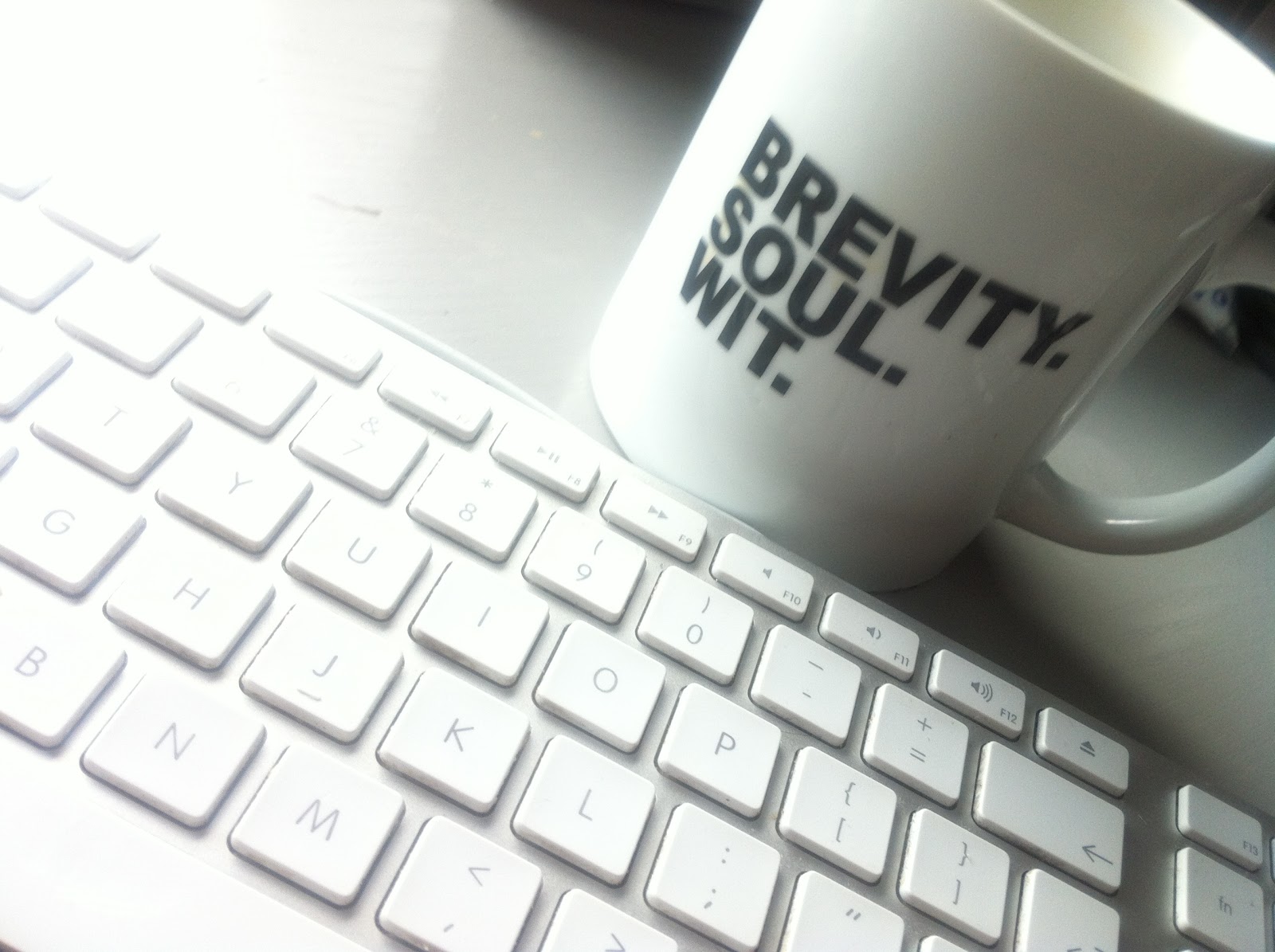
 Brevity. Soul. Wit.

This made me laugh.

There’s no magical length for a Tweet, but a recent report by Buddy Media revealed that Tweets shorter than 100 characters get a 17% higher engagement rate.

and

The ideal length of a Facebook post is less than 40 characters

Both of these are from an article on Buffer.com. (Buffer is a service that lets you write tweets in advance and it posts them to a schedule you specifiy. I’ve started using it on Fridays for when my personal blog, Self Distract, goes up. I’ll write the first tweet about it live but I’re recently used Buffer for the other times I mention it, specifically around lunchtime and early evening on Fridays – because otherwise I often forget.)

I have no reason to doubt or suspect or really in any meaningful or statistical way do anything but completely believe this information about writing short tweets and updates.

I am just humanly incapable of ever doing it. I see writing as our getting to talk, me and you, not as some trigger to get a reaction from you. Let alone to get 17% more of a reaction.

Plus I wish places would stop calling things scientific when they mean statistical.

But on the one hand, maybe you care about this detail more than I do, in which case I want you to see the full feature on Buffer.com. And on the other hand, maybe you like my Brevity – Soul – Wit headline as much as do. In which case I want you to see the Royal Shakespeare Company mug that has it written on.

keyboard+with+mug

See? Nobody has a writing process

Well, maybe that’s putting it strongly. But earlier in the week I mentioned how one writer I know has been trying to find her own process, to find how she works best. And how then by chance another writer I know blogged about how there is no such thing as one process that we can all adopt.

That friend, Ken Armstrong, refers to how there is a belief that creative people must work to a certain pattern yet he doesn’t agree with that. Now Casey N Cep of Pacific Standard says of this that:

Charles Dickens wrote while blindfolded. Virginia Woolf took three baths a day, and always with ice-cold water. Stephen King eats a blood orange at every meal whenever he is working on a book. Joyce Carol Oates writes only in Comic Sans.

None of those things is true. Before you go and stock your kitchen with blood oranges or switch the font on your word processor, let me assure you that I invented every one of those writerly habits. But what if I hadn’t? What if you had read them in an interview or in any one of the million aggregations of writerly routines? Would you really stop taking hot showers or start blindfolding yourself when you write?

The Myth of the Artist’s Creative Routine

Yes.

I’d do anything.

In particular, I would do anything rather than write. Hot showers balancing an orange on your throat? Easier than writing. Give me a list of habits I must adopt and I’m happy.

The idea that any one of these habits can be isolated from the entirety of the writer’s life and made into a template for the rest of us is nonsense. What none of these lists tell you is that sometimes these highly creative people weren’t waking so early on their own, but were woken by domestic servants. Or that some of these highly productive writers also had spouses or children or assistants enlisted in the effort. Or that often the leisurely patterns of drafting and revising were possible only because generous familial support made the financial demands of everyday life irrelevant.

Read the full piece for more.

Dear [INSERT NAME HERE] your email is very important to us

Let me say this. I don’t agree with the article I’m about to point you to. The quick summary of it is that it says you should cope with your emails by emailing people back with stock responses that effectively say you’ll get to them later.

I think this is bad for several reasons:

  • I abhor stock responses – I’m a writer, I don’t do stock responses
  • It means you are staying on email just to send these
  • When you email these people back immediately, they are likely to respond right away
  • It just adds to the number of bleedin’ emails flying around. And I like emails

Instead, I would offer that the solution to not being overwhelmed by email, to not losing your working day to writing replies, is to not check email every minute. Do it once an hour at most. Then when you get an email, if you can handle it right away, handle it right away. No postponement, just get on with it. If you can’t and you must respond, then, okay, send them a reply saying that you’re on the case. But don’t make it a stock, canned, cookie-cutter response.

The always excellent 99U site takes the opposite view and says stock, can, cookie is the way to go. See what you think – and if you agree with 99U, you’ll find such recommended stock cans in the article.

Go away. Far as you can.

I went to a Catholic school and I think every kid there was Irish Descent. That’s how I thought of it: capped up, Irish Descent. Like that was a thing, a statehood, a nationhood, like Irish or English or American, I was and we were Irish Descent. Then I went to college and nobody was.

Nobody else was.

They weren’t Irish Descent, they weren’t Irish and nobody was Catholic. It was wonderful. I can feel my eyes opening as I tell you this. To go from one familiar situation like my school to the unfamiliar one of a college. To go to a situation with the promise of so much being unfamiliar, so much being new and different. I basked in that and I’d say that I learnt more from the experience than from the lectures, except that’s far too easy a thing to say. You should’ve seen the lectures.

You know all this. You know that going away is good for you. Now Time magazine reports that:

Research shows that experience in other countries makes us more flexible, creative, and complex thinkers.

How does studying or working abroad change you? You return with a photo album full of memories and a suitcase full of souvenirs, sure. But you may also come back from your time in another country with an ability to think more complexly and creatively—and you may be professionally more successful as a result.

These are the conclusions of a growing body of research on the effects of study- and work-abroad experiences. For example: A study led by William Maddux, an associate professor of organizational behavior at INSEAD, found that among students enrolled in an international MBA program, their “multicultural engagement”—the extent to which they adapted to and learned about new cultures—predicted how “integratively complex” their thinking became.

How Studying or Working Abroad Makes You Smarter – Time

Before we go too far down this line, I need to tell you that copying-and-pasting that segment out for you also brought along a Recommended headline which was this:

Kate Middleton plays volleyball… in heels

If you’re thinking that were one even to accept the concept that this might be news, the entire story is there in the headline, you’re right. The headline just links out to a video. Want the link? The things I do for you.

Anyway. Time magazine, eh? I do still have it in my RSS feed and it regularly has features I enjoy. Including this one about studying and working abroad.  Take a look at the whole feature: there’s not much more to it than I’ve quoted but it has links out to the research it reports on.

Process stories – finding how you work

By coincidence, two friends talked to me about this lately: how we writers go about our writing, the way that we get it done. The process, the writer’s process. I was thinking that the short answer is a shrug: you do what you need to. But there is a comfort to having a system that works for you, specifically there is a comfort in that if you know you are always writing at the last minute and that always turns out okay, maybe you can stop beating yourself up about it now.

I can’t tell you my process. I can go on about the 5am starts (today was day 231 of that, by the way) but that’s less a process, more a stupidity. It’s 8:30 so now and I have written 1,200 words on one project, I have done a pile of emails about a couple of events I’m producing, I have drunk quite a lot of tea and gone through my To Do list. Including the stuff I found I’d done over the weekend, I ticked off about twenty items on that list. I think I probably only actually did six or seven of them this morning. But they’re done. And yet this isn’t a writing process, it’s a productivity one. Because it’s easier to be productive than it is to write anything down.

Maybe that’s my process: do everything else rather than write. It’s a rubbish process.

So I would like to find you a way to write that is efficient and quick and gets things done. But I haven’t found it because I can’t find it because I think the very notion is bollocks anyway. Not if the aim is to be efficient. If the aim is to explore your own writing and to end up having written instead of just thought about writing, that’s different.

One friend, Alex, says she’s still finding her system, her process. Then either by total chance or because we writers are all forever thinking about this stuff rather than actually writing, another pal, Ken, wrote a blog about it:

If there’s a point to this post. I think it’s this. I think there are lots of ways of writing and if you’re stuck staring at the notebook or the plotting software, consider letting it go for a while and just writing. Just write. See where you go and where you end up. Just don’t settle for what you write in that initial foray.

My Way is Not the Best Way but it’s Mine – Ken Armstrong Writing Stuff

He’s a smart guy, he writes very well and his blog was a key impetus in my making my own Self Distract be a weekly thing. Have a read of the whole piece, would you?

Negotiate like the FBI

Specifically, negotiate like you’re the FBI and the person you’re dealing with is currently holding hostages. They have your attention. You have theirs. You both have guns.

Eric Barker of Barking Up the Wrong Tree has taken the FBI’s Behaviour Change Stairway – a diagram of their standard approach – and applied it to the freelance life like so:

The Behavioral Change Stairway Model was developed by the FBI’s hostage negotiation unit, and it shows the 5 steps to getting someone else to see your point of view and change what they’re doing. It’s not something that only works with barricaded criminals wielding assault rifles — it applies to most any form of disagreement.

Six hostage negotiation techniques that will get you what you want – Barking Up the Wrong Tree

You’re wondering how he can say there are five steps when his article claims there are six. You are right. The five he lists there are FBI-based ones and the six are similar but extrapolated steps that make this fit the kind of situations we are hopefully more likely to encounter.

He’s boiled down the FBI’s distillation into these five or six steps but probably the first one is the key thing to focus on:

1. Ask open-ended questions
You don’t want yes/no answers, you want them to open up.

A good open-ended question would be “Sounds like a tough deal. Tell me how it all happened.” It is non-judgmental, shows interest, and is likely to lead to more information about the man’s situation. A poor response would be “Do you have a gun? What kind? How many bullets do you have?” because it forces the man into one-word answers, gives the impression that the negotiator is more interested in the gun than the man, and communicates a sense of urgency that will build rather than defuse tension.

But then you’ve got five more steps before they put the gun down and/or you get what you want. It’s quite a fascinating read, especially if you’ve seen eleventy-billion cop shows with exactly this kind of scenario.

Read the whole feature.

Force your To Do app to have start dates

Most To Do apps don’t have this but you need it and there’s a way to fake it on any software:

Screen Shot 2014-04-26 at 16.52.19

This is the ideal: you write one task and you give it both a start date – called “deferred until” in that screenshot – and a date that really have to do it by. All in one. (Actually, no, the ideal is to not use either start or end dates, especially not end dates. But that’s another story.)

There’s a good, solid, practical reason why this is the ideal when you have a deadline and there is a more nebulous yet enormously more important reason too. First, the practical one:

Having one task with start and end means you’ve one place to go change its details if you need

The nebulous one is:

Software that has start dates will keep your task hidden away from you until then.

It’s in your system, you won’t forget it, you just won’t have to consider it at all until the time you’ve said you should start.

Set it, forget it, get on with the stuff you have to do now.

I mean it when I say this is enormous. It’s the difference between a To Do list that you will use and one that just becomes this enormous long stupid hateful damn bloody list of a million things you still haven’t done yet, you total failure.

So it’s a shame that not every To Do app does start dates. My beloved OmniFocus does. (The screenshot above comes from OmniFocus for Mac where start dates are now called Defer Until dates. Apparently people got confused. But start dates are so crucial that the term is now burnt into me.) Other apps have it too: the online one Asana, the iPhone one Appigo To Do. It’s hard to give you a definitive list of what does and doesn’t have it because it changes a lot – and because some software firms look like they’ve only added start dates because customers wouldn’t stop shut up about them. The feature is there but, my lights, it’s hard to find.

You’d think you could just google like “omnifocus start date app review” or somesuch and get the answer for any app, but you simply can’t. Do try it. If you’re considering a particular To Do app, definitely google whether it has start dates. Be prepared to dig through articles. If the app is free, just get the bleedin’ app and try looking in that. But look for it, hope to find it, be prepared that you may not.

And if you don’t, fake it.

Do this:

  1. Give your task a deadline, a due date, that is really the day you should start it
  2. Call that task something like “Do that thing which is due on 1st May”
  3. Create another task called “Do that thing” and give it a due date of 1st May or whatever the the real deadline is

It’s two tasks instead of one. And you may see both on your list every day, but typically your app will at least put them at the bottom of the list until the first deadline appears.

It works. It’s not elegant. There’s a strong chance that it’ll go wrong: if you tick the first one, the starting task, when you begin it but you don’t finish on that day, you have to remember to continue it tomorrow.

Have you noticed that I’ve avoided saying oh, to hell with it, just buy OmniFocus?

Bugger.

Don’t give yourself a deadline

You’ve got this thing to do, it’s important, you want to do it, you need to do it, of course you’re going to put it on your To Do list and of course you’re going to put a deadline.

Don’t.

Does it actually, really, seriously, honestly, have to be done by a certain date? If you’re delivering something to a client, yes. But that is about the only time you need a deadline. If you work at a place where, say, the holiday rota comes out on a particular day and you’ve got this many seconds to get your request in, fine.

Everything else you do, avoid setting a deadline.

Don’t have a start date, don’t have a deadline date, just have the task.

Because you are going to get it done. It is on your list. You’ll write the task as if someone else is going to do it, fine. It’ll help you to say that it’s a task to do with this project or that: I have tasks for an event I’m producing, for instance. I’ll say the task belongs in that event project. If you’re using OmniFocus, you have to set a certain amount of detail in order to get the task out of your general-purpose, catch-all task inbox. (See part 2 of What’s So Great About OmniFocus.)

That task will then stay out of your way until you go looking for it. Part of using a good, trusted To Do system is that you don’t have to constantly see all your tasks because you elect to review the lot at certain times. It’s a core concept of David Allen’s Getting Things Done.

So it’s there, you don’t have to keep thinking about it, you will get it done.

If you added some artificial deadline, the task would pop up in your face on that date. But it’s an artificial deadline. A contrived one. Odds to onions, you’d see that notification and you would dismiss it. Why wouldn’t you? It isn’t a real deadline, you don’t actually have to do that now, swat it away.

Deadline notifications just became meaningless.

If you’re having to consciously stop and work out whether this deadline is the real deadline, you’re screwed.

I will spend time on my To Do tasks when I’m writing them in. Actually, no, I’ll often chuck half a thought in and then work it up into a proper task when I get home. But once that’s done, once it’s in the list, I don’t want to have to think about it until either I’m ready to do the task or it is time that I have to. Don’t make yourself have to work your list, deciding every day what’s real and what isn’t. Spend that time doing your To Dos.