It’s my job, it’s what I do

Quick aside? I love the line “It’s my job, it’s what I do” because to me it is the archetypal ridiculous line you used to get from so many cop shows. I say it with earnest dry seriousness and I am of course kidding. Unfortunately, it turns out that not everyone knows that TV cop show trope and one day I found out I had been seriously, seriously, seriously annoying an entire newsroom.

I’d like to say that I stopped using it but there are times when it still springs into my head unbidden. Such as now. I was just thinking about this thing I want to discuss with you and there it was, there was this old line. And I rather mean it this time.

Follow. A friend, Mary Ellen Flynn, said this to me recently after a tearoom natter:

I like your perspective since you are businesslike about writing but you still love it.

My lights, it has actually become true: this is my job, this is what I do.

I’m split now. She meant it as a compliment and I take it as one, but it’s sent me spiralling off into pondering the differences and the similarities and the Venn Diagrams of writing vs business, of art vs work. Then, okay, that’s further sent me off pondering how I have the nerve to call what I do art but fortunately I don’t. One dilemma at a time, please.

I think the reason I’m mithered over this is that her line reminded me of how I’ve previously been accused of being a commercial writer. It was not a compliment. Whoever it was – and I’m genuinely blanking on their name – pointed out that I write Doctor Who radio dramas and that every idea I was telling them was out-and-out commercial. Every idea was a thriller, a romance or both.

Oh, grief. I’ve just had a thought. If it were who I now think it might have been, she was writing literary fiction and it was bad. God in heaven, it was bad. One of the single most creative pieces of writing I’ve ever done is the way I answered her about what I thought of a certain chapter without telling her what I thought of a certain chapter. You’re asked your opinion in order to give your opinion but sometimes, no, the truth is best left out there.

Anyway. I like literary fiction but my best definition of it is a book that doesn’t fit into any other genre. Equally I suppose you can argue that the definition of a commercial text is that it is written to make money. It amuses me that she failed totally at being literary and I’m doing a good job at failing to make money.

Yet for all that I am supposedly commercial and for all that I agree I am businesslike, the fact is that I write romances and thrillers because I love them.

They excite me, they totally compel me and maybe I can’t do them well yet but I’m trying.

There is the part of my brain that recognises the existence of a mortgage and how nice it is to eat around three times a day. There is the part of my brain that knows deadlines and understands a brief and can copywrite and can build a structure, build an event. That’s the businesslike bit that is very easy for me; frankly because anything is easier than writing.

I said that all this pondering and noodling came from that friend’s line about my being businesslike. I was doing a talk last week and trying to convey a point about writing as a career, as a job. You know how you don’t know something until you say it?

This is what I think, this is what I do, this is what I said:

I write for a living – but I really write for a life.

Why the Apple Watch means you should keep writing

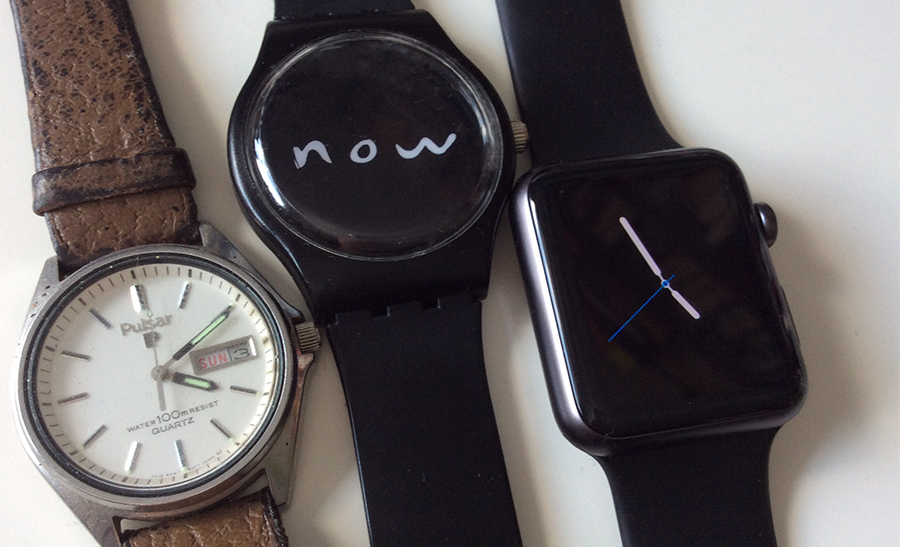
wg_Apple Watch-og_apple_watch-580This is going to take a time to get to its point, sorry. But Apple released details of its new Watch this week and a certain segment of the world has fallen apart.

It’s a pretty small segment yet it’s a loud one. And it’s saying Apple is bad, very bad. The watch does this or it doesn’t do that, it costs this or it doesn’t cost that, every bit of it is being criticised in volume. Mind you, what it does is also being praised in volume.

I was just disappointed – not surprised, to be fair – but disappointed at some of the reactions. I’ve nothing to do with Apple, they didn’t ask my advice on anything, but still I was disappointed because in many ways and at many times I’ve been a professional reactor. I’ve been a critic, I am now again writing software reviews. So I can’t help looking at critics with one eye on what they’re doing and one eye on whether I’m doing it too.

Here’s a criticism of Apple: one version of the Apple Watch costs £8,000 ($10,000). To me that’s one fact with an implicit second one – that I will never be able to afford that version – and this is all. Nothing else. I can’t extrapolate from that anything but that it’s a lot of money that I neither can or want to spend on a watch.

But to some critics this is ostensibly the end of Apple’s ambition to be “for the rest of us”. That’s it, Apple is cashing in, Apple is just out to make money, it is the end of days.

There is that word ‘ostensibly”, though. It is a fact that articles slamming Apple get more readers than ones praising it. Most people wouldn’t bother reading either, but if you’re an Apple hater then you enjoy the criticism. If you’re an Apple fan, you rather enjoy riffing on how pathetic the criticism is.

So I look at these criticism and I can’t tell whether they are genuine or just after getting some more readers. If it’s the latter then what can you do, haters gotta type.

But that does niggle at me. Professionally, I’m twitching at the thought of writing something whose sole purpose and existence is to get people to read it. Personally, I’ve realised that these criticisms have an impact.

Follow. I was on the MacNN podcast this week when Malcolm Owen talked about various Android phones that have been announced. He was quite dismissive of them and I asked about one Android feature that I think sounds really good: the way that if you put your phone face down on a desk, it mutes. Goes into Airplane Mode. Whatever the Android term is for not interrupting you while you’re working. I like that and, okay, I accept that a feature touted as being on Android first usually means it’s on one Android phone somewhere in the world first.

It’s on Malcolm’s phone and he says nope, he only ever got it to work once.

The hype of an Android feature had convinced me this was useful and I unthinkingly, certainly naively, assumed that it worked. Silly me.

So doubtlessly there are people out in the world reading and hearing criticisms of the Apple Watch and consciously or unconsciously making a decision about it. If all you hear is that it costs £8,000, you’re not going to consider buying one even though the real price is £299. That’s 26 times lower, by the way.

Now, someone buying or not buying an Apple Watch isn’t significant. They might love it if only they’d bought it; they might buy it and hate it. It’s just that seeing everything through the lens of perhaps self-serving criticism and being quick to diss before hearing anything substantial is so familiar to a writer. We have to be hard as writers and we are, it’s just that the thickness of our skin only protects us, it does not protect the work.

A piece of mine got a lot of criticism last year, criticism that – hand on heart – was in part so asinine that I had to bury a laugh. (“It should be a supernatural novel, I like supernatural novels.”) I went in to that session ready for a promised skin-tearing time and didn’t get it. Yet I haven’t written one word more of that book since. The criticism didn’t affect me, the critics didn’t affect me, but something affected that novel.

Nobody is ever going to get more readers because they’re criticising me but that doesn’t mean there aren’t other issues at play. The need to be heard, an inability to not say anything because you’ve got nothing to say. The expression of your own issues instead of anything to do with the book, the presumptions that one’s own preoccupations are correct and vital and important.

In that group, there was someone who’s set a novel in some particular area of London I’d never heard of. We weren’t in London, I’m not from the city and it’s not like the area was Westminster. I got the most deeply pitying look for asking where it was. The look was: you should know this, you aren’t a real writer, are you?

I’m just minded of this by a Facebook status I read this week about the Apple Watch. This is someone on Facebook, there’s no issue of getting more readers or not. It’s their real opinion. And their opinion is that the Apple Watch is of no interest because it doesn’t have X or Y, I can’t remember what. It wasn’t that the Apple Watch was of no interest to that Facebook writer, that would’ve been fine and normal, it was a dismissing dissing of the watch.

Whatever it is in us that makes us judge things before we see them ourselves, whatever it is that makes us slot ideas into categories and then judge those categories, let’s give it a rest.

Apple will keep on making that Watch unless the real thing, the actual physical product in people’s hands, proves to be a failure. It won’t stop because someone thinks it should run UNIX or needs to be set in a particularly obscure part of London.

Whatever you’re writing, write the damn thing and bollocks to anyone else. Get it done.

It’s not you, it’s me

Okay, you may have trouble swallowing this considering how I go on at you every week. But when we meet in person, I am infinitely – infinitely – more interested in you than I am in me. Have I said this to you before? I tell you everything, I must’ve mentioned it: my attitude when nattering away with someone is that I know all about me, I was there, I saw me do it, let’s talk about you.

Truly, time spent talking about me is wasted and boring. I’m not knocking myself, I’m just not interested and I have plenty of time to know me, I might get only minutes with you. And look at you: look at all you’re doing, all you know that I don’t, how could I possibly waste any time talking about me?

I got told off for this today.

I saw a friend for a coffee – she’s Steph Vidal-Hall, she does coaching for creatives and you could look her up right now – and she is doing so much that is so interesting. I was really looking forward to learning about it all.

And I did find out a lot but she also tricked me.

Before I knew it, I was telling her about a job I have on that is worrying me, about projects that are vastly delayed because of my cold, and I was even telling her about a thing recently that went spectacularly well for me.

Clearly I will never have coffee with this woman again.

She argued that this is how conversation between friends is supposed to be. I can’t disagree. I do also wonder if I’m a bit selfish in conversations, wanting to ditch me and talk about you.

This is all a small and maybe obvious point but I’m thinking about it a lot now. Previously, I admit this, I’ve liked that I put the spotlight on you. That’s mostly because that is exactly where the spotlight should be, but also we’ve all had people who can barely hide that they exist to tell you about themselves. So I have enjoyed not being like that.

Plus, my lights, you cannot believe the things people have told me. It is amazingly flattering and I’d give you examples but for how that would be rather destroying the whole trust that I seem to have got from strangers and friends alike.

I’ve looped around this thought before and always managed to kick it to the kerb. But today’s friend did two things that fixed the issue in my head and also made me want to talk to you about it.

First, she pointed out that she has previously enjoyed our chats but gone away feeling bad that they had been so completely about her.

And, second, she helped me.

I have this job on and I am nervous about it. I’m still nervous, I’m not going to say she changed my mind and has made me look forward to it, but she gave me a nudge that helped. It’s a nudge that may mean I get over these particular nerves given time, it definitely means I had a moment when I actually felt relaxed.

Also, she bought the tea.

If we were chatting face to face now I’d be grabbing your arm and bringing you over to her.

Let’s all get a tea some time and you can tell us about you, Steph can tell us about her, and hopefully you’ll both take long enough that I have time to make up some interesting lies.

It’s about Time

For some reason, 2015 is replete with time travel tales from the continuing Doctor Who through multiple movies and new TV shows. This could be good: I am obsessed with time, it’s something somehow personal to me, and I’m excited enough by all these that I want to talk to you about them.

Unfortunately, every one of these new tales is about time travel and that’s not actually what interests me. I’m really more into things like regret – you can’t go back in time to undo things – and it’s also a kind of practical obsession. I produce a lot of events now and your mind splits when you do that, it splits into planning out the time of the event itself with what must happen when, and it also has you working out what time you’ve got left to prepare it.

But.

I do have a fondness for time travel stories because alongside the TARDIS or the DeLorean, their stories at least touch on these time issues that so occupy me. Going back in time and seeing something from a new perspective, cor. Going forward in time and seeing the consequences of your actions, fantastic.

As a writer, time is a tool to examine characters and to truly test them. I think it is a woefully underused dramatic device. Mind you, it is also a bleedin’ complicated dramatic device and so prone to leaving you unsure what’s happening that even I haven’t pulled it off well yet.

I am trying. So I will watch all of 2015’s spate of time travel movies and TV. Unfortunately, I’m not looking forward to it. Not to all of it.

There are some good ones. I’ve seen the pilot to 12 Monkeys, the TV version of the film, and that is good enough that I’m definitely coming back for the series. (In the UK, it’s begun airing this week on SyFy.)

Similarly, I’ve seen the pilot to Outlander and it’s a bugger that this series will only air on Amazon Prime instead of proper telly. It’s a rather beautiful series that looks gorgeous and has a compelling tale of a 20th century woman in battle in the 17th century. Lots of utterly wonderful scenery in Scotland, also rather a lot of voiceover narration.

I haven’t seen Hot Tub Time Machine 2 which opens in UK cinemas in April. Reviews of it are so bad – and so convincingly bad – that I may have lied to you just now, I may not see all of these time stories. It’ll be on the telly some day, I’ll maybe catch it then. I did enjoy the first one, mind. If you don’t know that one or its sequel, the short summary is that they both feature a hot tub, they both feature time travel, but apparently only the first film has any jokes.

I should be nipping out today to catch Project Almanac as that’s finally in UK cinemas right now after a long delay. A year ago, I’d have gone for sure. I was intrigued by the first trailer that began circulating before the movie was pushed back twelve months. A group of teenagers discover a time travel machine and abuse it terribly – until they find that something they’ve done has gigantic consequences for the world. Usual stuff, really.

But there is a second trailer now that is so perfunctory that it feels like they knew they had to do something. Yeah, yeah, that bit looks good, use that, slap on the title, we’re done.

It also has poor reviews. I’m an ex-reviewer and my own work gets reviewed sometimes now, I should know that you don’t put too much weight on a reviewer’s opinion. Yes, when you find a reviewer who seems to share your tastes, that’s one thing. But a single bad review is unlikely to put me off anything, if I’m sufficiently interested in it.

Like Hot Tub, though, Project Almanac is getting chiefly poor reviews from everyone. I have to go see it now, don’t I?

Next, there’s a movie called Predestination that officially has opened in cinemas this week but you try finding it. It was made last year and it’s done the festival circuit, it’s had screenings all over, I’ve eventually come to accept that I’ll need to watch it on iTunes or DVD when that release happens in April.

Predestination is said to be better than Project Almanac, there is precious little doubt that it is better than Hot Tub Time Machine 2.

But.

It’s based on Robert Heinlein’s famous time short story, “– All You Zombies –” from 1960. Fancy reading it? You can right here. It has nothing to do with zombies as we’d expect today, no walking dead, grrr, arg stuff. Instead, it is a classic of time stories.

However.

I don’t want to spoil both Heinlein’s story and Predestination in the same breath – I like to space out my spoilings – so I can’t explain why I doubt the film is great and I am sure it won’t become a mainstream hit. Let me try anyway. Heinlein’s story is incredibly clever and it bashes through the kind of human drama that only time travel’s ability to show you the same events from different views can do. It’s just that it felt to me like a brilliant puzzle instead of a story.

Remember, I don’t care how someone travels in time, I’m interested in what this ultimate change in perspective does to them. So I’ll even ignore the odd plot hole if I care about the characters and Heinlein’s story is air-tight about plot, I’m just not especially interested in the characters.

Maybe it’s a clue that I’ve spent all this time discussing the plot and haven’t told you the story. If you see any new time travel movie this year, see Predestination, but be warned it looks iffy.

So there’s Predestination which is iffy, there’s Project Almanac which is iffy-plus, there’s Hot Tub Time Machine 2 which is grade-A iffyness incarnate. There’s Outlander which is beautiful and languid and absorbing and I want to see more but I’d appreciate it if they cut down on the amount of narration. There’s 12 Monkeys which I watched just to see how they could turn the movie into a series and they seem to have done it remarkably well so far.

There’s also a US series called The Flash which apparently features time travel. But I hadn’t even heard of The Flash until this character was mentioned on The Big Bang Theory. I’ve been told all sorts of complicated things about this guy and the versions of him in comic books, in this series and in apparently forthcoming movies, but deep within all of it was that the series is boring. It gets better, I’m insistently told, but.

Maybe I think too much about this stuff. Maybe if I were less into the issue of time, I’d better enjoy these movies that dabble in it instead of feeling they waste a potent situation.

But this is 2015 and while I don’t know why we’ve suddenly got all of these, I do know that the year was already special for time. For 2015 is both the thirtieth anniversary of Back to the Future and it is the year featured in its sequel as the far future.

Do a google search on this movie and you’ll see many articles now about how it got the future wrong. That astonishes me: time travel stories are never about the future or the past, no matter when they’re set. Back to the Future is so firmly about the 1980s and what it was like for people living then. The 2015 of Back to the Future Part II is not a prediction, it is a new perspective on how people thought and what they expected.

Plus hoverboards.

Look, I’m into this stuff – time, not hoverboards – and I’m telling you about all these things coming up because I’m interested in them and I want to share but the more I write, the more down I sound on them all.

Okay. If you see one new time travel movie this year, make it Predestination. But this is 2015, we can watch just about anything we want, whenever we want it. So have a deep dive into the very richest, very best of time movies.

There’s Looper, that’s rather good. Primer is superb and Timecrimes is brilliant. The film 12 Monkeys. Back to the Future is the easiest watch but no less good for that.

On TV right now there’s 12 Monkeys the series – it’s very different, you can watch both series and film without one spoiling the other. Doctor Who of course, though actually it is rarely about time. The episode Blink is and I defy you to not choke up at the line “It’s the same rain”.

Is that it? Or do I just feel I’ve taken up enough of your time?

Listen, one more thing. Just between us. I did call this Self Distract entry “It’s about time” because it’s about time. But Angela and I have a watch that dates back to when we finally got together, years upon years after we’d been friends and I’d been trying hard. It’s a lovely little pocket watch that hangs in a small bell jar and engraved on the back are the words “It’s about time”.

Told you it was personal.

The facts, ma’am, just the facts

Sometimes you have to say something before you realise that you think it. Consequently this may be very obvious and I’m definitely going to take a time getting to it, but I first realised it on the ring road near Damascus.

Follow. This week in Stafford there’s been a children’s event called Page Talk, produced by Hayley Frances for Writing West Midlands. It’s a writing event where a small group of 10-14-year-olds have worked with professional writers, journalists, poets and more.

On Monday, they had poetry with Stephen Morrison-Burke. Tuesday was journalism with Alex Townley. Wednesday was science fiction and horror writing with Alex Davis. Tomorrow they get taught performance by Cat Weatherill. (Seriously, what a week for these kids, eh? Stephen, Alex, Cat – I don’t know Alex Davis’s work as well as I do the others but the kids told me he was superb. I’d pay to see that lot.)

Today they got me and “Play in a Day”. Twenty kids wrote a play together from scratch. At 11am, we had nothing whatsoever. At 4pm, we had a play.

What I hope also happened is that they got to taste a little of what it’s like writing for real. Not in school, not to be praised for how clever you are. For real. I told them that I wouldn’t be giving out grades. I told them that if we didn’t quite manage to finish the play today then we needn’t have bothered starting.

(I can do that, I can play the this-is-real and this-isn’t-school card because it isn’t school and I’m not a teacher. I’ve only once been studied by Ofcom people and that was a mistake. I’ll tell you now, I came away from this Play in a Day feeling pretty good – but I could because today I’m in my office writing for 16 hours or so. No kids. No trying to teach anybody anything. I’m not even a parent. Truly, I am a civilian.)

Anyway. No near misses, I told them, no well done for trying, the job was to write a play and that’s what we were going to do. That’s what we did.

But I was also strongly aware that this was one day in a week and that they have been doing all these other types of writing. They were obviously going to see what the differences are but there are two that I particularly wanted and needed them to know from the start.

I think one of them is obvious and I’ve said it a hundred times. Scriptwriting is different to novels and short stories and journalism and poetry because the audience never reads the script. The script is there for you and everyone else involved to make something else: a play, a TV show, a film.

It’s the other thing that I hadn’t realised I really think and it’s this.

Journalism is about the facts.
Drama is about the truth.

Journalism is who did what, when, where, how and only in the most coarse way why. Drama is all about why and also why it matters.

I’m not convinced that I gave them a brilliant example but it popped into my head and I said it. Since nothing else has popped into my head since, I’m going to say it again.

I was working with a guy named Connor Evan so I pointed at him. “If I walked in here with a custard pie and slapped Connor in the face with it,” I said, “that might be a news story.”

You can see the headline: Prat Pies Producer. Connor would point out that he isn’t a producer but we’re talking 21st Century journalism here and alliteration goes a long way.

You can also see the news report. You can practically read it now. A reporter would get a quote from a witness, from Connor and from me about why I did it – “Well, I had this spare pie and…” but otherwise the whole news story is Prat Pies Producer.

Whereas drama would convey to us – not tell, never tell, always convey, always show – what it is like to be the victim of that pie. What it’s like to feel cold custard against your skin for the rest of the day.

It would also convey why I’d really done it – and it would’ve accepted the fact that actually, maybe I don’t know.

Drama is messy. Drama is people. Journalism is just the facts.

Say what?

If you don’t know something, fine. If I don’t know something, fine. We’ll work it out together. Or more likely one of us will look it up and explain it to the other. It’s not like there is a shortage of places to look things up.

But if you’re a writer and your characters don’t know something, that’s gigantic.

relativity 001Follow. Around 1996, I read the pilot script to a US series called Relativity. Written and created by Jason Katims, it was from the makers of thirtysomething and My So-Called Life. Plus, it was a romance and I like romances, naturally I read it. And I enjoyed that script a lot. I wish it were still online that I could point you at it.

I enjoyed it enough that of course I wanted to see the final show and I was enough of a writer to be curious to see how they would stretch this romance out to seven years of 20-odd episodes a year. They didn’t, as it happens. I think they made 17 episodes before being cancelled. I didn’t see any of them. I must’ve seen something, must’ve seen the title sequence or something because I knew what the major characters looked like.

But actual episodes: none.

Last year I got very excited when the pilot episode found its way on to YouTube – except that my face fell when I saw it. Because the YouTube copy was dubbed into German.

Now, though, the whole series is up on Dailymotion. Doubtlessly less than legally but then if the show were ever going to get a commercial release I would’ve bought that a long time ago.

As it is, nineteen years later, I’m finally watching the episodes.

It’s not great. Certainly not on a par with MSCL or thirtysomething. It tries to deal with some serious topics but it doesn’t have the bite of those other shows. And characters I remember liking on the page feel a bit whiny on the screen.

But.

What knaws at me in every single episode is one line from the title sequence.

It’s a smart sequence. If you ever seen a Bedford Falls show like thirtysomething, you’ve got the idea already: a montage of scenes, credits on the bottom of screen, great music by WG Snuffy Walden in his pre-West Wing days. All that.

But as well as the visual montage of scenes, this sequence has an audio one. Clashing, overlapping, audible and barely audible, clear and obscured lines rush by you in a way that seems chaotic. In practice every line is placed pixel perfectly in time and in the stereo image because you never fail to hear the key lines and you always fail to hear the lesser stuff.

It’s the main characters talking about relativity. “Like Einstein… E=mc squared…” They’re explaining what relativity is and quickly pushing the point. One key example is “the things you think you can’t do, you can do” which is just so far away from the definition of relativity that it belongs in a different series.

But then bam. The last line.

It’s said by the series star, Kimberley Williams, in character as Isabel Lukens. This show is primarily a romance but it’s really weighted toward her rather than her guy, Leo Roth (David Conrad). So this is your most important actor in the show’s most important role and she has the most important position in your entire title sequence. And she says:

“I have no idea what relativity means”

Then sodding look it up.

She says it with a laugh, with that kind of gosh, how could anyone be expected to know this stuff type of laugh.

If Isabel Lukens did not know what relativity meant despite having seemingly constant conversations about it, the character would be stupid. Not uninformed, stupid. Worse: passively stupid. She doesn’t know what a word means even though she’s just been discussing it. Couldn’t be bothered to either look the bleedin’ thing up or to listen to the people discussing it with her. Ignorant in every sense.

But Isabel is not speaking for herself. She says this to allow us to not know what relativity means. It’s okay not to know. In fact, gosh, who could know?

That one line is the most outrageously insulting line I can think of in TV title sequences. I don’t mean this because I know what relativity means, I mean because the makers assume we don’t – and the makers assume we need reassurance that this is not a bad thing.

I feel examining one line from a cancelled TV series of 19 years ago might be overkill. But I also feel that there is something in here about all of television and how all of it has gone down the reassuring ignorance route.

Didn’t we used to look up to TV characters? Was I just young? Detectives and heroes and all that, they were smart and they were cool and then something happened. I think it was around the time when computers became commonplace. Suddenly we hit the moment when we, the viewing public, knew more about this stuff than the TV characters did.

We knew and we know more than they are allowed to know.

TV characters are rarely allowed to be clever, certainly they are even more rarely allowed to think. Now thinking is a tough one to show visually – yes, I’m thinking Sherlock too but not every show can do what that does – so you can understand the problem. But if the plot requires a clever character, that character will not be the hero.

More, that character will be mocked for being clever. Just as you can’t be a woman doctor without a white coat, stethoscope and a clipboard, so you cannot be a clever character of either sex unless you wear glasses. And get kidded for being in some way socially awkward. Kidded by the cool-as-all-hell action hero, for preference.

We are expected to feel superior to the clever clogs. The expectation is that we will need to feel superior or we’ll stop watching.

I think I’ll make it to the end of Relativity but just four episodes in, that single line is threatening to stop me watching.

How about them Apples?

I do think it’s interesting and of course it’s newsworthy that Apple has just made more profit than any other public company ever. Weirdly, though, none of the many, many news reports I saw about this mentioned that it’s inspiring for writers.

Now, making lots of money could be inspiring for anyone, but I’m not actually thinking of the cash here. I’m talking inspiration and I’m thinking heartwarming. Seriously.

Apple just made $18bn, that’s £11.8bn and that bn is billion. Billion. I’m suddenly wondering if that’s a US billion or a UK one, but either way, it’s a lot. Doubtlessly, it is very easy to find the idea of lots of money inspiring if only because the idea of lots of not having to worry about bills is pretty great. Yet if you are driven by money, if you are drawn by money, you haven’t gone in to writing.

Here’s the thing. What none of the news reports really mentioned was that Apple nearly died.

There was a point when this company was within 90 days of going bankrupt.

Ninety days.

You and I are used to working under pressure but imagine being ninety days from bankruptcy while having thousands of staff on salary. As writers, our business is comparatively easy as we usually don’t have staff and we very rarely have any stock in warehouses. So imagine the staff and imagine having warehouses full of computers that aren’t selling.

This is where Apple was around the time that it brought back its co-founder Steve Jobs. So now imagine coming back to the company you made into a success and was ousted from in a boardroom fight by a fella you’d lobbied to bring in to the firm. No wonder there’s going to be a film about this guy.

Run the list with me. Immense pressure. Close to death. And deeply, personally invested in this firm. The degree and the volume and the sheer loudness of each of those must be more than any of us will ever face but we all face all of them. We all also have one specific problem that Apple did: our media and publishing seem to be these fast-paced worlds yet we know it takes centuries to make anything happen. Computers are this whizzy-fast technology revolution but pretend you’re designing fridges instead. It takes a lot of time, an immense amount of money, and with the technology available to you the very best you’re going to do is make a fridge that is slightly better than someone else’s. Then you have to get thousands of them made on spec and do everything you can to get those fridges in front of buyers.

Preferably in ninety days.

There was a lot that Apple could’ve done and there was a fairly infinite supply of advice from other companies and the technology press. They boiled down to two things. Sell the company or allow other firms to make Apple computers too.

What Apple did instead was hard and it was what writers need to do too. They simplified and they gambled on making something new that they thought was right.

The simplification was radical at the time. I don’t know how many different computers Apple had then but it was a lot. If you’ve ever asked a salesman or woman exactly what the difference between these six PCs are and they’ve recited something to do with gigahertz, that’s where Apple was then. A mess.

They dropped everything and instead planned to make just four things. A desktop and a laptop for consumers and the same again for professionals.

And for the consumer desktop computer, they designed the iMac.

I didn’t like it. The semi-translucent, brightly coloured, bulbous computer was garish but I admit that at least it wasn’t another grey box. Microsoft’s Bill Gates mocked it, saying that Apple was now the market leader in colours but he had a feeling PCs might just be able to catch up.

I don’t believe that Gates really thought that, I don’t imagine the man really missed what Apple had actually done. Yet he didn’t or couldn’t do anything then to compete with it. For what Apple had done with this (to my mind) ugly machine was to make it appealing. Computers weren’t appealing before: their audience already knew they wanted computers. Now Apple was reaching people who needed to be convinced to buy computers – and it convinced them. A lot.

PC stands for Personal Computer and this was suddenly personal. Apple put a handle on the machine not so you could lift it but so that you just instinctively understood that you could touch it. This was yours. And it was Apple’s: it wasn’t a commodity slapped together at a budget price, it was crafted and it was personal to them as well as to you.

When we’ve had umpteen rejections as writers, that’s what we need to do. Cut down on the number of projects we’re trying. Focus. And then write something new, something very personal, something if not with colour necessarily – this romcom needs more purple! – then definitely with vibrancy.

One more thing. That iMac was such a giant success that, yes, of course all other computer companies followed suit – or thought they did. They slapped a blue plastic bit on the front and waited for the money to roll in. They’re still waiting.

Apple isn’t. That ugly original iMac begat many variations and a couple of generations but then Apple chose to end it. They do this a lot. Make a hit and then kill it. Replace it with a better one. The brightly-coloured iMac became the plain white one and then iterated through I don’t know how many variations until it’s reached the beautiful one on my desk. I don’t use the word casually: this screen and this iMac are a pleasure to look at and since I might be looking at it 16 hours a day, it matters.

So there’s another thought. Write something you can bear looking at for 16 hours a day.

I like Apple products, I very much like their approach to design, but $18bn is so huge that I don’t think I can really imagine how much it is. Consequently I’m not that interested. Yet watching all those news reports, I really did find it heartening. You can be at death’s door and pressing the bell and you can turn that around completely by ignoring your critics and carrying on doing what you think is right.

You can’t go home. But at least you can shop there

I do quite a lot of work in schools now and I realise today that I have been lying pretty much every time I’ve gone in. Because at some point when I’m talking to the teachers, occasionally when I’m talking with the pupils, I will recount the reason I do this.

Which goes thisaway. When I was at school, my careers teacher laughed at me for wanting to be a writer. I’ve said this before, in case you’ve come to this through some strange Google search that has got you all my mentions of this instead of whatever career laughing advice you were actually looking for.

This fella, whoever he was, laughed at me and got the class to laugh too. It did damage.

What would’ve countered that was if the school had got a writer in to talk to us. Any writer. Even me. Seeing that writing is something possible as a job, that would’ve made a big difference. That’s why I go in. Also, I get paid.

So far, so true, not a word of a lie. The lie comes from how I then explain I went the wrong way instead. I went into computers and actually I still usually think it was the wrong way but it wasn’t half a handy wrong way to go. I worked hard to get out of computers, I got into writing about computers and then I worked hard to get out of writing about computers. Come on, one grey box after another. I’m asleep at the thought.

Flash forward a lot of years and there is nothing grey, nothing boring and if I’m falling asleep it is because I am so bleedin’ tired. But there is computing. Again.

For the past month or so I’ve been writing software reviews for MacNN.com, the Macintosh News Network. I’ve done some sixty pieces for them and I’ve had a ball. Old computing muscles come back and they join new writing ones: I don’t know if you’d like my review writing but I get to do things that are important to me. Specifically this: MacNN feels the same way I do about why one reviews things. There’s never going to be a geek-out analysis where I conclude that X is better than Y because it’s a pixel faster or a megabyte bigger.

Instead, MacNN is all about what does the bloody software do, is it any good at it, and who precisely will benefit? That attitude permeates the entire process starting with what gets picked to review. I should’ve made notes about this but at a guess, I’d say maybe 70% of my reviews have been positive because 70% of them were of software that did something well and useful. Might be a really obscure thing, might not be anything I have the slightest interest in myself, but they do something good for someone.

The key is someone. I think that thinking about people is more interesting than thinking about computers. Thinking who something would be for is certainly like marketing but I think that it’s also like drama. I don’t want to draw too contorted a conclusion here but the best software I’ve used has been really clear about who its audience is.

Just as with drama, when that audience happens to be me, I don’t just like the software, it grabs me. I become evangelical about it. It matters to me.

And the fact that some one or some few people working somewhere in the world can make something, can create something that matters to others, that is drama.

Despite all the other things I’m doing now, not one of which I’d trade you for, there is a certain portion of my week that is back being devoted to computers and computing and software. I have been wondering why I don’t feel like it’s a regression since I previously associated software with my very earliest writing days. The reason is that while the role and the importance of software hasn’t changed since I used to do this, I have. I’ve changed a lot.

The fact that I went into computers does not mean I went the wrong way. I just went a certain way. And in a Mobius-strip like fashion, it has led me on to drama in human and computer form.

You can go back, you just aren’t the same you when you get there.

Hide the card

There’s this thing I don’t have a word or a phrase for and I’d like to have, so I’m going to talk it over with you and see where we get. Also, it relates in part to a TV series that is presumably coming to the UK soon, so, you know, hang on in here, work with me on this.

I believe that writers can sense a good idea, somehow smell it. Taste it. So far, so obvious: we all recognise when something has potential. But we taste the full strength of that idea and – this is the key bit – we know just how great and effective and powerful it will be when we’ve worked out how to tell it to you.

I need an example. Try this. I’m working on a theatre project and after a very intense meeting about all sorts of things to it, I mentioned the ending. I don’t have the script, I haven’t written an outline. As it happens, I can recite to you the opening scenes but after that we have about ninety minutes of I-have-no-idea until we reach the last moments and specifically the last line.

Given who I was working with, I was happy to tell them everything and I needed to in order to get the job done, but I wouldn’t tell them that line. Alan Plater once wrote about a TV idea that he “knows the A and the Z and has a rough idea of B to about K”. I’ve got A, B and Z. So there I am, sitting in a pub, having discussed a project that I’ve worked on for at least 17 months and there is no chance you’ll see before 2016, and I will not tell the ending because I know it sounds weak without the beginning and middle.

Yet.

I struggled to say that I even had an ending because I literally struggled to say, to speak. I got choked up thinking of it. And I do every time. I can remember where I was the moment I first thought of it – I was on a bus going by the Birmingham Rep – and I choked.

I know I’ll get you.

I just have no idea how.

So assuming that I’m right, what is the right phrase for… tasting the idea, smelling the idea, sensing it? The ability to feel the full force of something that has no force until I’ve written everything that takes you on that specific trip from here to there.

I do know that it is tied in to what you reveal and when. (There’s that Suzanne Vega line from Pornographer’s Dream: “What she reveals / and what she conceals / is the key to our pleasure”)

There is a right moment for a story to bring you a particular key fact. Up until then it has to have other great ideas, it has to lead you down other lines that are equally good, equally interesting, but which you can pull away as you reveal the real… something.

The biggest TV drama surprise I can think of was a moment in Battlestar Galactica that I will not spoil even now. But if you saw the show, yes, I mean that one, that moment. And when it was airing, the creator Ronald D Moore used to do a podcast audio commentary: ten or more years on, I can remember him describing this scene as we watched. And he used the term “hide the card”. He kept repeating it – “hide the card, hide the card” – like it was a conjuring trick.

I suppose it was, I suppose all this is, but it feels cheapening to call it that.

What he specifically meant was that in this particular scene, we were set up to expect many, many things and it fulfilled them all. It seemed to tell us everything, if it had just done what we believed it was doing it would’ve been strong and effective but he didn’t reveal his hand until the last moment. I actually jumped out of my seat.

It was a shocking moment and the shock came as much from how brilliantly set up and misdirected we were as it is from what actually happened in that moment.

That’s the thing I think writers have. We know what that moment is going to feel like even when we haven’t set it up yet. Our job then is to set it up properly. Our difficulty is getting you to the point we sensed.

It is fracking hard. (I have got to watch that show again.)

And I think you can get it very easily, very badly wrong. This is why this is on my mind today, this is where the new TV show comes in.

It’s a comedy called A to Z – no connection with Alan’s comment – which is the first time I have ever tuned in to anything because of the cast. It’s a romcom, and I like romcoms a lot, this time starring Cristin Milioti. Also Andrew Lofland but I’d not heard of him. Milioti was remarkable in the final season of How I Met Your Mother which broke every storytelling sense I’ve got in how after eight years of never showing us the Mother of the title, made her the star of the ninth year. I think the writing of that was bold and supremely well done, I thought Milioti played the part terrifically, I was sorry it was the final season.

So her back in a new romcom, I gave it a go.

It’s not great. It’s also cancelled. It made A to about M. I’d have said that to you anyway, just as a gag, but it’s pretty much literally true too: each episode was named after a letter of the alphabet. The pilot was called “A is for Acquaintances”, for instance. Each week, a narrator would explain that “this television programme is the comprehensive account of their relationship… from A to Z.” She explains this a lot.

Quick setup. A stands for Andrew, who works at an online dating agency. Z is Zelda, which is the name you would only ever give a character if you really, really had to have her begin with that letter. No other reason possible.

We have no idea who the narrator is. Think of How I Met Your Mother’s narration by Old Ted, except that we don’t know who is speaking. I saw five episodes, I think, and we never knew, despite getting quite a lot of narration. I assumed that the narrator was just a device and a lazy one at that.

Is it hiding the card that actually yes, the narrator is a real character and we just haven’t been told yet?

No.

A draft script for the pilot episode of A to Z by Ben Queen is now online at Lee Thomson’s brilliant TV Scripts site and you can read it right now.

If you do, then the first line you read will be:

Our NARRATOR is female, in her 50s. Think Diane Keaton (or someone equally cool if that person exists)

Twenty-six pages later, Andrew has a folder of material about the online dating agency – here called Crush, changed in production to Wallflower – and:

He opens the file. Inside are press clippings about ‘Crush’ from its origins. We maybe see a glimpse of its founder JULIET MADDOX (who will turn out to be our NARRATOR).

Twenty-six pages. And over those twenty-six pages, our NARRATOR has twenty-nine speeches.

If you’re thinking that’s fine, it let us dangle before telling us, look at that direction again.

We maybe see a glimpse of its founder JULIET MADDOX (who will turn out to be our NARRATOR).

Nearly thirty pages and very nearly thirty speeches in, viewers do not learn who the narrator is. In the episode as aired, there is a file folder, he is carrying it, it does have newspaper clippings (about an online site? seriously?) but he doesn’t open it, it isn’t referred to, the whole exchange of dialogue about it is cut. The sole way to know that it’s about the narrator and who that will be is to read the script. I actually said aloud “Oh, okay” when I read that.

You need to hide the card, sure. But you have to have the card in play. Or you won’t get the audience to that great point you’ve smelled and tasted and sensed from the start. Maybe because they won’t stick with you that long, maybe because your show is cancelled before you get around to it.

Library of Birmingham speech

Just over a year since the gorgeous Library of Birmingham was opened, it’s under threat. More than half of its staff face redundancy, about half of its opening hours may be cut. Even in those opening hours and even if the staff that remain happen to be the experts you need, access to the Library’s archives will be further limited.

There was a public meeting this week, organised by the Friends of the Library of Birmingham, which saw the Library’s Studio Theatre full. Two hundred people turned out at 5pm on a wet Wednesday to have their say from the audience and six speakers got to have their say from the stage.

I was one of those six: I was there representing the Writers’ Guild. I want you to know about this. You can listen to the audio recording of my part here – though my mother warns you that afterwards Soundcloud goes straight on to an ancient BBC Radio interview with me – and the full text is below.

Since I had an almighty accident with the text on my iPad on the night (my finger grazed an on-screen button that fired off an automated reformatting and replacement of the last two thirds of it) I had to deliver most of it from memory. So this text is slightly fuller, slightly more detailed than I said on the night.

Go support the Friends of the Library of Birmingham, would you?

Hello.

I’m William Gallagher, I’m regional representative of the Writers’ Guild here in the West Midlands. And I speak to you today very much on behalf of the whole Writers’ Guild, the national union, because this is a national issue. It’s an international issue.

It’s international and it is personal.

For I am a writer, I am from Birmingham, I am recently returned here from London. So you know the crisis facing our Library is important to me. You know it is.

Actually, you know exactly how I feel about this because it is obvious. A writer. A Brummie. It is impossible not to feel shaking rage that this is happening.

Except.

It turns out that it is possible to feel other things as well.

Maybe less obvious things. Certainly things I don’t believe are being considered.

Such as embarrassment.

I’m regional rep for the Writers’ Guild and today I’m here for the whole union. But being the regional representative more often means representing Birmingham and the West Midlands to the Guild. I was embarrassed telling them about the cuts. I needn’t have been, as it turns out, because they knew the second I did, they feel the same way I do. To the national Writers’ Guild union, this is not a Birmingham problem, this is a national issue.

But to me, it is also personal and it is also very much Birmingham, and I was embarrassed. Telling Londoners.

Shaking rage and embarrassment.

How about shame? I am ashamed of what’s happening in my city.

Now, I am proud to be part of the arts and culture world that we have all created here in the Midlands but as well as arts and culture and media and literature, I am a businessman.

I’m a full-time self-employed freelance writer. I create my own work. I hire actors, I commission other writers, I book venues. I am a businessman. And this is supposed to be a great time for business in Birmingham. The city wants to attract companies, the city needs to attract companies, the entire point of HS2 is to bring businesses here to the city.

We are telling the world that Birmingham is a fantastic place for business.

But we are showing them that we can’t even keep our Library open.

Shaking rage, embarrassment, shame. One more.

Fear.

I am actually frightened for what this means to the future of our city. Now, that sounds like a bit of a reach. The library closes and a few writers have to buy more books on Amazon. Amazon needs the money. But no. It’s more.

I have taught writing to schoolkids in this very building. Schoolkids in the 21st century, thrilled to be coming to a library, having the best and the loudest day and then leaving roaring with excitement.

I think that’s worth the world.

But let’s talk hard business cash.

Take one hundred of those kids, any one hundred of them. How many will become writers? Novelists, poets, scriptwriters, journalists, playwrights, sports reporters nearly count, how many? There is no way to know. That’s one reason this kind of decision is easy: you can’t measure it.

And you do know that it won’t be many. Statistically, there is even a good chance the answer is none. That not one of those particular hundred kids will do what I did, will make writing their career. That makes it even easier: who needs the library?

But.

All one hundred – all of them, every single one, one hundred percent – go away from this Library able to write, able to communicate. They go away communicating at the top of their lungs, they go away working together, creating together. They go away with books, they go away with ideas, they go away seeing, actually seeing, that art and writing and communication is something vital, something they can do and that it is something they might be capable of doing well.

All one hundred – all of them, every single one, one hundred percent – will use what they get from this Library in whatever career they have. They will do well in their careers because of this Library, because of communication.

A teacher told me here, told me in this building, that he can look around a class and tell you which kids are readers and which are not. It is that obvious. It is that physically obvious. Reading and writing and seeing what reading and writing does, it changes all of us. It improves all of us. It improves and it empowers our city.

I’ve come back to Birmingham after years of commuting to London. Now I’m back I wish I’d never left because Birmingham and the West Midlands have this vibrancy, they have all this creativity – and we have this Library of Birmingham.

And we’re thinking of cutting it.

So yes, I am afraid. I am afraid, I am ashamed, I am embarrassed and I am shaking with rage.