But I hate computers

Writers tend to think I am very technical. Every technical person I know thinks I'm an idiot. I'd like to say that the truth is between the two, but that suggests it's in the middle whereas I suspect I'm only a pixel away from the idiot side. But it's a significant pixel to me because whatever I am capable of ever understanding technically, I did also choose to walk away. I chose to leave computing and go into first media, then journalism, then drama. And I wouldn't change that.

But you don't forget any dabbling you do in technology, just as you never really forget anything if you were raised Catholic. And it is certainly true that I spend my days surrounded by this stuff and might even be said to wallow in it all.

Except it's not technology. It's not computing. At least, it isn't to me.

There is a very easy way to say that, for instance, this morning I have been heavily using iTunes Radio, Pages, Numbers, Excel, Word, Mail, OmniFocus, Editorial, Final Cut Pro X, iMessages and possibly more. Reeder. That's another one. Pocket, a bit.

But I had to think about that. If you had asked me what I'd done so far today I'd have told you I cooked breakfasts, drafted a radio proposal, emailed a lot of people about a lot of things, done my regular financial stuff, got up to date with everything I'm supposed to be working on. I put the bins out and emptied the dishwasher. I would never imagine, never conceive of telling you the make and model number of my dishwasher. It's my dishwasher and I cannot remember what type it is, I just know dirty plates in, clean plates out.

When I like technology, it is enabling me to do something more interesting than play with technology. Yet telling you any of this always sounds like a list of software and hardware – usually iPads more than dishwashers, but there you go – and I'm thinking that's a barrier.

Yes, if you use all these tools they will help you stay creative yet become more productive. Guaranteed.

What I can't guarantee is which tools will help you: for something as abstract and technical as software, applications are vividly too personal to make grand recommendations or rules. I know this, you know this, but in the talking about it all and what might help you most with what, I end up sounding like a geek rather than a writer. I'd be okay with that if I thought I were and if I knew it would be of use to you, but I geek out and imagine every real technical person I know stepping away from me.

Use this stuff. Start with whatever you've already got: you're a writer, you write on a computer, there is no question but that it can do more for you than you realise or you let it. And when you've poked around a bit with that, then start looking into other applications and tools to help you more. You will find them, at some point you will become addicted to them, and you will find that they are not just useful, they are transforming.

I'm not kidding.
New videos on The Blank Screen site

There’s a new section on the site called – wait for this – Video/Audio. Isn’t that a cracking name? Honestly, if you can think of a better one, I am all ears. I won’t pay you. Let’s just be clear on that.

But the new excitingly named section is an already-growing one with – wait for this – video and audio. Mostly video at the moment, to be honest. You’ll hear a selection of my radio interviews over time but today there are three videos. I might not like my Video/Audio name, but I love these.

There’s an hour interview with me talking to Gillian Bailey at Kaleidoscope, there’s a package from BBC Breakfast with me lamenting the end of BBC Ceefax, and there’s a short showreel featuring familiar faces from Doctor Who, Torchwood and BBC Weather. You know it makes sense.

Have a look at the lot on the new – wait for it – Video/Audio section.

Now you shouldn’t focus on your goals

Not that we’re winging it here, no. You may have heard that it’s good to focus on how productive/happy/fit/slim/sexy you will be after you do whatever masochistic work you’re putting yourself through. But the site 99U says nah.

By all means visualize your goals to help get yourself started in the first place, but once you’re underway, try to let your long-term mission fade a little into the background. Revel in the process and you’re more likely to make it to the finishing line.

I don’t really have a problem with that: the journey is the reward (as Lifehacker, which pointed me at this article, mentioned too) and that’s fine. That’s drama, really. Plus the rest of that 99U piece has some rather interesting points about how subtly people can be affected by the smallest things.

XXX and ZZZ: lovely writers and their sleeping

I’ve said this before: I now cannot imagine staying in bed later than 5am – but I can’t half dream about it. It turns out that 5am is my best writing time and I hate it. But I do it. And I’ve had countless discussions with people who tend to claim that the best writers get up early (if they like me) or that the best writers work overnight (if they don’t). But now there are facts.

Sort of.

Brain Pickings did a gorgeous thing of trying to work out the unworkable-outable and somehow calculate/divine/guess (*delete as applicable) how early or late the best writers did their thing. They’re open about how you can’t really compare writers and they are frank about how you can’t trust writers anyway, they could all be lying. But as a point of comparison, it’s interesting. And moreover, it’s resulted in some rather beautiful graphics:

The end result — a labor of love months in the making — is this magnificent visualization of the correlation between writers’ wake-up times, displayed in clock-like fashion around each portrait, and their literary productivity, depicted as different-colored “auras” for each of the major awards and stack-bars for number of works published, color-coded for genre. The writers are ordered according to a “timeline” of earliest to latest wake-up times, beginning with Balzac’s insomniac 1 A.M. and ending with Bukowski’s bohemian noon.

Read Maria Popova’s Famous Writers’ Sleep Habits vs. Literary Productivity, Visualized on Brain Pickings.

Oh, yes it is: Time says CES a success, so there, possibly

I'm not alone in thinking and saying that the annual Consumer Electronics Show is always hot air and lately not a lot of that. (See We're Done with CES – in both senses.)

But Time magazine's Harry McCracken says no, it definitely probably isn't true because there is this other CES he calls the secret one. It's the CES behind the CES where companies and people go to show off their brilliant technologies while everyone else is looking at their not so brilliant technologies:

Every CES participant attends his or her own distinct Shadow CES: Nobody gets to see anywhere near all of it, and I’m afraid that some of the juiciest parts are off-limits to journalists like me. (They involve hush-hush products we won’t learn about for months to come — in some cases, not until CES 2015 or beyond.) So it doesn’t make sense to declare that this year’s Shadow CES was better or worse than last year’s Shadow CES. But I do know that it remains an essential ritual — and that any assessment of CES’s relevance that doesn’t acknowledge its importance is too incomplete to take seriously.

We could wait for two years to see if he's right – or we could just look back two years. CES 2012 featured laptops and TV sets. Okay. There was a thing that let you control Windows with your eyes. Haven't seen a lot of that around though, to be fair, each time I use a Windows I tend to roll my eyes and that's the kind of edge case that delays a product launch.

Verizon had a Borg-like eyepiece for you to see your mobile phone without lifting it up. HP unveiled a laptop that was apparently just as good as a MacBook Air so that was definitely innovation, so there, QED.

And Audi showed a car that did something. This year's CES featured a lot of cars doing a lot of things with your smartphone but we are still waiting for KITT.

I am a fan of technology that can help me and I love how it has enabled me to do more and to be in a career I wouldn't have imagined. I have no doubt that there is more and better to come. But lauding this year's tinsel and saying yeah, but, but, next year, just you wait, that is too asinine to take seriously.

10-4, good buddy – writing buddies rather than groups

I’ve never been in a writing group that actually worked for me. Lots of nice people, often lots of interesting writing, but somehow, no. I did once suggest to a fella that rather than a group per se we should just set a challenge to write this or that by some time. That fella was Piers Beckley and, wow, did he take that on. For years, he would set a month’s challenge whereby an increasing number of us would agree to write a TV script, a play, all sorts of things, and we’d do it by a certain date.

No discussions of the work, unless you particularly wanted to. No notes, no plans, no debates. You wrote it and you delivered it to the group purely to prove that you had done the work. It really was quantity rather than quality in that the sole thing measured was whether you delivered on time. But it didn’t half work for me. Committing to something, knowing other people were waiting, it was an impetus to get writing. It was also liberating: worry about the details later, get the idea written down and finished first.

Ten or more years on from this, I’ve finally twigged that it was the accountability that I needed most. Obviously I need help with my writing – maybe I’m thinking professional help by people with earnest expressions and white coats, maybe I’m not – but that’s not what I need from a group. And it is usually all that a group can offer.

But I earned a place on Room 204, a Writing West Midlands programme, and one of its members, Jeff Phelps, set up a buddying system. A self-selecting subset of Room 204 people got writing buddies. Just a few of us. And I contributed one thing: my wife Angela Gallagher‘s recommendation that we try monthly buddying. Go around the whole group, one month at a time. It’s a shame when you get someone good and then have to leave them but it’s a huge relief if you get someone you can’t bear and yet know you’ve not got long to wait for freedom.

I think we’re almost through the first round of month buddying. And one good outcome for me is that I haven’t hated anyone, I’ve either been very fortunate in who I’ve paired up with or Writing West Midlands is very canny with who it selects for Room 204. The only bad outcome for me is that the month isn’t as long as you’d like. Christmas nobbled one month down to two weeks, too.

So we’re going to move to a two-month cycle shortly but otherwise everything’s the same and I recommend everything.

Particularly this. At the start of each month, I now send my new writing buddy a list of the three things I really need to work on during our time together. That’s it. The idea is Yasmin Ali‘s and she was my first writing buddy so I stole it from her and use it every time. And every time I’ve used it, I’ve said it’s Yasmin’s idea and every one of my subsequent writing buddies has said yes, they know, they’ve stolen it too, isn’t it great?

You get the focus of picking three things and then you get the accountability that the buddy on the end of that email or Skype or FaceTime or phone or across the coffeeshop table knows what you should be doing and you have to tell the bastard when you’re not.

Accountability. When you work for yourself, it can be hard to do. And it can become contrived if you force it. But find the right group of writing buddies and I’m finding it works a huge and enormous treat.

Pattern Weeks part 3: ready for you to see

Well, there are limits. I want you to see an illustrated plan of my typical or pattern week because I want you to see if it’d be any use to you too. Plus, I hope that showing it you here means I’ll stick to it and find out whether it’s really any use to me.

Previously on Pattern Weeks… really the only thing to check out if you want to know more about this is the first post I wrote back on 31 December. Now read on.

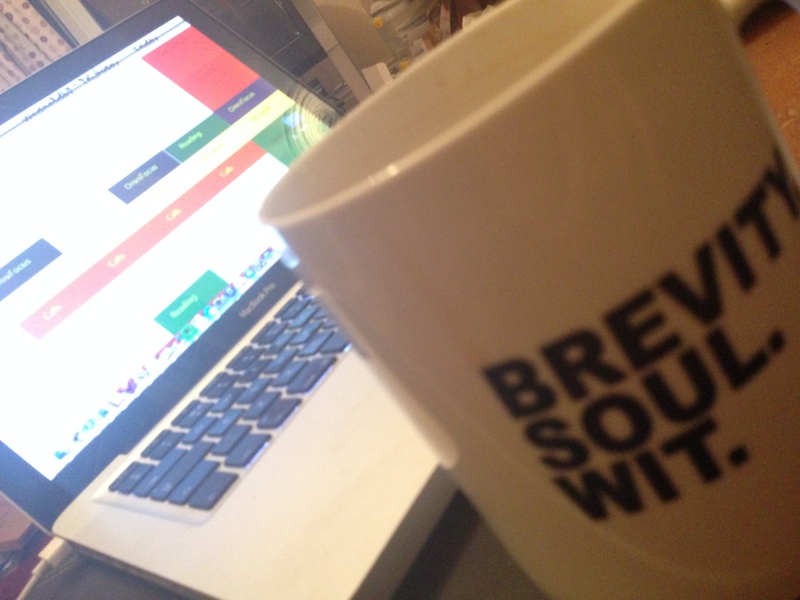
Or rather, look on. Here’s the final thing: a pattern for my week that I’ve made my desktop wallpaper on my iMac and, here, my MacBook. The MacBook and its screen are artistically blurred; the tea mug in the foreground is mistakenly blurred.

TBSmug

And below it is the actual pattern, albeit without any incriminating text.

Pattern-Week-No-Text

I won’t get any points for artistry. And without the incriminating text, I think there is only a little you can take away from the idea. But it’s a good little. And it’s this: I have put these many tentpoles into the week where at certain times I will do these certain things. That means on the one hand that I’m trying to guarantee that these get done but also on the other that there’s all that whitespace. That’s when the real work of the week will be done. If I planned it out too much, I’d be so often breaking the plan that I’d come to ignore it.

I think what I’m trying to create here is analogous to an ordinary office job’s schedule. Whatever you do, you have certain times in which to do it and there are points when you have to attend meetings or deliver reports. And as I say in The Blank Screen (US edition, UK edition) I believe that when you have a commitment like those, it takes away a lot of the churning stress. It adds other issues, but for that hour or whatever, you know you are doing what you have to do and you therefore don’t spend a lot of energy questioning it. You just get on with the gig.

The one other thing to say is that I’ve got to underline the word pattern. This is what my week should look like, it is the pattern for the future. And I know it won’t be like this. For one thing, I’ve planned out here 05:00-15:00 which I’m finding is a good amount of time to work both in when I’m at my best and in how much I can get done. But this coming Thursday, for instance, I’m definitely working until 21:00 so I might start either that day or Friday a bit later than usual.

But we’re halfway through January already and while I’m getting a lot done, I need to do more and the visual reminder right here on my screen, constantly, permanently, I am hoping that it will help. That it will keep me on track through the week and that it will also appeal to the visual side of me as I go.

We’ll see. But this is something new and just sometimes I suspect I need a new toy to help me work.

Maybe the five productivity apps you need but probably not

Two reasons to show you one article about five productivity apps: first, they might help you. But second, I'm fascinated how differently we all approach what we do. I very heavily use exactly one of the five applications mentioned here (iWork with Pages, Numbers and Keynote) and I can't fathom how anyone would leave out 1Password, Evernote and my beloved OmniFocus.

And I shudder at the idea anyone would include a fitness app. Shudder. Told you.

You know and I'm slowly realising that there is no one way to do what we want and that if there were, many of us wouldn't like it. I think I'm at the point where my work flows along just about as well as I can make it and if I pootle around trying other things, it is more curiosity than it is a necessity.

Still, I have a terrible weakness for articles such as Apple Gazette's 5 Apps to Boost Your Productivity.

That’s rubbish: positive vs negative thinking

I'm British and a journalist, cynicism comes to me a lot more readily than happy happy joy joy thinking. But the kicker for me is that it's quicker to think positively.

You know this already: when things are bad, you spend an awful lot of time brooding. That's too feeble a word: worrying, fretting, chewing, pondering, hating. When things are good, you get on to the next job.

I have also realised that it's true: I shouldn't make decisions and I definitely shouldn't act on them when I'm depressed. I still struggle with the concept of telling myself everything is wonderful all the time but I like the idea of head-down getting-on-with-it-all regardless.

Which is what I take away from this piece on The Simple Dollar about negative thinking:

You have to recognize when you’re telling yourself to make poor choices. For me, the best way to counteract this is to have a checklist of the things you’re working on and review it several times a day.

We’re done with CES – in both senses

There was probably quite a lot of talk at this year's Consumer Electronics Show in Vegas about technology that will help us be the more productive, creative, happy people we should be but I wasn't listening. Were you?

CES gets feted as a big deal in a lot of places – BBC News's Click looked like it was going to love it there from the brief bit I saw before changing channels – and certainly big announcements there are treated as world-changing.

But I lost interest years ago when I noticed that the world kept on staying pretty much the same.

Full personal disclosure: I worked on computer magazines for many years and was never allowed to go to CES. I can tell you this now: that was because I don't drink. It was regarded as a waste to send me. But maybe I was showing signs of disinterest even then. Maybe I was sober.

Because CES still talks the talk yet it's been a very long time since anything was unveiled there that you remember. We're talking home video recorders. CDs. There have been others since but I'm struggling here. And the show is now better known for big announcements of new products that then never go on sale.

So CES is an empty roar and it was so obvious to me that I wouldn't be talking to you about it that I can't even call this a big editorial decision. It was just CES, uh-huh, what else is happening? But now that the show is closed and the excited pre-event articles are being followed by post-event shrugs, I came across a description I just like a lot.

In the New York Times article about the Consumer Electronics Show, MIT's Natasha Dow Schüll summed it up exquisitely: “It’s like a high tech SkyMall”.