About that flirt-fave thing

I’ve been utterly unaware of such a thing until just now when I learnt of why people favourite tweets but the flirt-fave is sticking with me.

It’s worrying me, to be frank. I’m trying to remember every tweet I’ve favourited. Only Suzanne Vega has ever favourited me so that’s something for me to glow about later.

That previous story about reasons for favouriting linked out to many resources including this definition of my flirting:

Flirt Fav

Deployed almost exclusively on personal tweets about your undateability or selfies where your hair looks good. Also applies to people who fav any and all things you tweet, even if they are banal/stupid/something you’re going to delete in the next five minutes.

A Simple Guide to Twitter Favs – Jessica Roy, Time (4 February 2014)

I’m not liking the word ‘favs’. But I would more dislike the next entry, the Hate Fav, if I weren’t ignoring it and going la la la.

Read Roy’s full feature.

What does it mean when someone favourites your tweet?

Bugger-all.

Now, I’m telling you this despite the fact that I got very excited one day as I reached for my iPhone exactly as a notification popped up that Suzanne Vega had favourited a tweet of mine. That’s different. That doesn’t factor into any of the following whatsoever.

What’s in a Twitter fave? It’s a gesture – just the click of a button – that can mean any number of things given the context. We’ve developed an entire ecosystem of Twitter faves over the past few years. There’s the hate-fave. The flirt-fave. The fist-bump fave.

Now, researchers have gone one step further and developed what purports to be a scientific taxonomy of favoriting behavior, based on survey responses from 606 active Twitter users. The biggest surprise? Over a third of Twitter users said they weren’t even aware the favoriting function existed. Among the rest, only 3/4ths of users had ever favorited a tweet.
The researchers asked the remaining 290 users open-ended questions about why they favorited things. They coded the responses into a number of categories, and the taxonomy above was born.

The most popular reason for faving something? People simply liked the tweet. For many people it’s analogous to Facebook’s “like” button. Not surprisingly, bookmarking things for later reading or recall was the second most popular reason.
Others used it as a conversational feature, to let someone else know they had seen their tweet, or to signal agreement. 25 people favorited tweets that made them feel special. Six people favorited tweets but had literally no idea why they did so.

What Does it Mean When Someone Favourites Your Tweet? Here are 25 possible answers – The Washington Post (4 June 2014)

Actually… I like the sound of that ‘flirt-fave’.

Via Katharine D’Souza

The Complete History of Android

Or near enough. There are reasons why the earliest days of the phone software will never been told and – this is the bit that interested me – there are reasons why the history has to be written now because soon so much of it will be lost.

Nonetheless, you do have to like Android. I managed about 10,000 words of this 40,000 and it is interesting, I just had little reference: I can’t remember which Android versions I’ve tried, I just have this vague memory of surprised how slow and unfinished they all seemed. Plus the article is very in favour of Google’s apparently very fast development cycles where it sounds to me like a cacophony of trying everything, then trying to fix everything, and just possibly noticing something that happened in 2007.

But the site Ars Technica has been promming ahead about this article and it is the big deal they say: they’ve done a good job and I’m fascinated by the top where they explain why it had to be done right now. Have a read, would you?

Save your emails into Evernote for quicker searching

I’m not convinced by this because Mail in OS X is quick at finding things but I can see a lot of advantages to saving emails into Evernote because it’s a good pot for all things. It’s a good place to save everything and know that it’s all there, to know that everything you save is therefore everywhere you go.

But the official Evernote blog is persuasive about all this – and has a lot of tips for how to do it. Take a read, would you?

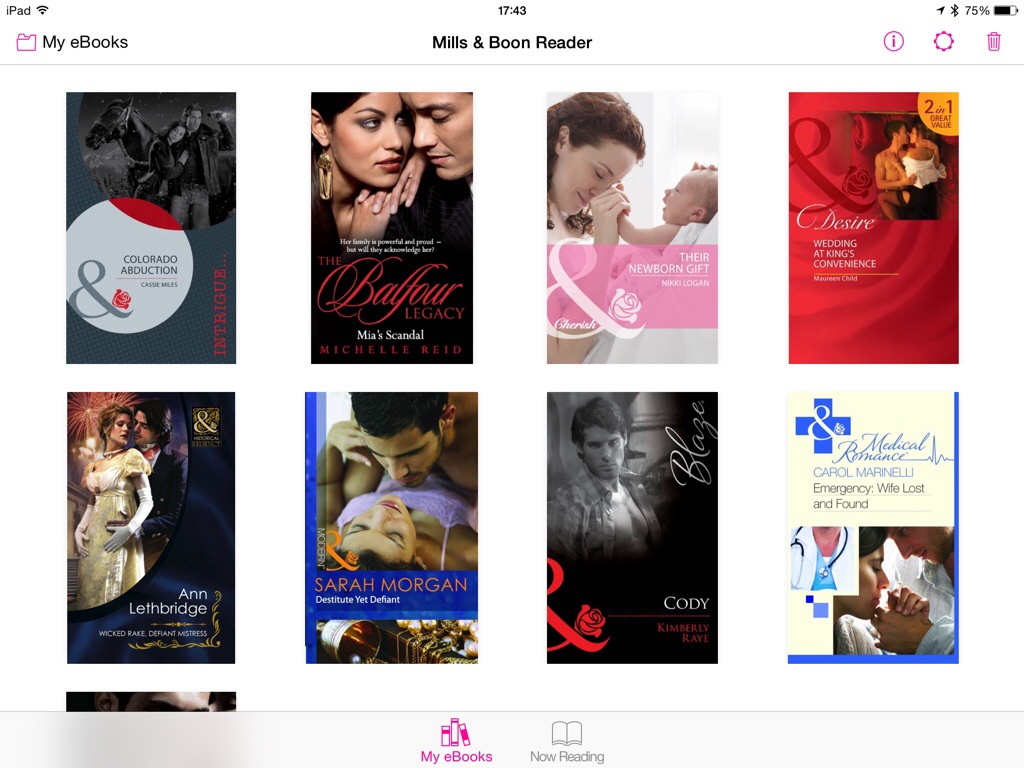
Mills & Boon ereader

20140615-180935-65375074.jpgDon’t we have enough ereaders? Alongside the hardware ones like Kindle, Nook and Kobo, we have the software ones: you can read Kindle books on iPads. And iPads have iBooks.

That’s my personal favourite: iBooks. The range of titles available is clearly much smaller than on Kindle but wherever a book is on both, I’ll buy the iBooks version. Even if it costs a little more. It’s only ever a little bit more and the reading experience is worth it. Kindle feels very clunky-ugly to me, like you’re accepting a substandard product in order to get the convenience of an ebook. Whereas iBooks just feel like books.

So I think we’re well served by iBooks and it’s pretty clear that we are very well served in volume by Kindle. What we aren’t doing is making enough money for publishers. Amazon takes money from the publishers for Kindle, Apple does the same for iBooks. Mills & Boon has decided to circumvent that by selling its own books in its own reader.

I’d be surprised if they also took the titles off iBooks and Kindle but you would certainly make the publisher happiest if you bought from them and you then read their books in their reader.

It’s not a bad ereader, either. It’s basic and it feels like you’re reading a PDF chopped up into pages but maybe you are.

What’s less clear is how much the books cost compared to other services. It’s a clunky process to sign up: you need both a Mills & Book account and an Adobe ID; I have an Adobe ID but it wasn’t recognised and I got a bit bored schlepping through setting all this up again so I admit I stopped.

I’m reminded of UltraViolet: a bunch of companies decide they don’t like paying Apple a cut so they go their own way but can’t quite pull it off. It’s as if the companies can’t agree with each other so users end up having to log in here and there and elsewhere. The need for both a Mills & Boon ID and an Adobe ID is that kind of thing.

If you’re a fan and you already have a Mills & Boon account, I’d have a go at signing up but then compare prices across all the services. I’m seeing prices vary from free to £3.49 and can’t fathom a pattern to it.

But the Mills & Boon ereader is free: you can get there here now and it comes with a few books.
Five Reasons to Read Your Work Aloud

Script writers will often get a bunch of actor friends around to read a script – I’ve done it myself – and it is specifically to make sure that the dialogue sounds real. You get the bonus of the actor’s input, their ideas and suggestions, but really it’s to stop things sounding bad.

I’m not convinced. They’re your friends and they’re actors, they are going to do the damnedest to make your words sound good.

But then I am a dialogue man, it is the thing I do. It’s everything else I’m rubbish at.

Nonetheless, I have now been persuaded that there is a benefit to hearing your words aloud – but it’s your prose words, and it’s you speaking them all:

Reading stuff aloud forces each and every word to earn its keep. This is why you must read it yourself, rather than getting some voice-software programme to do the honours. The very act of rallying all those small muscles and making sounds rise up out of your voice-box changes your perspective. You’re forced to say every single word. Suddenly, you’re not so inclined to hand free passes to superfluous, inappropriate or just plain stupid words, sentences, paragraphs or even whole sections.

Five Reasons to Read Your Work Aloud – Jason Arnopp, INT. JASON ARNOPP’S MIND – DAY/NIGHT (14 June 2014)

The other four reasons are smart too.

Here’s how well I know the story of the ⌘ symbol that has come to mean so much to Apple users – because we use it so very much – and to mean absolutely nothing to us – because we barely think about it. I used to have a white sweatshirt that had a ⌘ icon on it. Loved that.

Loved it so much I wonder where in the world it has gone. I do know where in the world I got it but unfortunately you can’t still get them. (But keep an eye on the website of Susan Kare, famous icon designer who didn’t design this one. She did pick it, though, and that’s the story of the ⌘:

Known sometimes as the St John’s Arms, it’s a knot-like heraldic symbol dating back in Scandinavia at least 1,500 years, where it was used to ward off evil spirits and bad luck. A picture stone discovered in a burial site in Havor, Gotland, prominently features the emblem and dates from 400-600 AD. It has also been found carved on everything from houses and cutlery to a pair of 1,000-year-old Finnish skis, promising protection and safe travel.

It’s still found today on maps and signs in northern and eastern Europe, representing places of historical interest. More famously, though, it lurks on the keyboard of almost every Apple computer ever made—and in Unicode slot 2318 for everyone else, under the designation “place of interest sign.”

What is Apple’s command key all about? – Tom Chatfield, Medium.com (13 April, year uncertain)

Read on at the full article – and if you find my sweatshirt, please let me know. Last seen in Paris, if that helps.

Share and share sort of, a bit, kinda alike

20140615-121520-44120762.jpg

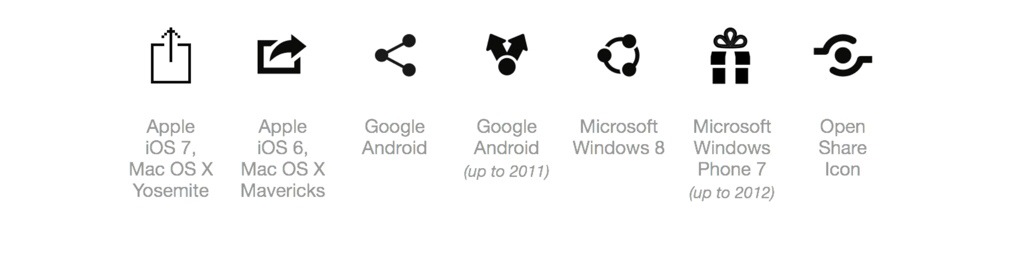
If there’s one question I get asked about how to do things online, well, actually, I don’t know what it is, I haven’t been keeping track. But I do very often get asked how to send somebody something. It’ll be how to send a photo, how to forward a webpage, all sorts of things and the answer always begins “You see that ‘Share’ icon?”

Unfortunately their response nearly always begins with “What ‘Share’ icon?” because there are so many and, arguably, none of them really sing out to you as meaning the thing by which you show somebody something. I think the Apple one up there, the square with an arrow bursting out, is the clearest but I am also certain that I think this only because it’s the one I see most often.

Min Ming Lo sees more of them: that image above is from his blog where he says:

What do each of these symbols have in common? They are all trying to convey the exact same action – share! Sharing to a social network or via email is a ubiquitous action nowadays but designers have still not been able to reach a consensus on what symbol to use to represent it. Not only does each major platform use a different icon, but they’ve each witnessed changes over the years.

I have spent sometime thinking about this, trying to figure out which symbol best conveys sharing to the user.

Share: the Icon Nobody Agrees On – Min Ming Lo

He does come to a kind of conclusion. But it’s the journey that’s worth the read, especially when you see the strange ideas different companies have for what icon to use.

Weekend read: “Only Apple”

Chiefly because I’ve been reading this and it’s the weekend, let’s have a Weekend Read. This is an interesting and chunky piece by John Gruber of Daring Fireball – I do just like the name – about where Apple stands today and specifically about one recurring issue. Apple head Tim Cook has apparently taken to repeating the phrase that “only Apple” can do various things that it’s doing.

Sounds like typical marketing guff to me. Apple uses words like “magical” a lot and everything is “incredible” so I do rather tune that stuff out. But Gruber argues that there is a point, that there actually are things only Apple can do at the moment.

It’s all to do with how Apple controls its own hardware and software so it really controls the entire experience of getting and using its stuff. If something doesn’t work, it’s Apple’s fault. If something works brilliantly, it’s Apple’s fault. The suggestion, especially from Cook, is that there is simply no other company that is doing this on this scale and with this success.

Is this true, though? Is Apple the only company that can do this? I think it’s inarguable that they’re the only company that is doing it, but Cook is saying they’re the only company that can.

I’ve been thinking about this for two weeks. Who else is even a maybe? I’d say it’s a short list: Microsoft, Google, Amazon, and Samsung. And I’d divide that short list into halves — the close maybes (Microsoft and Google) and the not-so-close maybes (Amazon and Samsung).

Only Apple – John Gruber, Daring Fireball (13 June 2014)

Read the full piece for a careful, weighed examination of whether Apple is really different to those – and why it’s important.

The internet did not kill newspapers

Yeah, right. But not so fast. Matthew Gentzkow of Chicago University says they were dying anyway.

His full paper Trading Dollars for Dollars: The Price of Attention Online and Offline is restricted to academic subscribers and you’re not fussed enough but The Guardian had a look and says his reasoning is that we make three mistakes in our assumptions:

Fallacy one: Online advertising revenues are naturally lower than print revenues, so traditional media must adopt a less profitable business model that cannot support paying real reporters.

“This perception that online ads are cheaper to buy is all about people quoting things in units that are not comparable to each other—doing apples-to-oranges comparisons,” Gentzkow writes.

Online ad rates are typically discussed in terms of the “number of unique monthly visitors” the ad receives, while circulation numbers determine newspaper rates.

Several different studies already have shown that people spend more time with newspapers and magazine than the average monthly visitor online, which makes looking at these rates as analogous incorrect.

By comparing the amount of time people actually see an ad, Gentzkow finds that the price of attention for similar consumers is actually higher online. In 2008, he calculates, newspapers earned $2.78 per hour of attention in print, and $3.79 per hour of attention online.

By 2012, the price of attention in print had fallen to $1.57, while the price for attention online had increased to $4.24.

Fallacy two: The web has made the advertising market more competitive, which has driven down rates and, in turn, revenues. That, says Gentzkow, just isn’t so.

Fallacy three: The net is responsible for the demise of the newspaper industry. No, writes Gentzkow, the popularity of papers had already significantly diminished between 1980 and 1995, well before the internet age.

And, he finds, sales of papers have dropped at roughly the same rate ever since. He concludes: “People have not stopped reading newspapers because of the internet.”

Newspapers’ decline not due to the rise of the internet, says professor – Roy Greenslade, The Guardian (13 June 2014)

That looks to me like fallacy #1 had some work done on it and the other two were just chucked in with a so there.