All artifice just script away

Last week I was asked why I read other people’s scripts. For one brief, rather happy moment I thought the fella might be asking because I am such a fantastic writer that I have no need of learning from other people.

No, he said, I mean why read the scripts when you can just see the bloody film?

He had a point. Crushingly cruel as he was.

I do know many writers who will avoid the actual script if the film or the programme or the show has been made. The script is, as I completely understand, the detailed blueprint. It’s not the final show any more than a house is the sum of its elevation drawings or isometric projections.

And I’ve just now finished being one of the many judges on the Writers’ Guild of Great Britain’s radio awards. I can’t tell you which entries were my favourites and apparently I can’t even know myself which one has actually won. But I can tell you that some of us simply read all the scripts while others listened to all of the finished shows instead.

I can make you a strong argument for both. If you needed this for some test, I could stock you up with reasons to read the script and reasons not to.

You can imagine all of them except, I find myself hoping, one that matters rather a lot.

It’s quicker to read the script.

There. I’ve said it. I can read an hour-long script in about twenty minutes. A full-length feature film, say 120 pages, is maybe fifty minutes reading time at most.

I do read quickly but I never speed-read and I don’t skip anything, it’s just that I’m fast and scripts have very few words on the page anyway.

There is also this. I know in the first few seconds on page one whether I’m going to think it’s a good script. Recently I read a set where it took a page to get going and if we were in production I’d just kill those pages. But even then, they didn’t get going good enough: my first reaction was maybe harsh but definitely fair.

One interesting thing about reading other people’s scripts is that you come back to your own with a different perspective. Hopefully a better perspective but unquestionably different.

The trick is to read the ones by the fantastic writers.

Room 204

The other day I caught myself telling someone that I got my start in radio. I wasn’t lying to them, but not two hours before, I’d mentioned to someone else that I got my start in magazines. If you asked me now, then depending on the direction of the wind I might say radio, magazines, newspapers, BBC, college or in writing computer manuals. There was a bit of TV in there, too.

All of this is true: I was simultaneously doing all of these and the one I pick when you ask is not chosen chronologically. I don’t even really choose it, it’s just the one that I unconsciously know I’m leaning on for whatever you and I are doing.

I could defend that and anyway I don’t need to: you get it.

What I think is less defensible, is less reasonable and yet I know is still true is that I also want to tell you that I got my start in the Room 204 development programme from Writing West Midlands. It’s indefensible because I got on that for a year back in 2013. You can’t honestly call it a start when I’d already spent more than a decade on Radio Times, my first book was out and so were a couple of Doctor Who dramas.

Yet I’d recently lost that Radio Times work. I’ve been hired back since – would you believe they keep making the magazine without me? – and I was only ever freelance, but losing it was a big deal. Not so big that I didn’t just have to check what year when it happened, but at the time it was a blow.

So coming back home to Birmingham and learning of this Room 204 programme could reasonably have felt like a new start. I didn’t get on it that year and I believe I just squeaked in the following year. But I will always take a squeak, I will always take being a second or third or tenth choice. I’ve no problem with that at all.

And as I write to you now, my head is back in that office when I’d got on the programme and was having the first of three serious Room 204 consultations. I can see the room – you’ll never guess what number it was – and the people and the table.

Plus I can see me explaining about all of these different starts, all of these different things I was doing. In my head then and now, these were six major areas of work and I laid them out on the table like folders. I didn’t. But I felt like I did and I remember feeling a bit foolish as I’d talk about, say, fiction writing and would nod at the second invisible folder from the left.

This is all on my mind today because everyone who’s ever been involved with Room 204 has just been asked to spread the word about how it’s open for submissions again. Applications are now open for what will be the new 2019/2020 cohort. It seems to have come around quickly this time but I know I’ll be having conversations with people about it and I know I’m going to over-enthuse.

I promise you that isn’t over-enthusing because I’m exaggerating or paid. But it could be considered over-enthusing because I suppose it is actually possible to go through Room 204 and get nothing out of it. I think you’d have to put your back into it to achieve nothing and defeat all the efforts of organisers Writing West Midlands but you could do it. And I have seen people waste the time they get on it.

The trouble is that it isn’t a course. There isn’t a syllabus. It’s not for beginners and it doesn’t set out to teach you anything or pat you on the back when you write a poem about the ocean. Rather, each year and each person are given what they need to develop their writing career. That can well include getting you work or putting you in touch with people who may need you: It most definitely does include workshops and sessions and experts in areas your year’s cohort needs.

In my case, what it gave me during the year was that I got my head straightened out. I swear that by the end of this key introductory conversation, organiser Jonathan Davidson was also pointing at these invisible folders of mine. I remember him saying that, right, this one and this, you could do those today. That one at the end will take longer so maybe park it until you’ve got these others developed.

I love, utterly love, thinking of something and then doing it. The idea is the thing but the doing it is the other thing. I need them both and as I felt I was being more open with these people than I usually was with myself, they saw this in me. Consequently where I understand many Room 204 people left their first conversation with an idea of what to do next and maybe who to speak to, I didn’t.

Instead, I left that room with a To Do list of 40 specific steps to take to sort me out. I went in a mess who wasn’t writing, I came out straightened and ready.

By the end of that week, I think I’d done 20 of those things. By the end of the month, I know I’d done 39. All these years later, I’ve not managed the last one but it isn’t for want of trying. Well, it wasn’t for want of trying but now it is: it was to do with contacting someone or other who has never replied to me.

My year on Room 204 was ignition. And it was just a year, you do get just a year on this programme. At the end of mine, I tell you I was deeply upset at this great time being over. They do tell you, repeatedly, that once you’re on Room 204 you never really leave but bollocks. When your year is done, another 15 writers are starting, you’re gone.

Except you’re not.

A few months after my year finished, I needed some advice and I got it from Room 204 exactly as if I were still on it. That was a few years ago now and to this day, they still help me.

You can see why when they asked us all to spread the word that applications are open for the next year’s cohort, I wasn’t certain that I could be concise about it all. Let me try, before you go applying: you have to be a writer in the West Midlands of the UK, you can’t be a beginner – and you have to be someone that they can help.

You can see that I’m a fan. I hope you can also see why I sometimes think I got my start in Room 204.

Technically speaking

Yesterday, a woman at my bus stop chided me and I suppose the world, really, for what she referred to as the curse of modern technology. I couldn’t disagree with her: I had my head in my phone at the time. And I also wouldn’t disagree because if it weren’t for her nudging me, I’d not have noticed my bus come.

Only, at that moment I was texting someone to arrange a time for a mentoring session. On the bus to an event, I was checking out the running order and going over the bits I was due to do. I proof-read a short story of mine that I was due to email out, then I emailed it out.

So this is my work in my phone. So that’s this stranger at the bus stop and there’s also the fact that this week I’ve written more about really technical technology issues than I ever imagined I’d be interested in.

But it was when I got off the bus that I knew I wanted to talk to you about this. About how technology is vastly more than technical specifications and horrendously expensive prices and I think more so for writers than anyone.

Because I could tell you what the phone is and I know enough to explain how I have all of my work with me wherever I go but it’s not about the technology. It’s about what it does to us.

The bus stop woman was right about my being distracted, but not long ago I’d have been distracted with a heavy bag around my neck and half a dozen mains cables.

Today I can leave my office with my large-screen iPhone and an incredible forthcoming keyboard called a TextBlade. That’s my office in my jeans pocket. And I carry a pair of AirPods, wireless headphones, in another pocket. So that’s my entertainment too. I walk around physically lighter than I ever have and it makes more of a psychological difference than I ever expected.

It was the AirPods that did it. I’d just got them back after loaning them out for a week and now I popped them in as I ran to the event.

If I looked it up, I could tell you how AirPods work and I’m sure between us we could read comparative reviews of how they sound. But knowing that they sound good and reading that they work without wires, that you just pop these in your ears and there is no cord, that doesn’t tell you what they’re like.

AirPods are like Regina Spektor. They’re like The Beatles’ White Album.

Just freed of that cord, I strode through Birmingham surrounded by music and knowing every single thing I could need for work was right there in my pocket.

I was physically lighter and I felt mentally lighter, except that I was now also late, I’d mangled one of the text messages and I’d left three typing mistakes in the short story. Also it’s all battery powered and doesn’t last long enough. Plus it all costs so much.

But apart from that, writing tools today are bliss.

My hardest writing job

I do want to tell you about the single hardest thing I’ve done, and as soon as I type that to you I think of a few other things that would be a contender. But really I want to talk with you about how astonishing it is that something which was a stone in my stomach six days out of seven every week for 18 months could be so completely forgotten.

I mean, it was writing and it was in Radio Times every week back in 2005/6 when that magazine’s sales figures were just over one million and the estimated readership was three million. So it’s not impossible that you saw it. It’s unlikely, but it’s not impossible. If you did read every week of it, though, you’d still have completely forgotten about it because it was the smallest slice of nothing.

No exaggeration. It was perhaps 100 words in each issue and lived on a corner of the letters page.

What astonishes me is that I’d forgotten it entirely too.

Yesterday, I was on the Dot Davies show on BBC Radio Wales as an author and TV historian. It was in response to the news that some 7,000 people in the UK have a black and white TV licence. A bell rang. I think now that it was a Cloister Bell warning of dire trouble because for the first time in 12 years I remembered Radio Times and the TV Stats column. I remembered covering this topic in there.

Only a week ago, I was talking with someone about RT and told them that I’d written the On This Day in TV History piece for it. I can’t remember how long I did that but it was at least four years and every issue had a little nugget by me on each of the day’s listings page. I remember that, I’m proud of that, but I’d clearly suppressed TV Stats.

But I had a couple of hours between BBC Radio Wales asking me and my being on the Dot Davies show. So I searched. I’ve got RT on PDF up to the late 2000s so it didn’t take as long to search as this will sound, but I did go through 60 editions before I found it.

I can’t show you any. Each week was this 100 words or so but it would always be accompanied by a cartoon illustration and I didn’t do those. I said that six days out of seven I was in pain about this: you’ve guessed that the seventh day was when I delivered the copy and the strain was off until tomorrow. But there was also the pleasure of seeing what cartoonist Robert Thompson had come up with.

I’d get that pleasure twice, actually. I’d usually be shown his roughly-sketched proposal and then every week I’d open the issue to see the final illustration. I can’t imagine how hard a job it was to illustrate this stuff in an amusing cartoon fashion.

At the time, though, I was too full of how hard it was to write. The job was to think of a topic to do with television and then research or calculate some statistics to go with it. Find an interesting topic, figure out the details and then hope the result was worth publishing because otherwise it was scrapped and you started again. And of course still facing that same deadline.

Oddly enough, I have an idea that this one about how many people in the UK still had black and white TV licences was among the easiest. I can’t recall now whether I was specifically asked to find out or whether it was my idea, but I’m pretty sure that I just phoned the TV Licensing people and asked them.

The answer, by the way, was 58,000 people and I either calculated or was told that at that time in 2005 this was 0.2% of the licence-owning population. At this distance of 13 years, I can feel an echo of the relief that week.

When you’re writing something like this you can’t get too far ahead because there’s supposed to be at least some element of topicality. But also you should try to have a few ideas banked up and ready. Sod that. The joy of having filed that copy and not absolutely having to think of the next one for a couple of days was fantastic.

I do say days. Because I truly had bad nights because of TV Stats.

This all sounds overblown, I know, and especially so because I’ve had many columns and myriad deadlines. Yet this one is giving me the sweats again today, over a decade since it finished.

Precisely how many films were shown on terrestrial TV in 2005? How many shopping channels are there? What proportion of digital channel profits come from advertising and from our subscriptions? Just how many characters in EastEnders are self-employed compared to real life? Exactly what percentage of characters in Albert Square have owned the Queen Vic?

You’re curious about that last one, aren’t you? In 2005, the answer was that 6.5% of all major characters in EastEnders had owned that pub.

You see the job. Try to find something interesting, try to put a figure on things we’d all noticed like that turnover of Queen Vic owners. Oh! I remember proving that the murder rate in Morse was actually pretty much the same as the real-life number of murders in the Oxford area. That was because Morse ran in very short series each year where actual murderers tended not to take such long breaks.

Anyway.

Week after week. I should be able to rattle off the statistics of how many I did but I’m rebelling. It was something like 18 months and I won’t research any closer than that.

I’d rather tell you instead of one moment of relieved pride. I got the commission over email, I think, but there was to be a big meeting to decide how all this would be done. Here’s how much TV Stats buried into me: I can still picture that meeting. Where it was – BBC Woodlands in London, the second of three BBC buildings I worked in that was demolished – and also exactly who was there.

I can remember where I sat and who I faced. How’s this for research? I can show you that spot.

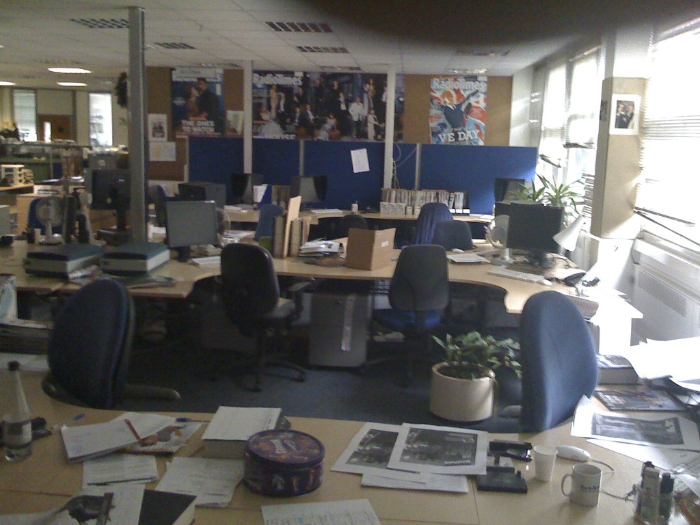
Radio Times office 2008

That shot is from 2008 and this was just before the place was demolished. So, first in one morning, I took a photo tour of the whole place. See that second chair from the left? I don’t remember whose that usually was but for this meeting, that’s where I remember sitting.

I can also remember that I’d misunderstood the brief and the example I’d brought had the text right but I’d illustrated it myself. I’m not then and never will be a cartoonist but I’d done some Photoshop work that was a graphical illustration of whatever statistic I’d found. I remember the art editor saying he didn’t know how to do what I’d done.

That was the moment of pride. And being gently told they had their own illustrators was the relief.

Oddly, I’ve no memory at all of TV Stats ending. I know it began because of a redesign on the magazine that saw the letters page bumped to the back of the issue. I imagine it ended because of the next redesign, but I don’t know.

TV Stats was one fraction of one job I had as a writer and yet it punched high above its weight because of how difficult it was to think of the bloody things. I did learn to write better because of it: I learned how to make the very most out of a sometimes flimsy statistic to produce an interesting read because there was usually no alternative and often no time.

And apparently it is all still lodged in my brain as it was waiting to pour out of me yesterday. I did get to bring up that 58,000 figure on BBC Radio Wales but I don’t think it particularly contributed to the piece.

There’s a bit of me that quite likes that.

Oh! One more memory? I spent at least seven hours one week calculating how much you would have to spend on Amazon to buy all the spin-off merchandise from children’s TV shows. You know it’s a lot but, sorry, I can’t either remember or find the figure.

But I can tell you that to this day Amazon notifies me each time there’s a new product to do with Dora the Explorer.

Revealing writing and reading

You realise that I am, of course, an incredible human being. And that’s despite being reduced to complete fanboy behaviour when meeting the writers of Lou Grant the other day.

(They were too polite to notice and anyway, I’m not likely to be within 100 yards of Santa Monica again any time soon, so it’s all a fuss about nothing.)

Anyway. I do genuinely think there is one thing where the nature of what I do gives me an unusual perspective. Writing always gives you perspective and I find that fascinating: the more you look within yourself, the more you reach other people.

But in this specific case, the perspective I get is because I’m writing a lot of journalism while also doing books and scripts. I like writing about writing, I adore exploring tools that make giant differences to my writing life and it’s great to get to write about those and share them.

I like and I have always cherished being both a writer and a journalist. I can’t actually speak to how good I am but I can know that having the two sides makes me better.

This week it also made me angry.

Last Tuesday, Apple launched many new products and did so with one of the firm’s typical big events. That’s all good: they do it well and they had plenty to say this time.

But.

You know Apple is this huge company and that it earns an incredible amount of money. The head of Apple’s entire retail arm, the part that includes 505 Apple Stores and the website store, came on to make a speech.

I’ve actually written a profile of her: she’s Angela Ahrendts and has an interesting background as well as a fascinating job. But you’ll notice I said ‘her’.

The second she stepped on stage I read some comment somewhere in the torrent of people following this event where they called her Miss Apple Stores or something like that. It wasn’t in the sense of a beauty pageant but it was meant to demean: she ‘just’ runs the shop.

Then I kept reading reports of the event which named her as Ms Ahrendts or wrote about what “the lady” said.

Nobody called Apple CEO Tim Cook “Master Apple”. Nobody called him “the gentleman”. No one says he ‘just’ runs a trillion-dollar company.

I’m glad to say that none of this was on display at AppleInsider.com where I was writing. But it was so prevalent across journalism and across twitter.

You can like Apple or dislike them, that’s up to you, but its audience craves new technology, new ideas. It craves new. And yet some of it sounds like it’s in the past.

Writing reaches into other people but what you write also shows them you.

Some 529 Not Out

Look at me there: I could not, just could not write a title that begins with a number. I had to contort that word ‘Some’ into it and I think that changes the meaning. If I were sure what it changed the meaning to, I might worry but if you don’t mind, I’d like to put all of this behind us and discuss 529 other topics.

As I write to you, it’s half midnight on Thursday 25 October 2018 and it’s not as if I’ve finished work, it’s more that I have to stop. I’m running a day-long workshop tomorrow for actors, musicians and journalists, and I’d like to be a teeny bit further along with the planning. Each time I do one of these, I rewrite the whole thing just to really get it all into my head and to freshen it up.

Tonight I want to add in a photo but considering the mistakes I’ve been making for the last hour, I’d probably end up photographing my thumb.

So the sensible thing is to stop, get some sleep and pick it up in the morning. There’s time, it’s sensible and practical.

Only, there’s also that 539 business.


I decided to read a script a day for 2018 and it’s fair to say that I’ve failed because so far I’ve read 539.

I haven’t read one tonight. Er, Thursday, I haven’t read one. I have a pain in my side from writing at this table for the last five hours, there is a bed calling to me from less than a metre away – this isn’t the most luxurious of hotels – and, oh, stop looking at me like that.

Okay, fine. Okay. I’ll read number 540. Because of that face of yours.

I’ve no idea what it will be as I’ve exhausted the short Danger Mouse ones.

But I do know this. I am writing a lot better this year. And there may have been some truly dreadful scripts. Yet I’ve been engrossed and exhilarated and sometimes upset to the point of tears too. And just occasionally, I’ve been a bit proud.

Such as now. I’ve read 530. I picked a short film script of my own because it was here and because I couldn’t remember anything about it. Also, it was short and you were looking a bit mad at me.

It’s not great. But the idea is and the script feels alive. I finished it wondering who I could pitch it to.

So on the one hand I do credit reading a lot of scripts but I also blame you for being so disciplined with my time. Can I go to sleep now?

Santa Monica

Zoning out

This is the earliest I have ever written to you on a Friday morning and it is also the latest. I’m writing at about 6am but I’m in Los Angeles and now realise that it’s about 2pm where I usually am in the UK.

Only, I thought I was extremely conscious of time zones because around half of the people I most work with are on the East Coast. Usually I can therefore deliver work to them early and to UK places right on time. Easy.

Except the UK being eight hours ahead and the East coast five hours, now I’m behind everybody and everything.

I’m shocked at how instantly I became adjusted to LA time. But I’ve done this before, you’ve done it before, I don’t know why this trip is different.

It is, though. This won’t sound like a good thing but it feels great: I feel like I’m in a bubble beneath everything. That’s definitely the word, beneath: the rest of the world seems to be going on above me as well as many hours ahead.

I should find that abhorrent and even writing it to you feels wrong, feels a betrayal of my usual self. And it’s not as if I’m on holiday: I am working as much as ever, just in Santa Monica. Whenever I’m not in meetings, I’m watching the clock trying to figure out how to fit the next thing.

So there I am, clock watching – in the best way, I’m not wishing this time away – and still I forget time zones.

I’d like to tell you something else I’ve forgotten, too, and I think it might be related. For just these few days I’m here, I’ve stopped worrying about Brexit. I’m working with someone who is just genuinely optimistic about life and as he stands there in Santa Monica sunshine, it’s impossible to not be lifted.

Mind you, I’m in the kind of gorgeous hotel you’d reject in order to have enough money to eat. For the first time in my life, I got on the plane in London and turned left. Later today, unless this time zone failure of mine reoccurs, I’m meeting some of my heroes.

And all of this is happening because I write. The things I think, the words in my head, are the direct and specific reason that I’m here. I’ve even been told that it was a Self Distract blog post that sealed the deal.

Writing is a scary career and no one can ever recommend it, but if you happen to know any of the teachers at my secondary school who laughed at me, do please give them a funny look from me.

To have and of not

It’s just you and me here so I’m going to confess something and you are not going to tell, okay? I used to have a profoundly deep crush on Darcey Bussell. Then during an episode of Strictly Come Dancing, she told some dancer that they “should of” done something.

I didn’t hear what they should’ve done because I was twitching too much. I don’t remember the dancer or the dance or even when this was. Yet that phrase switched my crush off like a light switch.

And yet this month when the Doctor said it in Doctor Who, well, I still twitched. But I didn’t switch off, I didn’t think much more than a pixel less of actor Jodie Whittaker and a fathom less of writer Chris Chibnall.

Maybe I’ve become inured to it. Maybe I accept that we’re on our inevitable way to having this nonsensical pair of words become a legitimate part of the language.

Or maybe I’m just not letting it switch off Doctor Who for me. It’s possible that I’m maturing, though I see no other evidence of this.

Also, it has been on my mind for six days straight and I needed you to help get it out.

But you have done and I thank you.

Just don’t tell Darcey. You pinky-promised.

Travelling in a fighter convoy

Since the 1980s, that’s what I have thought the opening line of Men at Work’s Down Under is: “travelling in a fighter convoy…” and not “travelling in a fried-out combie.”

Now, in my defence, I haven’t actually thought about the song in decades. And back when I did give it a bit of a ponder, I was more gingerly curious about what a vegemite sandwich might be.

Writer and lead singer Colin Hay now performs the song acoustically and you know how this goes, the song is revealed to be somewhat deeper than that original appeared. I do think that’s a measure of some superb writing, when radically changing the delivery of a piece works, when the material can be delivered in gigantically different ways.

But we’ve seen that.

Most recently there was Aha’s reworking of Take On Me which, slowed down, also clarified some previously mysterious lyrics. What was originally energetic and catchy proves to be arresting and even mesmerising in its new form.

Most famously, it’s the same with Mad World, originally a Tears for Fears track sung at lighspeed but then redone by Gary Jules.

https://youtu.be/4N3N1MlvVc4

Only, there’s something different about Down Under. I saw a live acoustic video of it a week or so ago and it’s stayed with me. More, yesterday Apple Music happened to throw the original at me while I was working.

And here’s the thing. That original has changed.

That didn’t happen with Take On Me, although I do now hear the lyric I kept missing in the original. I know to listen out for it but that’s not the same as changing that original, altering the sound of it.

Nor does Mad World’s slow remake alter how the Tears for Fears one sounds, except I do more appreciate the writing in it.

No, Men at Work’s Down Under was this jaunty 80s track with the daft video and now the same piece in the same way is somehow more serious. I can’t help it: I listen to that original and it’s like I finally get it.

Without distorting the original or loading it down with a weight it can’t bear, the acoustic one is just a plain rendition that reveals it was always serious and I can’t help but hear that now.

I should say I recently caught a snippet of an interview with someone, I imagine Hay but I wasn’t watching, where it was mentioned that no one notices the coffin being carried in that video. I think they said it was symbolising the death of Australian culture and I want to say I thought that was interesting but really I didn’t think at all.

Then I don’t want to say that Down Under was actually a Dylaneseque howling protest song yet I am sobered by it. Specifically by how I only saw the surface jauntiness and that this is like what happened to Bruce Springsteen’s Born in the USA. That’s another 1980s song and to this day there are people who think it’s pro-American.

It’s really a miserable track and the lyrics are as clear about that as can be. I’ve secretly liked how I got it and people including President Ronald Reagan didn’t. He used it as a campaign song, can you imagine that? Walking out to make a speech as a song about rancid poverty in America and the toll of the Vietnam conflict booms out of speakers.

Imagine a US President being dumb.

Well.

Down Under is not so stridently anti-American or rather anti-Australian but still I missed what strength it has. Again, don’t let me overplay this, I’m not dumping huge political import onto the shoulders of a pop song.

But have a listen. It’s a good song but it’s richer now.

Kirsten Bell in Veronica Mars

Now I wish I were writing Veronica Mars

There is no chance I’ll get to write Veronica Mars but what makes me ecstatic is that today there is slightly less of no chance. Because the show is coming back.

So, true, it’s already written and presumably by series creator Rob Thomas. And true, I have absolutely zero chance of making my television drama writing debut – I don’t count Crossroads – on this show.

But there is a series. It was over, then it was a movie, then that was over, now it’s back. Stuff writing, I’m getting popcorn, I’m ready.

I don’t actually know when it’s coming and I do actually know that this news is old. It’s been a month or even two since the return of Veronica Mars was announced but I wouldn’t believe it at first. I needed an awful lot of evidence and here’s one of the last little bits: series star Kristen Bell talking about it:

I’m a writer but I’m also a journalist and normally if you give me two credible sources plus some documentary evidence, I’ll believe something is true. Unless you’re in government. This time I didn’t because it was just too important to me.

Five years ago I wrote a piece called I wish I’d written Veronica Mars and the title says it all. Except while I could’ve written that at any time during or since the show’s initial 2004-2007 run, I was writing it then because we’d had multiple sources and documentary evidence that a film version was coming.

I wrote that piece partly because I couldn’t contain myself and partly because I was hoping aloud that around a year later I would be seeing this film and wishing I’d written it. Sure enough, four years ago, I wrote I still wish I’d written Veronica Mars.

This time I’m just going to take it for granted that I’ll like the new show this much. It stands a bit of a chance.

And that’s it, that’s all I wanted to exclaim about to you today. Except writing this, I’m conscious that I haven’t even said what Veronica Mars is. That’s not uncommon: if you try to describe the show it generally sounds so poor that you wonder how Rob Thomas managed to sell it. Veronica was a teenage detective and I want to write “but…” here, yet anything you say after that sounds like an apology or an excuse.

No excuses. No apologies. Veronica Mars is great.

Years ago, I remember someone insisting very seriously that The Bill was the greatest crime series ever made. And I remember telling her she should stay in more.

At the time I would’ve been thinking of Homicide: Life on the Street, Hill Street Blues, Between the Lines, I’d have run out of fingers and borrowed yours to continue listing more forever. Today I’d just show her Veronica Mars.