Year planning in May

If you didn't even make it in time to have New Financial Year's Resolutions, do it now. Sketch out your next year and make me feel more sensible for how I'm doing it.

I did a rough year plan last December or perhaps really I had a thought about making a rough plan. I definitely helped others with theirs and they definitely tried to help me back, but I resisted. Mostly through being a bit focused on the month, the week, the day, the hour and occasionally the minute plan. But also because a year seemed a bloody big thing.

The year has got shorter now we're in May, but I'm not specifically planning 2014, I'm looking 12-18 months ahead now. And the reason I think I can do this is that my work has changed. I'm much more tied to a calendar now: I just did a gig at a festival and that was on a certain day, it was arranged many months before. It used to be that everything I did was task-based in that I'd get some work, I'd do it, I'd go straight on to the next. There were usually deadlines but they were always short ones and the quicker I could turn something around, the better.

With festivals and events taking over, I feel like I've got these tentpoles ahead of me. I can't do much in early October, for instance. Knowing that now, here in May, is weird but I like it. And whenever you find something you like, enjoy it, exploit it a bit. I've already used that October tentpole to say I can't do this other particular thing until December. I know that the two events need to be separated by a fair time, I know how long it will take me to finish up one and get the other going, I know how much time that will leave me for the short-term work I rather live for.

When did I get this organised? Today. And the thing with being organised around tentpoles in your calendar – I'm just making up terms now, aren't I? – is that the constraints are liberating. Knowing that I've just this week done one event means I can wipe that from my head and concentrate on one I've got for 31 May and then I can forget that until the next one in August.

I'm losing the anxious uncertainty I had when people would ask if I were available for something and I'd always say yes regardless of how hard or sometimes impossible that would make my month.

I keep saying this. As writers, we create characters and we set rules – our blind watchmaker can't suddenly see just because it solves a plot problem – and setting ourselves just a few rules, a few plans, helps.

Go plot out your next 12-18 months, would you?

Wonderful

I'm British, I can't do this. Actually, I'm British so that means I can and I do but I don't tell anyone. It's just the way we are. But I'm going to tell you. You've got that face, I can tell you anything.

Alongside my email Inbox, I have the things I recommend in The Blank Screen (UK edition, US edition): a Follow Up mailbox and an Archive. Also a trash and a junk and I'm both ruthless and quick about sending things to either of those. I do also have a Travel Bits mailbox that holds train and plane ticket emails. Much as I use and rather adore TripIt, it recently couldn't parse a plane ticket and there are some operators like National Express who want to see their own format emails when you wave the phone at you.

None of this is difficult to tell you.

This is.

I also keep an email mailbox called Wonderful.

When an email arrives that really lifts me, I'll put it in there and cherish it. Certain commissions I've longed for. Gorgeous messages from people about enjoying The Blank Screen (UK edition, US edition). There's more, I'm not telling you. But you get the idea. Lately I've also started an Evernote notebook called Wonderful for things like this that don't arrive via email. Letters I have scanned in anyway, I'll put in there. Tweets, facebook messages. I'm not very consistent but I do it.

And the result is that every now and again I can go take a look and feel better.

If you want to get techy about it, I suppose I could just tag these things with the word 'wonderful' and leave them wherever they be, but I like having this growing pot of people I like saying the most amazing things. When you see them all lined up like that, it's overwhelming enough that I can't process it so easily. I can't rationalise that she was just being polite, that he wanted something, that they got the wrong man.

So I want to recommend this to you.

Do it yourself, go on. Have your own Wonderful inbox. Just pretend like it was your idea and not mine, okay?

Pattern Weeks #5 – the conclusion(ish)

Pattern Weeks #5. (Here's #4 and if you want to hear my Secret Plan to Take Over the World, here's Pattern Weeks #1.) Now, read on. So, did it work?

No.

I'd like to say that my laying out a pattern for a typical week failed only because I haven't had a typical week in a while. This is true. Not only have I had many talks or other events but I have to factor in the day beforehand when I get paralysed with nerves and the ten minutes afterwards that I am (usually) elated. (I've done 71 gigs since records began back in late 2012 and 70 of them went brilliantly. That 1 makes my nerves churn and the 70 also make my nerves churn.)

But it really failed because I let it.

I've been more Pavlovian lately, usually when I get an iMessage: I seem to be good or at least better than I was at not reacting to emails, at not even reading emails so instantaneously, but not iMessages. It may be the red notification badge. I've switched that off on Mail but haven't seen how to do it on iMessages.

Actually, I can't see how to do it on Mail either. On my office iMac, it's bliss: no red badge unless I get an email from someone I've said is important or urgent. On my MacBook, not so much. I can choose between a red badge for everything or a no red badge for anything, I can't see how I did it in my office.

Also, by the way, I've let myself get distracted by tiny puzzles like that.

Overall, though, the problem is more that working hard is hard work. It has to be done, I want to do it, but it's still hard. Some days are harder than others. And if you think I'm now saying the most obvious thing you've ever heard, here's one to top that: I must get down to working harder.

I'm going to restart the Pattern Week – and that is one good thing about all the productivity stuff I tell you, you can pick it up and start again any time – and I'm going to get on with it.

I just felt I should be honest with you and admit failure. Not defeat, not yet, but failure.

Now this is handy – iOS compass trick

I don’t often publish what you might call tips and tricks here. Too often I read features called something like “10 Things You Didn’t Know Your iPhone Could Do” and one of them will be “It can make phone calls!”. But I read this one and actually said aloud: “That’s handy”. So I want you to know it too. It’s about the compass in every iPhone with iOS 7:

With the needle locked into a position, straying from the set (locked) direction will cause the compass to turn red, indicating the degree of sway and helping to course correct. Whether you’re directionally challenged or not, this is helpful for navigation for many reasons.

Lock the Compass Needle Position on an iPhone for Better Navigating – OS X Daily

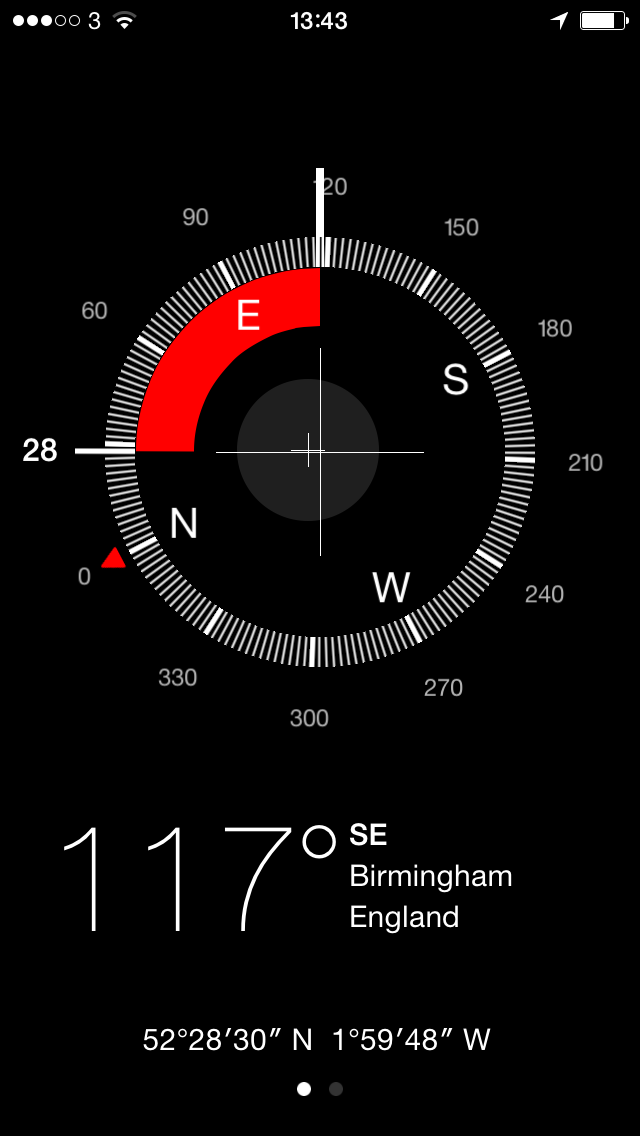
So I just pointed my iPhone toward Birmingham city centre, tapped on the compass and turned away to one side. This is what the screen shows me now:

compass


So you line up on what you want to get to, tap on the centre and every time you deviate from the route, you get that big red warning. OS X Daily goes through the instructions in more detail but that’s it really, open Compass, point, tap, walk.

David Sparks on using technology to help meetings

The best use of technology for when you’ve got to go to a meeting is pulling the battery out of the back of your phone. Or ‘accidentally’ thumbing it into Airplane Mode. That’s not David Sparks’s advice, though I’ve read his books and he’s as up for avoiding unnecessary meetings as I am. Assuming that you want to go to them and you want to get things out of ’em too, he has recommendations.

There is a certain dance that goes on between people trying to set a meeting via email that makes me crazy:

David to Hans: “Let’s do lunch”
Hans to David: “Great. When is good?”
David to Hans: “I’m not sure. You go first.”
Hans to David: “I’ve got some time next week.”
David to Hans: “How about Tuesday at noon.”
Hans to David: “That doesn’t work. Give me another day.”

This just goes on and on. Instead, when I’m setting a meeting with a single person, I write and say, “Let’s have lunch together. How about next Wednesday at Cardiac’s House of Cheese at 11:45AM?” By putting not only the idea of lunch in the first email but also the details, I’m usually able to cut out a lot of later email traffic. The surprising thing is that most people accept my proposal in their very first reply.

Scheduling success: four tech tricks for planning meetings – David Sparks, Macworld, May 2014

Since the day I read that in a book or I heard the fella say it on the MacPowerUsers podcast, I have done exactly that and it has worked for me exactly like that.

Try his other three suggestions, though: they cover scheduling meetings, preparing time for them and also a very nifty TextExpander way of writing emails reminding people about the meeting and its agenda.

Annie Dillard: how we spend our days is how we spend our lives

Jack London claimed to write twenty hours a day. Before he undertook to write, he obtained the University of California course list and all the syllabi; he spent a year reading the textbooks in philosophy and literature. In subsequent years, once he had a book of his own under way, he set his alarm to wake him after four hours’ sleep. Often he slept through the alarm, so, by his own account, he rigged it to drop a weight on his head. I cannot say I believe this, though a novel like The Sea-Wolf is strong evidence that some sort of weight fell on his head with some sort of frequency — but you wouldn’t think a man would claim credit for it. London maintained that every writer needed a technique, experience, and a philosophical position.

The Writing Life – Annie Dillard (UK edition, US edition)

Dillard examines the idea of order – “a scheduled defends from chaos and whim” – but I think she’s less recommending that we set a timetable than that we become aware of what we’re doing. I want to rush you every line from her book but instead I’m going to be honest first and say that I learnt of it from an absorbing article on Brainpickings.org. Read that for more of Dillard’s writing and writing style.

Just five more minutes – or how we don’t like to stop

Even I think you need to stop working some times. For a bit. Not for long, obviously. But I work for myself and I wouldn’t swap this job for anything – seriously, I get to natter with you, what would I want to replace this with? – so you would imagine that people with office jobs don’t look at it the same way. I didn’t when I had an office job. Well, I did a bit. But the poll company Gallup says only 2 out of 10 workers in America think working late is a bad thing.

They were asked specifically about working remotely, so that’s checking your emails and using your phone rather than having to stay in the office, but still, it’s only 21% of those surveyed who said nah. Don’t wanna do that. Actually, it was 8% who folded their arms and 13% who were disgruntled.

While a strong majority of working Americans view the ability to work off-hours remotely in a positive light, far fewer say they regularly connect with work online after hours. Slightly more than one-third (36%) say they frequently do so, compared with 64% who say they occasionally, rarely, or never do. The relatively low percentage who check in frequently outside of working hours nearly matches the 33% of full-time workers who say their employer expects them to check email and stay in touch remotely after the business day ends.

Among those who frequently check email away from work, 86% say it is a somewhat or strongly positive development to be able to do so. However, this is only slightly higher than the 75% of less frequent email checkers who view the technology change positively. Even among employees for whom staying connected is compulsory, 81% view this development it in a somewhat or strongly positive light.

Most US Workers See Upside to Staying Connected at Work – Gallup (30 April 2014)

There is a stereotypically predictable slant in that young men are more likely to be happy with checking their emails EVERY BLOODY SECOND but also broadly the more you earn, the more you’re happy about working out of hours.

This is an American survey so it could of course be different here in the UK but one suspects not. And one suspects that there are few employers who won’t take advantage of this.

Turn up the music, I want to work

Penny Anne O’Donnell of Relaxation Direct came to one of my The Blank Screen workshops and in the Twitter nattering that’s followed since, we were in a conversation about the use of music while working. Her advice:

It depends on the music, learning style and ability to focus. Baroque and Mozart are conducive to focused attention

@relax_therapy

Right now I’m listening to Hallelujah by kd lang from Hymns of the 49th Parallel and – no, wait, now it’s Useless Desires by Patty Driffin. I have an iTunes playlist of music that I especially love. Just single tracks that have got in my head and stayed there, that I have played so often and so much on repeat that I can hear every instrument in my head. I call it Discoveries and there are current 146 songs in it, apparently the lot lasts me 9 hours 34 minutes. Very often now I will start that playlist on shuffle and get to work.

Sometimes it makes me concentrate tremendously, sometimes it doesn’t. (Like now when I’m very conscious of it all because I’ve said to you what’s on. Currently Four Leaf Clover by Abra Moore. Some years ago I discovered Lilith Fair and there is a lot, I mean a lot, of music from that in this playlist.)

When it stops me concentrating, I’ve recently turned to iTunes Radio. You can currently only get this in America but I have both a US and a UK iTunes account so I can swap to it and listen away. At first it was tremendous but lately there’s ever more ads in it and I could get those from commercial radio here. For some reason I can take spoken word, I just can’t work through an ad. I used to listen to BBC Radio 4 all day but it got strange. I’d not consciously realise I’d heard a minute of it but I’d go switch on the TV news and know every detail of every story.

I’d like to now take you through my every musical thought – I’ve started skipping just so I can tell you that next up is You, Me and the Bourgeoisie by The Submarines and then Monday Morning by Liz Lawrence and I Know I Know I Know by Tegan and Sara – but there has to be a better way. A more statistically useful way. And by chance, Lifehacker this week decided to look back into its archive for exactly this purpose:

This week, we’re reviving a particularly old post listing some of the best music and sounds for productivity, as crowdsourced by the Lifehacker commentariat of 2009.P

Does Music Really Make You More Productive? The answer falls somewhere between “Listening to Mozart makes you a genius” and “Just be quiet and work.”P

The most often cited study into the question of music’s effect on the mind involves the so-called Mozart effect, which suggests that listening to certain kinds of music—Amadeus Wolfgang’s classical works, in particular—impacts and boosts one’s spatial-temporal reasoning, or the ability to think out long-term, more abstract solutions to logical problems that arise. The Mozart effect has been overblown and over-promised, and even outright refuted as having “bupkiss” effect, but that doesn’t mean a great mind-juicing playlist can’t be created.

The Best Sounds for Getting Work Done – Lifehacker

Check out the full article because it might be a bit inconclusive about the answer to whether you can work better with music, but it does have a lot of links out to different types you can try.

I’m now on Mississippi by Sheryl Crow, incidentally. Want my complete Discoveries playlist? You’re mad. But here it is:

Across the Universe (Fiona Apple)

Afortunada (Francisca Valenzuela)

After All (Dar Williams)

Ageing Superhero (Newton Faulkner)

Another Green World (Brian Eno)

Answer Me (Barbara Dickson)

Backstreets (Bruce Springsteen)

Because the Night (Patti Smith)

Been It (Cardigans)

The Bell & the Anchor (Catherine Feeny)

Better Love Next Time (Caryl Mack Parker)

The Big Bang Theory theme (full)

Bitch (Meredith Brooks)

Boom Boom Boom (The Iguanas)

Born to Hum (Erin McKeown)

Brand New Day (Ryan Star)

Breathe (Alex Murdoch)

Brilliant Disguise (Bruce Springsteen)

Brimful of Asha (Cornershop)

Broadcast News

Building The Barn (Maurice Jarre)

By Way Of Sorrow (Cry Cry Cry)

Change of Time (Josh Ritter)

Dance Me To the End of Love (Live) (Leonard Cohen)

Dance The Night Away (The Mavericks)

Devils & Dust (Bruce Springsteen)

Don’t Come Around Here No More (Tom Petty & The Heartbreakers)

Don’t Let Your Feet Touch Ground (Ash Koley)

Don’t Look Back (She & Him)

Dry the Rain (from High Fidelity) (Beta Band)

Dulce (Francisca Valenzuela)

The Enterprise (Star Trek) (Jerry Goldsmith)

Everywhere I Go (Lissie)

Fall At Your Feet (Crowded House)

Fall to Pieces (Avril Lavigne)

Find The River (R.E.M.)

Fine (Julia Fordham & Paul Reiser)

Fools Rush In (She & HIm)

Four Leaf Clover (Abra Moore)

Hallelujah (k.d. lang)

Handle With Care (Traveling Wilburys)

Handy Man (James Taylor)

He Thinks He’ll Keep Her (Mary Chapin Carpenter)

Hero (Regina Spektor)

Ho Hey (The Lumineers)

Hounds of Love (Kate Bush)

How Deep is Your Love (Sharleen Spiteri)

I Believe (When I Fall In Love It Will Be Forever) (Stevie Wonder)

I Don’t Wanna Be The One (Patricia Conroy)

I Don’t Want A Lover (Texas)

I Know I Know I Know (Tegan And Sara)

I Turn My Camera On (Spoon)

If Anyone Falls (Stevie Nicks)

If I Can’t Have You (Sharleen Spiteri)

If You Could See (Lucy Kaplansky)

In Demand (Texas)

An Innocent Man (Billy Joel)

It’s Sonata Mozart (The Kids from Fame)

It’s Too Late (Carole King)

Jack and Diane (John Cougar Mellencamp)

Jive Talkin’ (Ronan Keating and Stephen Gately)

King Of The Mountain (Kate Bush)

Kiss Me (Sixpence None the Richer)

Let Loose the Horses (The Rescues)

Life Boat (Miranda Lee Richards)

Linger (The Cranberries)

Linus and Lucy (Vince Guaradli Trio)

Living Next Door to Alice (Smokie)

Love Is Everything (k.d. lang)

Mary’s Prayer (Danny Wilson)

Memories Of East Texas (Michelle Shocked)

The Men Below (Latin Quarter)

Michael And Hope’s New Baby (W.G. Snuffy Walden)

Mississippi (Sheryl Crow)

Monday Morning (Liz Lawrence)

Moonlighting Theme – Al Jarre (Al Jarreau)

Muredete la Lengua (Francisca Valenzuela)

My Freeze Ray (Neil Patrick Harris)

Never Coming Back (Lynn Miles)

New Soul (Yael Naim)

New Year’s Prayer (Jeff Buckley)

Ocean and a Rock (Lisa Hannigan)

One and Only (Mary Black)

One Small Day (Midge Ure)

Ordinary People (Chantal Kreviazuk)

People Have the Power (Patti Smith)

Queen of Hearts (Dave Edmunds)

Radio Radio (Elvis Costello and the Attractions)

Railroad Man (Eels)

Real Gone Kid (Deacon Blue)

Rise Again (The Rankin Family)

Runaway (The Corrs)

Runaway Train (Soul Asylum)

Rush Hour (Jane Wiedlin)

Sad Eyes (Bruce Springsteen)

Sanctuary (Donna De Lory)

Self Control (Laura Branigan)

She Will Have Her Way (Neil Finn)

Shine Silently (Nils Lofgren )

Simon & Simon (extended)

Simple Song (The Shins)

Sleep (Texas)

Soak Up The Sun (Sheryl Crow)

Soda Jerk (Buffalo Tom)

Somebody That I Used to Know (Gotye)

Somebody That I Used to Know (Parody) (Key of Awesome)

Someday We’ll Be Together (Vonda Shepard)

Something New (Tanita Tikaram)

Space 1999 Year Two extended

Speaking With The Angel (Cry Cry Cry)

St Elsewhere (full theme) (Dave Grusin)

Stargate Universe

Stay (Cyndi Lauper)

Stay (Lisa Loeb)

Steppin’ Out (Joe Jackson)

Stop! (Erasure)

Summer in the City (Aztec Camera)

Sweetest Decline (Beth Orton)

Theme from Mission: Impossible (Adam Clayton & Larry Mullen)

The Thief (Lucy Kaplansky)

Thieves (She & Him)

(This Song’s Just) Six Words Long (Weird Al Yankovic)

This Woman’s Work (Kate Bush)

Trouble in the Fields (Nanci Griffith)

Truly Madly Deeply (Savage Garden)

Underneath It All (No Doubt)

Undertow (Lynn Miles)

Unravel (Lynn Miles)

Useless Desires (Patty Griffin)

The Valley Road (Bruce Hornsby)

Voodoo Child (Rogue Traders)

Walk On By (Cyndi Lauper)

“Walk on By (Live (Revamped)” (Cyndi Lauper)

Walk on By (Tony Moran mix) (Cyndi Lauper)

Wander My Friends AAC (Bear McCreary)

We Didn’t Start The Fire (Billy Joel)

What About Us (Texas)

What I Am (Edie Brickell)

What’s Up (4 Non Blondes)

Who Let In The Rain (Cyndi Lauper)

Why Do You Let Me Stay Here? (She & Him)

The Worst Day Since Yesterday (Flogging Molly)

You Just May Be The One (The Monkees)

You, Me and the Bourgeoisie (The Submarines)

Zoo Gang (Paul McCartney & Wings)

Tell me you didn’t really read this far. Go make your own list. And stop looking at me like that for mine.
Have courage of one’s vocation – Picasso

Pablo Picasso on how hard it is to work as a creative individual and yet how important it is to keep at it – and not give in to having a second, more financially stable career too:

When you have something to say, to express, any submission becomes unbearable in the long run. One must have the courage of one’s vocation and the courage to make a living from one’s vocation. The “second career” is an illusion! I was often broke too, and I always resisted any temptation to live any other way than from my painting… In the beginning, I did not sell at a high price, but I sold. My drawings, my canvases went. That’s what counts.

Well, success is an important thing! It’s often been said that an artist ought to work for himself, for the “love of art,” that he ought to have contempt for success. Untrue! An artist needs success. And not only to live off it, but especially to produce his body of work. Even a rich painter has to have success. Few people understand anything about art, and not everyone is sensitive to painting. Most judge the world of art by success. Why, then,leave success to “best-selling painters”? Every generation has its own. But where is it written that success must always go to those who cater to the public’s taste? For myself, I wanted to prove that you can have success in spite of everyone, without compromise.

Do you know what? It’s the success I had when I was young that became my wall of protection. The blue period, the rose period, they were screens that shielded me. Picasso on Success and Why You Should Never Compromise in Your Art – Maria Popova, Brainpickings

Don’t just read more in the Brainpickings article, go on to read more in the book it features: Conversations with Picasso by Brassaï (UK edition, US edition). The conversations are absorbing but there’s also the engaging and encouraging story of how they came to happen at all.

Not all hours are equal

I tell people that I work in one-hour bursts and of course it’s true, I wouldn’t lie to you. I also point out that many folks follow the Pomodoro technique of working for, say, 25 minutes, then breaking for 5, working for 25, break for 5 and so on. Whatever works for you, works for you. But it does all unthinkingly assume that every hour is the same.

It’s a qualitative lens instead of a quantitative one. Focusing on your time management skills sounds great but all hours are not created equal.

We’re not machines and the time model is a machine model. Our job isn’t to be a machine — it’s to give the machines something brilliant to do.

Do you accomplish more in three hours when you’re sleep-deprived or in one hour when you feel energetic, optimistic and engaged?

This may sound fluffy but it’s an important perspective to take: 10 hours of work when you’re exhausted, cranky and distracted might be far less productive than 3 hours when you’re “in the zone.”

So why not focus less on hours and more on doing what it takes to make sure you’re at your best?

Time Management Skills are Stupid. Here’s What Works – Barking Up the Wrong Tree (September 2013)

Eric Barker writing in his productivity blog. He goes on to recommend that we work like athletes do:

Use the analogy of an athlete. They might train for long periods of time but the focus is not on monotonous hours of uninspired grind.
For athletes, it’s a focused explosion of effort followed by rest and planning before another all-out push.

I don’t know. I find what works for me is the steady drip, drip, drip. Some days I fly and that’s when I am at my most creative, when I am simply creating the most, but the mountain of work gets climbed in small steps for me. But Barker writes persuasively: see what you think in the full piece.