In this week’s newsletter… 8 August 2014

Be elated and delighted or crushed and embarrassed and mortified at how Kids React to Typewriters in this week’s new edition.

Plus the pick of the very best productivity apps that have suddenly gone on sale – seriously, a flock of them, boom, on sale, wow, grab, detail, links, prices, go.

Read this week’s free newsletter now – and then go get it sent to you automatically every week.

Are you still on AOL?

I’ve disliked AOL ever since doing some work for them. Nothing against the company, I wasn’t there long enough to get any sense of the place – I was just freelancing and I have a feeling I was actually freelancing for some other firm, probably BBC, and working with AOL on their behalf.

But I did have to create some AOL pages and that was enough.

It was stupidly awkward, just a true pain and you ended up making every page look the same because you only have so many days of life left in your body.

Then around that time someone bought AOL – was it Time Warner? my mind’s gone – and the story was that this corporation mandated that all employees switch to AOL email. And then quietly stopped mandating when they found that it was so bad.

But AOL and CompuServe were once what the internet is today and if it isn’t true that everybody used them, it might as well have been true. Just as today if it isn’t true that everybody has fled AOL and CompuServe, it ought to be true.

The only advantage to staying on AOL is that you get to keep your @aol.com email address and for some people it’s worth the hassle to keep that.

What I didn’t realise was just how many people that is. I mean, seriously. It’s a lot. Enough that people who pay to just keep their email address is adding up to $143m US (£85m UK).

We’re in the wrong business.

Read a little more at Re/Code.

Practically an ad for FileMaker Pro

It’s a video with jaunty editing, a kind of indie-pop-folk-happy soundtrack and lots of folk looking very happy with their computers. The only thing that stops this being an actual ad is that they ain’t paying me and I’m not trying to sell you anything.

Take a look at it, though, would you? This is aimed at small business owners and its a promo for FileMaker Pro, a database service. I used to run my Radio Times On This Day research through FileMaker Pro, I wrote The Beiderbecke Affair book using it, I like FileMaker Pro a lot.

And you can find more details about FileMaker on its official site.

Favourite productivity apps now (briefly) on sale

There’s a bunch of productivity apps that have just had price reductions. As ever, the price of these is rarely all that much so if you miss a sale, shrug and buy at the full price anyway. But if you’ve been havering over any of them or you just want to try a category of app out, this is a good time.

From all the ones I can see, this is what I’d pick out for you. Click on the titles to go take a look.

MindNode
Mind-mapping software that plays very nicely with outliners and To Do lists such as OmniOutliner and OmniFocus. It’s now £2.99 UK or $4.99 US instead of £6.99 UK or $9.99 US

Appigo ToDo
This was the app I lived in before discovering OmniFocus. There’s a huge amount to love in it and I did deeply love it, I’ve just found OmniFocus is a far better fit for me. Since I moved on, Appigo has released a range of versions and I get a bit confused – some have Cloud syncing, some are for older devices – so read the release notes before you buy. But this one is now £1.29 UK or $1.99 US instead of £2.49 UK and $4.99 US

iDatabase
Never used it. Never heard of it. But it went on sale today and I’ve already told three people it looks worth a go – and they’ve all bought it. One has bought and is sold: it’s just what she needed. Now 69p UK, 99c US instead of £1.49 UK or

Very important: this is for the iPhone version of iDatabase and you’ll benefit from having the Mac version too – and that’s on sale as well. It’s an even bigger sale: iDatabase for Mac is now £1.99 UK instead of £13.99 UK ($2.99 US instead of $19.99 US) and the second I found that out while looking up the price for you, I bought it myself.

Fantastical 2 for iPad
The app that finally got me to change away from the regular Apple Calendar on both my iPhone and my iPad. Buy the iPad version now for £5.49 UK or $7.99 US instead of the usual £6.99 UK or $9.99 US and you’ll be buying the iPhone one soon. Right now that is also on sale: £2.99 UK or $4.99 US instead of £6.99 UK or $9.99 US.

Launch Centre Pro and Launch Center Pro for iPad
Use this to set up one button that, say, rings your mother. Instead of tapping on the phone icon on your iPhone, then contacts, then scrolling to your mother’s name and finally tapping on whether you want to ring her mobile or her landline, you just tap once and your iPhone does the rest. Maybe that would be handy enough for you but LCP can get really powerful – also, disclaimer, I found it a bit confusing – and it can do all sorts of things for you. Ridiculously detailed things.

I recommend you take a look but, confession, I keep popping it back onto my iPhone home screen and taking it off again. The biggest use I had for it was rapidly adding a new task to OmniFocus and it was faster than going through OmniFocus itself and tapping on Add Task. But now OmniFocus 2 for iPhone is so quick, I just don’t find the benefit.

Launch Centre Pro and Launch Centre Pro for iPad (two separate apps) are both $1.99 US now instead of $4.99 US

Take a potter around the App Store’s productivity category for more, but these are the best ones.
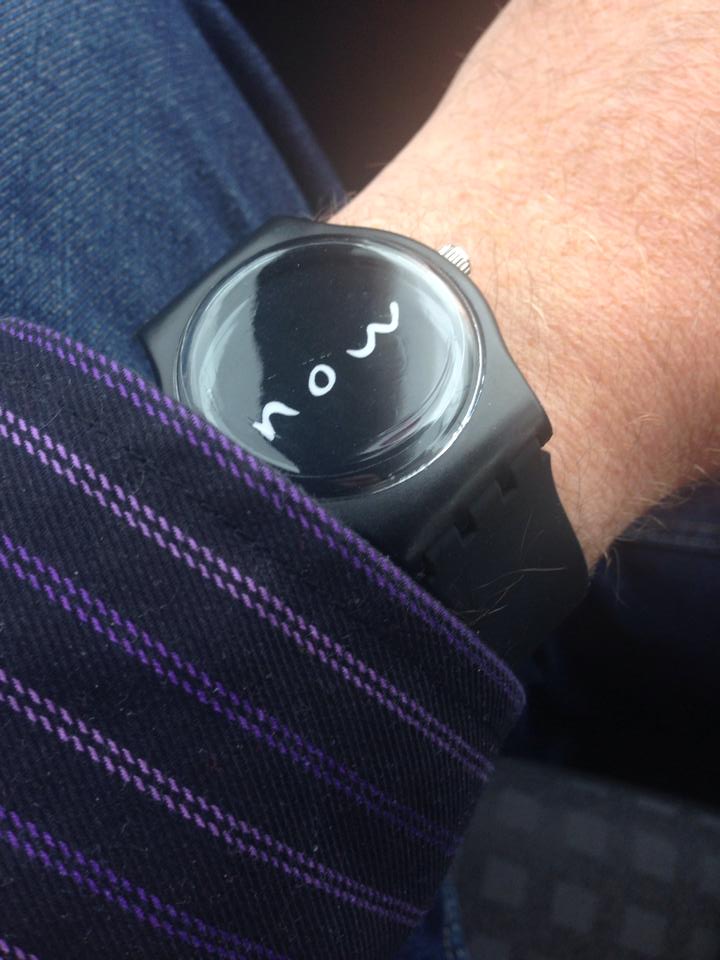
The time is now. Literally.

now-watch
I think you’ll like this and I’m pretty sure you haven’t been married to Angela for twenty years so she’s unlikely to give it to you as an anniversary present.

So you can get your own from Tiny Time Machines right here. I can’t tell you the price, it was a gift and I’m not supposed to look, but Angela wants me to make sure you know that there are import and customs charges on top of this. She paid £12.49 to get it into the UK.

Oh, you’re so powerful, Mr or Mrs or Ms Swoon

This isn’t me. I suspect it isn’t you, either. Creatives and artists are more focused on the work and worried about our neuroses than we are on jockeying for position and trying to make a splash in a company. But then we also regularly meet and rely on the people who do exactly this. So whether you want to appear powerful yourself or you’d just better recognise the signs in others, Time magazine has you covered:

Take up lots of space. MIT researcher Andy Yap says the way we stand and sit can give both those around us as well as ourselves the sense that we’re powerful. Specifically, what Yap calls “expansive poses,” where people adopt a wide stance when standing, put their hands on their hips instead of at their sides and stretch out their arms and legs when seated. “High-power posers experienced elevations in testosterone, decreases in cortisol, and increased feelings of power,” Yap writes. “That a person can, by assuming two simple 1-min poses, embody power and instantly become more powerful has real-world, actionable implications.”

Scientists who study the effects of these hormonal changes say they’re associated with status, leadership and dominance — and all you have to do is take up more space.

5 Scientifically Backed Ways to Seem More Powerful – Martha C. White, Time (21 July 2014)

Oh, someone please help me. Or someone please stop articles claiming science when they mean, at best, statistics. But there is another one of these five ways that rang a few bells with me: I’ve seen us doing this too:

Tap into the “red sneaker effect.” This is why Mark Zuckerberg can get away with wearing a hoodie. Researchers from Harvard Business School studied how sometimes looking out of place can have a positive effect. “Under certain conditions, nonconforming behaviors can be more beneficial than efforts to conform and can signal higher status and competence to others,” they write. (They give the example of someone wearing a pair of red sneakers in a professional setting as an example.) Since most of us try to conform to social norms, we tend to think that people who deliberately don’t do so because they have enough social status that they don’t have to care what the rest of us think.

I did know a guy who was considered a rebel at his company because he wore something like a Winnie-the-Pooh tie. I thought this told me a lot about the company.

Read the full piece

Short version: managers can cock it up, seriously

We’re creative, it’s what we do. We keep meeting people who say they aren’t creative and I think maybe we’re a bit guilty of reacting the wrong way. Sometimes we’re entrepreneurial – you don’t need to be creative, just hire me! – or, whisper it, we’re patronising. As we’re the creatives, we know what to do and everybody else is just a paper-pusher.

The thing is, people who are not creative do not understand us or what we do. And they don’t like that. They don’t like that one little bit. And what we don’t understand, we seek to control. So you get people like the British Prime Minister, David Cameron, telling our film industry that we should only make successful films. Idiot.

And you get people trying to structure our lives. Now, sometimes that is more than fair: I’m not saying a company that employs you shouldn’t object if you never bleedin’ turn up. But we get micromanaged. We get treated as resources. There’s the Hollywood Approach: if a project is good with one writer, it must be better with ten. Or the BBC Approach: if these creatives love their work so much, we can pay them less.

All you can do is get the work done and keep an eye out for places that think creativity comes in shrink-wrapped boxes off some shelves. But if we can’t fix the situation, we can at least be glad we’re not in this one. Bloomberg Businessweek reports on how 3M has gone from an innovative company to a far more efficient firm that just doesn’t innovate any more. It all happened when they hired a new CEO, James McNerney, and the firm seemed to take a collective “hang on a minute…” when he left again.

At the company that has always prided itself on drawing at least one-third of sales from products released in the past five years, today that fraction has slipped to only one-quarter.

Those results are not coincidental.

“Invention is by its very nature a disorderly process,” says current CEO George Buckley, who has dialed back many of McNerney’s initiatives. “You can’t put a Six Sigma process into that area and say, well, I’m getting behind on invention, so I’m going to schedule myself for three good ideas on Wednesday and two on Friday. That’s not how creativity works.” McNerney declined to comment for this story.

At 3M, A Struggle Between Efficiency And Creativity – Brian Hindo, Bloomberg Businessweek (10 June 2007)

It’s an ancient story and while the full piece is a long and deeply interesting read, would you mind going off to see how 3M is doing today? I can tell you that Buckley lasted at 3M until his retirement in 2013.

Another hat tip to the superb 99U for this.

Weekend read: How Phones Go Cross-Eyed at Airports

Wired has an interesting piece on what goes on inside your mobile phone when you switch it back on after a flight. If you think about it at all, you think that it’s just sometimes a pain waiting for it to find a carrier. But according to Wired, it’s a street fight:

The average mobile phone is programmed to search out the five closest antenna signals. When you’re driving in your car this system lets you switch from antenna to antenna — usually without losing your connection. But in an airport, things can go haywire, especially as you’re switching from the powerful outdoor “macro” antennas that you’ve connected to on the tarmac to the smaller indoor devices that AT&T has tucked all over the airport.

For travelers, that means that the moments after you walk inside an airport are where you’re most likely to have a dropped call.

Why Your Phone Freaks Out When You Get Off a Plane – Robert McMillan, Wired (22 July 2014)

The full piece has a little interview with someone whose job it is to see that your phone wins the fight.

Work in 90-minute bursts for best effect*

*One caveat: I found I work better in hour-long chunks. Many folk do 20 minutes on, 20 off, and so forth. But the thing is to do it in concentrated blocks of time and maybe 90 minutes is a good one.

The theory boils down to the fact that we can’t increase the hours in the day, but we can increase the energy with which we make the most of those hours. Taking short, scheduled breaks throughout the day rejuvenates and restores us physically and mentally, helping us plow through those assignments and to-do lists in a third of the time.

The coolest take away from the article concerns what I now call “work blocks.” In short, after that 90 minutes of work, our bodies and minds need a break. But our 9-5 (or 7-7) work culture demands focus for much, much longer blocks of time, so many of us fight that urge to break by filling up the mug with more coffee, rubbing our eyes and refocusing on the screen.

No more.

Inspired by [New York Times writer Tony] Schwarz and the studies he cited, I created a Daily Schedule that broke up my day into 90-minute Work Blocks, separated by 30 minute Breaks and, in the middle of my day, a 2-hour lunch. I know some of you just spit your coffee out. But you read that right. I take a 2 hour lunch to get a long run or workout in, eat and read from a book or write a few lines in my journal.

During the 30 minute breaks I read, clean, walk to the post office and complete those little, once distracting tasks that now actually kill two birds with one stone. Sometimes, if I didn’t get enough sleep the night before, I’ll even knock off for a cat nap.

Do Less = Do More: The Art of Being Creative and Productive – Chase Jarvis, own blog (27 March 2013)

As always, the full piece is worth a read: particularly so this time, I think, as I just got rather absorbed reading it. Hat tip to 99U.