Emotional intelligence

I once went to a seminar about emotional intelligence. The first hour or so was rather good: I’ve forgotten it now because the rest was so bad that I walked out, but there was something interesting and appealing about an idea that alongside regular intelligence one can have an emotional one. I think I was expecting it to be an empathy or maybe street smarts.

It was bollocks.

This fella had lots of great ideas but then he did the science trick: stick the word science in there in order to make your concept sound better. He even put some maths up: he put a formula up that proved EQ was better than regular intelligence and when I took it apart and questioned the variables, he didn’t know what they were.

He then proved that emotional intelligence was real by revealing how science could detect people’s hearts from a few feet away. “How?” I asked. “Heat? Electrical current? Sound?” His eyes flicked to the assistants at the back of the room. “Also, the heart is only the seat of emotions in fiction. In reality, the heart is a pump so what precisely is your point here?”

“Next question?” he said, looking around the room.

I shut up. But soon he was being very forceful about how emotional intelligence is so strong that if you have it, you cannot be beaten by anything or anyone. Somebody else in the room asked what happens if such a person meets someone else with emotional intelligence. Apparently it doesn’t matter, you still can’t be defeated. A third person asked what happens if one such person meets two or ten or a hundred such people.

“Anyway, time for coffee,” said the guy.

I make it sound as if the group was against this guy and there were a few of us but that was a day-long workshop and I was the only person who didn’t come back after the break.

And I didn’t mean to go off on this with you, I was just going to point you at a piece by Creativity Post that I thought you might be interested in:

What makes some people more successful in work and life than others? IQ and work ethic are important, but they don’t tell the whole story. Our emotional intelligence — the way we manage emotions, both our own and those of others — can play a critical role in determining our happiness and success.

Plato said that all learning has some emotional basis, and he may be right. The way we interact with and regulate our emotions has repercussions in nearly every aspect of our lives. To put it in colloquial terms, emotional intelligence (EQ) is like “street smarts,” as opposed to “book smarts,” and it’s what accounts for a great deal of one’s ability to navigate life effectively.

How Emotionally Intelligent Are You? Here’s How To Tell – Creativity Post (May 2014)

See? They said ‘street smarts’. I really think this fella had some good material that he torpedoed by being stupid. Which is entertainingly ironic. And nothing to do with the Creativity Post which I do think is worth a read.

Now, don’t skip this too quickly…

Apple has released its iOS Human Interface Guidelines as a free iBook. And the thing of it is that even if you don’t like Apple, even if you’re looking at me like that because you can’t conceive of being interested in interfaces, the book is a good read. I think everything is interesting, except football, and behind anything is a lot of thought. Read this to see what lies behind the apps we use every day.

Screen Shot 2014-05-14 at 07.49.47From iOS Human Interface Guidelines, free on the iBooks Store


That’s a page recommending that an app just gets on with it. No fancy startup screen, just wallop straight in there.

Startup screens, sometimes called splash screens, are where a company’s logo or the app’s name are displayed at the start. Lots of people hate these and argue that they’d rather get on with using the software but the splash is often there because it takes time for certain apps to load and the alternative is that you have nothing to look at. The alternative is that you wouldn’t be sure it had even started. So they can be necessary. But Apple is really keen on you making apps that load quickly enough that you don’t need them.

I read the old Mac Human Interface Guidelines in paperback a lot of years ago and I’ve never designed a Mac app. It’s still like getting a peek at a philosophy of craft. I don’t believe there’s a Microsoft or an Android equivalent book but I’d read it if there were. Mind you, Microsoft has done something similar in blogs and I did read those until they suddenly took a daft turn into being demonstrably ridiculous. That’s where I read about a redesign of Microsoft Word and its last blog post showed a final screenshot and you could see what huge flaws remained.

It’s when an app fails that you realise how much you like it

TripIt_icon_flatThere are bad apps that you either ditch or tolerate. There are good apps that you use a lot. Then there are great ones that you use so much you forget that you’re using an app, it’s just the way things are. (I would offer that there are then even greater apps that are melded into your DNA: if I’m being harsh then I’d say only OmniFocus is like that with me, but isn’t it great that a tool can become so much a part of your life?)

Right up there in the so-great category for me is TripIt and I only appreciated that this week when it failed on me.

This is what is supposed to happen:

  • Make any travel booking anywhere and get an email ticket from ’em
  • Forward that email to plans@tripit.com
  • TripIt parses the ticket and pops every detail into your TripIt account
  • When you’re travelling, see everything you need on your iPhone

That last doesn’t sound so great but, seriously, it is. I had a thing where I was travelling from Birmingham in the UK to a village in the deepest part of southern France and it meant a lot of train rides and a lot of connections. Many of them were easy and great – I especially loved that I got a couple of hours in Paris both ways – but some were very, very, very tight. There was one where I had six minutes to get across what turned out to be a giant train station on multiple levels and though the guard I asked turned out to speak fantastic English, he also told me the wrong thing. Please picture me running, running and eventually sliding, sliding, sliding Charlie-Brown-like onto my train.

I do remember stopping on the way to help a woman carry an enormous suitcase up some stairs. So, you know, give me credit there: I may have made a mistake booking trains too close together but I’m a mensch under pressure.

What helped me throughout the whole journey was that I could look at TripIt on my iPhone at any time and be shown exactly what I had to do next. What the next train was, where it was, where it was going, what my seat reservation was, any booking references I needed, all that. I could choose to look at any or all of the steps in my journey so if something came up I’d be able to judge if I had the time to do it.

I’m not going to say that it made the journey pleasant when in fact the whole journey was great anyway, but it was a help and a guide and it became automatic that I would check TripIt along the way.

However.

It gets all this information from your email ticket. It parses that ticket: goes through it looking for departure times, train or airline reference numbers and so on. Fine. It’s handy that you just forward your ticket email to plans@tripit.com. (And clever that it’s always that same address: I can show you that address. It’s not a secret one like Evernote or OmniFocus use to let you email details in, it’s a big wide-open for-everyone email address and the smarts are in how it also parses who sent it. If I forward an email to plans@tripit.com, the service sees it’s from me and the details are popped into my account.)

Ticket emails differ between companies, though. TripIt is really good at this parsing but it gets thrown by two things: firstly a company it hasn’t parsed before and secondly if a company changes the layout of its emails. TripIt is an American service and I’m based in the UK so I’m not surprised that I occasionally hit companies that it doesn’t know. When that happens, TripIt sends you a warning that it couldn’t do anything with this stuff and that it has instead kept a copy of that entire ticket email in your account’s notes section. So at least you can see that.

But this week I booked a flight via Tripster and TripIt fell over. It believed it had parsed the email correctly, I got the regular TripIt success confirmation rather than any warnings, but it hadn’t. It believed my flight was tomorrow, it believed there was no seat or airline or reservation number. It was as close to a blank item in my travel itinerary as could be.

But TripIt is so useful when you’re travelling, so very useful, that I’ve taken the time to enter all the details for this trip by hand. Man, it was boring. And the knowledge that I will rely on this detail later actually made me nervous of entering it all, of not making any mistakes.

TripIt usually enters all my details for all my trips and it usually never goes wrong. I know I’m telling you of a time that it failed and that it was a boring time because of that, but it’s made me appreciate how good this app and this service is.

Let me quickly tell you that you can join the TripIt website for free and that there is a free app. I used that free app for years even though I don’t like ad-supported ones: I’d rather pay than have ads, I find them that intrusive. For those years, the choice, though, was between an ad-supported free app or a Pro version that required an annual subscription. I seem to travel more and more, but it’s still not enough for that.

However, at some point the company caved and released an app that you pay for but only pay that once. No subscription. It’s got an ungainly name: it’s called TripIt Travel Organizer (no ads) but it costs only 69p UK or 99c US. When I bought it I paid £2.49 and I still paid up before I’d reached the end of the sentence telling me it existed.

So: I thoroughly recommend, verging on urge you to use the TripIt website and this particular TripIt app.

I’ve changed my mind, he said lying

If there is one good thing about me, it is I am saintly about admitting when I’m wrong and truly Godly about changing my mind when you persuade me. Admittedly, I do it because you cannot believe how it throws people. Yes, I can look like a fool, but whoa, their faces. Love it.

However, I am unusual. Brainpickings.org looks at the issues of changing one’s mind and in particular how one book talks about it:

David McRaney explores [this] in You Are Now Less Dumb: How to Conquer Mob Mentality, How to Buy Happiness, and All the Other Ways to Outsmart Yourself [UK edition, US edition] — a fascinating and pleasantly uncomfortable-making look at why “self-delusion is as much a part of the human condition as fingers and toes,” and the follow-up to McRaney’s You Are Not So Smart, one of the best psychology books of 2011. McRaney writes of this cognitive bug:

“Once something is added to your collection of beliefs, you protect it from harm. You do this instinctively and unconsciously when confronted with attitude-inconsistent information. Just as confirmation bias shields you when you actively seek information, the backfire effect defends you when the information seeks you, when it blindsides you. Coming or going, you stick to your beliefs instead of questioning them. When someone tries to correct you, tries to dilute your misconceptions, it backfires and strengthens those misconceptions instead. Over time, the backfire effect makes you less skeptical of those things that allow you to continue seeing your beliefs and attitudes as true and proper.”

But what makes this especially worrisome is that in the process of exerting effort on dealing with the cognitive dissonance produced by conflicting evidence, we actually end up building new memories and new neural connections that further strengthen our original convictions.

I fancy the book now but Brainpickings writer Maria Popova writes an interesting piece about this.

Spell Happiness with four Ps

There’s an overwhelming amount of happiness research. Forget incorporating it all into your life — merely remembering it is daunting enough. I like to keep it simple: Remember the 4 P’s.

Purpose
Perspective
People
Play

Work those into every day and you’ll be smiling more.

The Way to Happiness: Remember the 4 Ps – Time

Ye-ess… I’m listening… tell me more.

Taking the Pomodoro technique to its obvious conclusion

The Pomodoro technique is where you set a timer and you work for, say, 25 minutes and then take a break for 5 minutes. Then you do it again. And again. The name Pomodoro comes, through a reasonably short but twisty route, from a type of clock or timer that was apparently popular somewhere. This timer looked like a tomato. And the word pomodoro means a kind of tomato sauce. Flash forward to the age of the app and we get this:

Screen Shot 2014-05-13 at 21.37.30

Looks more like a fella with green sunglasses if you ask me, but it’s a tomato timer for the Pomodoro Technique:

Pomodoro Timer helps you boost your productivity using the Pomodoro Technique™, one of the most effective time management methods out there. Not only will you get a fully configurable timer that lets you customize every aspect of the technique, but you will also enjoy a clear and beautiful user interface.

Pomodoro Timer costs £1.99 UK or $2.99 US and is available in the Mac App Store.

You lookin’ at me?

I want to tell you this:

Being a bully may be good for your health, study finds

Children who bully others have lower levels of inflammation later in life

Childhood bullying has been linked to a number of physical and mental health effects, including lower self-worth, depression, and serious illnesses later in life. But until now, researchers had largely focused on examining these effects in victims of abuse, not the bullies themselves. This may soon change, as a long-term study published today in Proceedings of the National Academy of Sciences was able to demonstrate that “pure bullies,” people who have never experienced bullying themselves, do in fact face a long-lasting health effect from abusing others. As it turns out, that effect is actually beneficial — even when compared to people who aren’t involved in bullying at all.

The Verge

Because I want to show you this:

Though do go pay some cash to the Frasier folk now, okay? The show is available on DVD.

NowDoThis and take it seriously

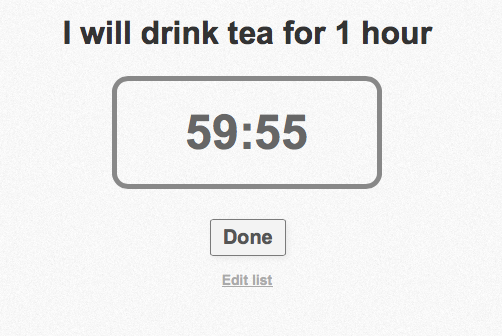
There’s a new online To Do service called NowDoThis. Go to a website, type in your To Do list right there and watch it look at you. It sits there, the list on your screen in a nice font. And if you’ve included a time – such as “I will do press ups for 1 hour” – then it will also automatically include a countdown clock.

You can hit Done early or you can wait until the clock runs out but then it’ll sit there with a Time’s Up reminder and a ping. Click and you’re on to your next task and it sitting there on the screen, watching you.

If you’re wedded to something like Things, Asana or OmniFocus then it won’t work for you, it just looks you in the eye and backs away, defeated. But for fast turnaround tasks, it’s a strong prod. So long as you take it seriously and don’t do anything like this:

Screen Shot 2014-05-12 at 12.24.33

Excuse me, I’m off to make tea. I have to. It’s right there on my list. What, you thought I’d really do press-ups? You’re adorable, thank you.

Practice like an expert, not an amateur

Creativity Post has an article about the methods successful people use for practicing whatever it is they do. The article is chiefly about sports success and what I don’t know about sport would fill every sports book, channel, magazine, blog and stadium. But the idea of having an aim, a purpose that requires practice to attain and to sustain, that applies to us all.

What do the fittest people do that I’m not? How are their workouts different? Are there key things they do while they’re working out that provide a bigger payoff than the things I do? In other words, are they extracting disproportionately greater results from their time in the weight room than I am?

The same can be said for our practice time. What do top performers do when practicing a skill? What do the less effective practicers do? Are there any differences?
Indeed, it appears that there are.

Two Things Experts Do Differently Than Non-Experts When Practicing – The Creativity Post (8 May 2014)

You’re wondering what the two expert things are. I feel if I told you both, it’d be stealing from them. Let me tell you the one that chimed with me: have specific goals. Now take a look at both the other thing and at more of the reasoning behind why they work.