It’s your fault

Here be spoilers. Well, there be spoilers: down there, a lot of spoilers a bit of the way down the screen. If you haven’t seen the 50th anniversary special of Doctor Who, please do. Go watch it. It’s very good.
All I ever want from a story is to be caught up in it to the exclusion of anything else. That’s all. Analysis and whathaveyou, that can come later if it must. Just scoop me up, please. And Doctor Who: The Day of the Doctor did exactly that. Job done.
Only, I’m surprised that it did because at its core is something that goes against a thing. I was going to say it goes against a drama principle of mine, but nuts to drama principles: if it works, that’s your principle right there. But we tend to have issues that colour our writing, things that we come back to because we’re trying to find them in ourselves, beacuse we’re trying to mine them for others or maybe just because we’re good at them.
And I have one thing that is guaranteed to appeal to me, utterly certain to get me obsessed, and which you break at your peril. Yet Doctor Who broke it and worked. I don’t know how. Let me tell you that right up front, if you can call this the front when I’ve already rambled on at you a ways. I want to explore this and see if I can figure it out because it matters to me.
Here’s what it is. If you wanted to get all academic about it, drama is about obstacles. I seriously do not know why you would want to get academic if that means boiling down the richness of drama into a checklist with only one thing to check, but it’s not unreasonable to say drama equals obstacles. Fine. Someone is faced with something, that is or at least that can be drama.
But for me, it’s really only drama when the thing they face is their own fault. Having something done to you, that’s awful. It’s powerful. Having something done to you and it is entirely your own fault, though, that’s wonderful. It’s not that I’m especially in to my characters being punished for something and it’s only a little bit that I am in to the genuine meaning of tragedy: a tale that ends badly because of something within the lead character. It’s specifically the point that if this terrible thing is your own fault, you could have prevented it – and now there is absolutely not one single thing you can do to put it right. You can’t undo the past. This is the real reason I am forever coming back to the issue of time in my writing: the regret, the permanent regret for things lost and things done badly. You can’t rewrite history, not one line.
Except in Doctor Who. This is where the spoilers start.
The day in The Day of the Doctor is the one where the fella ended the Time War. This was a huge and so far never seen portion of Doctor Who history: immediately before we saw Christopher Eccleston’s Doctor, there was this war, right. War between the Daleks and the Time Lords. And it was ended by the Doctor. We slowly came to learn that though he ended it – so far, so Doctor-heroic-like – there was something of a cost. The war was ended only by the complete and total destruction of both sides. Time Lords and Daleks, all killed. All killed by the Doctor.
Cor.
The Day of the Doctor undoes this and if you’d told me that before I saw it, I’d have thought again about going to the cinema. I read an interview with Steven Moffat on DigitalSpy this week that ran in part:

It was about a year ago. I remember thinking, ‘What occasion in the Doctor’s life is the most important?’ Well, it’s the day he blew up Gallifrey. Then I tried to imagine what writing that scene would be like and I thought, ‘There’s kids on Gallifrey and he’s going to push the button? He wouldn’t!’ I don’t care what’s at stake, he’s not going to do it. So that was the story – of course he never did that, he couldn’t. He’s the Doctor – he’s the man who doesn’t do that. He’s defined by the fact that he doesn’t do that. Whatever the cost, he will find another way. So it had to be the story of what really happened, that he’s forgotten.

I see his point and he wrote it superbly in the show, but I’m mithered. I detest beyond measure the way that a soap, for instance, will get a character into a dramatic situation and then pull back at the last moment to say it’s all right, really. It wasn’t him. It isn’t her. They’re dreaming, whatever. Go away. I’m never watching again. So having this thing in Doctor Who that we know was big and then showing us it being even bigger but then taking it away, it shouldn’t have worked for me.
I think it’s that bit about ‘I don’t care what’s at stake’. For me, the drama was in how there were these stakes that required him to do this. Now, actually, I have to play this both sides because a huge amount of the drama – can you quantify drama like this? a good 43% was angst, 12% personal torture and so on – was to do with how he had no choice. But if the Doctor has no choice, that is big and huge and enormous but it isn’t the same as him having a choice and making the decision anyway. If the Doctor presses the big red button, everyone dies on Gallifrey. If he doesn’t press it, everyone dies on Gallifrey anyway because the Daleks are attacking very thoroughly.
There is the fact that they’re attacking because presumably they’re seriously hacked off at the Doctor so nearly efficiently destroying all their plans, ever, so the whole attack is his fault. I’ll have that.
So with this storm of issues going on, it does all come down to the small moment, the huge yet tiny moment where he has to do this or not do it. The fact that he does speaks to me about the stakes of the story but it also completely engages me in this Doctor character. The fact that he doesn’t do it, that takes most things away. It reduces the stakes, because somehow he’s now got a choice, and that reduces the character for me.
Except, maybe it worked for me, worked in this one story, because Moffat could undo the destruction of Gallifrey, he could rewrite one very big line of history, yet do it in such a way that the Doctor was left with the same burden we thought he had.
Doctor Who often reunites various different Doctors and there is always the issue of why a later one doesn’t remember all this from when he was the earlier guy. The Day of the Doctor makes many little nods to this and does explicitly state that the Doctors’ time streams are out of sync and that neither David Tennant’s Tenth Doctor nor John Hurt’s Nth Doctor can possibly retain the memory of what has happened. It’s plot convenience and it’s what has always happened before, but this time the lack of memory means that John Hurt’s Doctor and David Tennant’s and up to a point Matt Smith’s one all believe they destroyed Gallifrey. They carry that burden for four hundred years.
Four hundred years. That’s enough carrying of blame and regret and fault even for me.
Good people doing bad things. That’s what chimes with me. Making irrevocable choices. That’s me. But I thought it was a rule, an inviolate rule of drama that you do not ever undo a character’s bad choices, you do not give them a reprieve, you do not give them an escape. The drama is in living with the things you cannot live with. And The Day of the Doctor says bollocks, William.
Quite right too.


It’s not you, it’s me

I’ve been talking with other people.

Are you okay with that? We’re still special, you and I, aren’t we?

I’m not going to excuse what I’ve done but I owe it to you, I owe it to both of us, to be completely open with you. I talked with RadioTimes.com. Yes. Yes. I talked with them about Doctor Who, which is usually our thing, isn’t it? One of our things. We’ve got a lot of them. But we’ve always had Doctor Who and we always will. It’s just that this time, I wrote a piece for RadioTimes.com about the show’s fiftieth anniversary and, actually, I really want you to see it. Just because I had such a good time writing it and – I can tell you – I also think it came out rather well.

I’d simply slip you a copy or post the text here but that would be stealing so instead, let me give you a link. Here’s Radio Times with the Bluffer’s Guide to Doctor Who – I mean, How to be an Instant Doctor Who Expert.

Doesn’t that feel like I’m trying to push something on you? Get you here, sit you down, try to sell you something.

No.

This does.

Also out this week is my new book: “Self Distract – from Doctor Who fan to Radio Times and Big Finish“. (That’s the UK link: if you’re in the States at the moment, this one on Amazon USA will do you better.)

It’s an ebook on what it’s like being a Doctor Who fan inside Radio Times and then being with fellow fans at Big Finish plus it includes a major new interview with the Restoration Team. Doctor Who is forever special and I have always been a nut for radio drama so you know it is a privilege to write for Big Finish and you can guess that it’s an immeasurable pleasure to hear the productions. It’s immeasurable or I’d have measured it for you.

Self Distract is my attempt to quantify it in some way and tell my disbelieving teenage self how far that decision to watch The Invisible Enemy would take me. Plus, I did once say to Steven Moffat that I thought The Snowmen was magical – the TARDIS in the clouds? Gorgeous – and he thanked me but said my other review was funnier. He meant ‘Live Blogging Doctor Who at Christmas’, a piece I wrote mocking the real live blogs of this world. So naturally, that’s here in the new book.

And naturally I want to tell you about it.

Um.

I’d also like to see you.

If you’re in Birmingham tomorrow (Saturday 23 November) at the annual Writer’s Toolkit, come say hello and I’ll buy you a cup of tea.

And we can get back to nattering madly about drama and writing and OmniFocus and everything.

William

Lie to Me

The UK mobile phone operator 3 phoned me last week and asked what I do for a living. “I’m a writer,” I said automatically. And as it turns out, that was a dangerous answer because it triggered a whole new script from them: did I mean journalist?

I said no then, but more calculatingly than automatically. I’ve known this before: if you’re a journalist, you are excluded from most marketing surveys and the like. I know it because I’ve been glad and after I’ve mentioned this to other people, they’ve pretended to be journalists for the same reason. This time I knew where it was going and I said no mostly because I wanted what they were offering: I’m about to beta test their 4G service. Now, in case you get a job with 3 and have a conscience, and/or they have a Google Alert on their name – and employ myriad minimum-wage people to read every website that ever includes the number 3 – then I want to tell you that I wasn’t lying.

On the strict, literal, in that moment, defense-in-court kinda way, I wasn’t lying because that day I wasn’t doing any journalism at all. In a feels-better-in-your-heart way, I wasn’t lying because I’m a writer. I even told them that I used to do journalism. “But you’re cured, right?” they didn’t say.

It’s the word automatically that I want to talk to you about. I think you missed that: back there in mid-rant I said that I’d automatically answered that I’m a writer. You know the difference but maybe you don’t think it’s a very big one. Apparently 3 does. But you’re not convinced.

I left computers and got into journalism writing because I wasn’t technical enough and I certainly wasn’t interested enough in the latest metal box and the newest drama about a poorly-written Windows DLL executable. What I didn’t realise for a long time that it was really that I was more into actual drama. Genuine drama. Television and radio and stage and prose drama. I wrote about computers, then I moved into media writing.

But for all the fun I had and all I learnt and all the people I got to meet –

– wait, quick aside?

When I was writing for BBC Ceefax at BBC Television Centre, the Corporation’s drama department was based over the road at Centre House. Julie Gardner was there. Google her now and you’ll get a tonne of results about how she brought back Doctor Who with Russell T Davies and that is true, that is something superb, that is something to be proud of and it’s right that there should be all those web pages. But she did much more and you have to Google deeper to see what a force she was in drama at BBC Wales. And then you can Google as deep as you like, you won’t find that she encouraged me.

To be utterly honest, I can barely remember the details. This is maybe 15 years ago now and more that specifics of script writing advice and comments, what I remember and in fact what I carry with me is that I have yet to come within a pixel of achieving what her other writers have. It is a smouldering, burning, igniting ambition of mine to write something that impresses her. If I did, I doubt she’d even know about it because she’s long left the UK: she’s now being a force in American television. If I did write something that well, there’s no reason to think she’d connect it with the journalist she met half a dozen times in 1999.

Yet that’s my ambition because even in those few meetings and despite how I wasn’t that keen on the shows she was working on at the time, I admired her then for what she said. And of course now I admire her for what she did.

– that wasn’t a very quick aside, but it is relevant, I promise.

I was saying that I had all this fun, I met all these fascinating people, I learnt so very much and in all of it, there’s only probably an hour I’d ever change. But I had one thing that I now understand prevented me ever becoming a hard news journo.

I want you to lie to me.

Okay, I did this one phoner interview with a guy I can’t name. Let’s call him Trev or even Bert. Bert was the toughest interviewee I ever did because he could be and though I felt then that he was excruciatingly shy and struggling, I’ve been told myriad times since that no, he’s just excruciating. Because I have this pretty detailed knowledge of American television drama, I may be the only journalist he spoke to who knew about a particular series he went there to do. He lied to me about it. I could accept a boast about it being more successful than I knew it was, but he casually lied about facts and figures. He must’ve known I knew. So I didn’t like that lie.

But that was only a small part of a foul interview, I can’t take it as an exception. In general, I want you to lie to me and I want you to lie good.

At least, I do in drama. And while it’s become a universal rule for me, it started with Doctor Who.

For I can see me now, driving down to London around 6am one morning and hearing on the radio that Christopher Eccleston was leaving the show. Remember this: Doctor Who had just come back and it was immediately the most enormous hit. It was a surprise hit and that just made its success feel all the greater. It was also the most vibrant show with enough energy and verve to make other dramas feel unfinished. So the news that he was walking away from this massive, massive success was a shock.

No question: it was news.

But imagine how much more of a shock, how much more of a news story it would have been if we’d got to his last episode and didn’t know? We’d have had the usual building tension about whether the Doctor will survive and of course we’d have the usual naturally-he-will-or-the-show-is-over tap that keeps us from quite believing it. Then it would have got much further along this tension than usual and we’d start thinking well, it’s the end of the season, this is building to a really big cliffhanger. And then Eccleston’s Doctor would’ve died and who the hell is this new guy standing there?

David Tennant’s first lines as the Doctor include a reference to teeth. He could’ve been talking about every one of us because our mouths would’ve been open and our jaws bouncing on the floor.

And we were denied this because the news leaked.

Russell T Davies, speaking in the rather nightmarishly mesmerising book The Writer’s Tale (with Benjamin Cook) said the news was leaked by the BBC’s Peter Fincham, Controller of BBC1 and Head of Drama Jane Tranter. He doesn’t blame them, but:

The BBC is powerless with the press. No one can control the papers, they’ll print what they want, and we need them, so threatening to withhold or punish simply doesn’t work. We’ll just go crawling back, cap in hand. But the central problem is that the BBC is a public service broadcaster, funded by the public so we are Not Allowed To Lie – and we end up craven and apologetic. That’s why the leak about Christopher Eccleston leaving could not be plugged. Once asked by The Mirror, Jane Tranter could not deny it. Even though it ruined the surprise cliffhanger to Series One. How incredible would it have been to keep the Ninth Doctor’s regeneration a surprise? But we had to be scrupulously honest. It’s all the consequences of the Hutton Inquiry. But Doctor Who is hardly Hutton! This is fiction! I don’t give a damn, I’ll lie all I like if safeguards the stories that we’re telling. They can’t stop me. But there’s little point when Peter Fincham has to tell the truth. Madness.

I don’t know that it’s the Hutton report, though. I think there is an element that is down to the soaps. There’s certainly pressure from fans – of anything, not just Doctor Who – to be told everything now, now, now. That gets fed a lot by producers aware of the interest and wanting to keep it, wanting to stoke it, and doubtlessly also wanting to talk with people who care so much about their work. But without exception, whenever anything at all is revealed about anything at all, someone loves it and someone hates it. Loudly. Then whether anything revealed is true or not, it is treated as truth and we end up with the weird situation where people are disappointed that something that wasn’t going to happen doesn’t happen.

Next time Apple is about to announce something, take a peek at the storm of analysts saying it will definitely be an Apple TV set or it will be an iWatch, no question, we’ve got proof, and then when it isn’t, shield yourself from the storm of “Apple fails!” stories. I switch off my RSS news feed around these times.

But with soaps, I can’t. It’s not that I plug soap news into my RSS feed but I do tend to shop in supermarkets and there is not one day I do that there isn’t a shelf of magazines with soap headlines on them. This character is about to die, this one is about to kill, that one is pregnant. Most of them are extremely over-hyped but some would genuinely be big moments in their series, except we know about them already.

It’s not a mistake. I don’t think it’s right, but I know it isn’t an accident. The job of big moments in soaps is not to tell a story, not to completely arrest the viewers. The job of big moments is to advertise that you should watch the series. This is when soaps are not drama. Coronation Street had a gigantically successful storyline a few years ago with a long, long, long-running tale that ended up with a court case and a major character in danger of being falsely imprisoned. Even I watched some of this and I don’t happen to follow Corrie. But then the producers had one last big thing to leak that would get them some headlines: they said that they would never let a character be falsely imprisoned.

I never watched another second.

That’s soap: build it up in the press, let it fizzle away on the screen. All I ever want, all I have ever wanted from a story is to be in it. Absorbed. Carried away by its characters and its tale. And this will not happen with soaps because I can’t even pretend to myself that anyone is in any jeopardy and there will never be any true surprises, true dramatic delights because every key moment is on my supermarket shelf as an advert.

Of all the dramas on TV, I’d take a guess that Doctor Who gets the most coverage after the soaps. At the moment, at least. Actually, since its return in 2005. It’s been a remarkable run. And to this day, to this minute, every possible scintilla of news about what’s happening in the show gets picked up and examined.

So I was delighted to read this recent comment by Steven Moffat:

I’ll be honest with you: what you know is entirely conditioned by which bits we had to shoot outside. So then we say ‘we’ve decided to tell you…’. We just tell you what we have no choice about. If I could make this on the dark side of the moon and tell you nothing at all, I’d do it. I’d also lie to you prodigiously and regularly if I thought it would help keep a secret. Watch me!

Good man.

Keep it up.

Do you know yet why I’m saying this to you today? If you don’t, I don’t want you to. I want you to find out for yourself. It’s fifty/fifty whether you’d shrug or you’d be delighted, but I watched something yesterday without knowing anything about it and this little show was a truly delicious, surprising delight.

So delicious that I wanted to keep eating it, somehow, and as ever with these things, I had a poke about online. And the very first thing I found that was talking about it had the show’s biggest surprise slapped right there in the headline. Followed by the tiny word ‘Spoilers’.

Don’t tell me these things. Don’t tell me anything.

And if you must, then lie to me. Please.

Writing the perfect thriller

I once went to a workshop about writing thrillers. I went partly because I like thrillers very much and also, frankly, everything I ever write turns into one eventually –

– wait, what was that noise?

– is someone following us?

See what I mean?

But I did also go because I rate the producer who ran it and I wanted to work with her. That happened: we worked on a project that fizzled away. But I enjoyed it, I hope I work with her again, and today I want to tell you what I should’ve said to her three years ago. She wanted to know how I could say I like thrillers but I visibly can’t cope with blood and gore. She wanted to know how anyone could claim to love thrillers yet be unable to watch The Silence of the Lambs, for instance.

Um, I said.

But today, I have the answer.

I’ve just watched something that had no gore, no blood and was a primetime US network TV show so there was never going to be a lot of anything. And the scene that made me want to talk to you about this and to track that producer down to go see? there? look! had nothing happening in it. I mean, nothing. Tim Daly starred as this character who was, for this quite long scene, waiting in a room. On his own.

And what made it a thriller was watching how he became ever increasingly sick with fear.

No dialogue, no other characters, no inciting incidents or whatever you could call it. Just a man in a room trying to stay calm. It was riveting.

And it was The Fugitive.

You know the title, you certainly know the Harrison Ford film version from 1993 – oh, my lights, I just looked up the year: I can’t believe that this is now the 20th anniversary of that movie. I watched it recently and it’s still very good. For writers, it’s particularly interesting because it has no rise and fall, light and shade, ups and downs, it is a ramp from start to finish with unrelieved, unreleased tension.

Hopefully you also know that it was originally a TV series in 1963 starring David Janssen and Barry Morse.

The Fugitive was created by Roy Huggins, who also made Maverick and The Rockford Files, and the story goes that one day when he was working at home, he called for his wife to come quick. Take a photograph of me, he said. I want a record of the moment I thought of a perfect TV show.

Roy Huggins:

I thought it was the greatest idea I’d ever come up with and was a cinch sale. And a cinch success.

(Incidentally, I got that quote from the late Huggins’ appearance on the astonishing Archive of American Television interviews on YouTube. Hours upon hours of detailed interview with utter legends of US television drama.)

But to give every writer in the world some solace, Huggins says he discussed the idea with friends and colleagues:

Every one of them hated it. Howard Brown said Roy, you’ve got a great reputation in television, don’t tell that to anybody or it’ll be gone. My agent’s [eyes] glazed over and he changed the subject. Nobody liked it.

The series ran for four years and for a time its finale held the record as the most-watched show ever screened on American television. Then there was the film. And then the one you are less likely to know about, the one I’ve just been watching: a TV remake made in the year 2000.

I don’t think that’s a great trailer. And the show itself had a dreadful title sequence. You can only get the first two episodes on DVD, or anywhere, and that shiny disc cost me a whole £1.34 two weeks ago. (Have a look at it on Amazon, though while you’re there, you know, if you’re in the vicinity, you could also look at my new book. I thank you.)

The 2000 series is by the same production team that made the 1993 movie, more or less, and I bought it in part because I’d just enjoyed watching that film again, because I liked Tim Daly in a detective show called Eyes, and because I wanted to see how they could tell the same story for the third time. Dr Richard Kimble is convicted of the murder of his wife and no one believes his claim that it was a one-armed man who did it. On his way to prison, there is an accident, Kimble escapes and goes on the run.

I think the one-armed man is weak. In all of the versions. If he weren’t one-armed, there wouldn’t be even the breadcrumbs there are that let Kimble at least begin to track him down.

And that’s part of what does make this a perfect TV idea. The story is not that Kimble is innocent, it’s that he is hunting the one-armed man. It’s that as he does so, Kimble himself is being hunted by the police and specifically the dogged Detective Gerard. Roy Huggins points out on the DVD for this version that this means the show has two chases going on, permanently, and he’s right that it’s unusual and unusually effective.

Then there was the fact that Kimble is a doctor. Roy Huggins:

I made him a doctor because I wanted him to a have a profession that I could use for good storytelling. Here was a guy who every time he had to behave like a doctor was putting himself in jeopardy. 

Being a doctor means that he has skills but also you can believe the compulsion to help people. So now your lead character has an ability and a need to get involved in new stories every week. He’s a bit of a do-gooder type but he’s a more believable do-gooder than your usual character in this type of TV show. Plus unlike every other hero who rolls into town in those shows, Kimble can never just call the police.

Two constant chases, one constant requirement to get embroiled in new stories. Huggins was right, it is a brilliant idea and that original version was the most enormous hit. It doesn’t half seem ponderously slow now, though. Take a look. This is the opening to most of the early episodes.

Just for completeness, I don’t think the trailer for the 1993 film is all that much better:

I can almost see why Huggins’s pals didn’t like the idea. Three versions, three trailers of a sort, all a bit dull. Then there’s the fact that you know in every version that Kimble will prevail in the end and, more immediately, that he can’t be caught this week or the show is over. That’s no different to any other series and if we are caught up in the tension, it is at least partly our willingness to be.

For all that its format is exceptionally tense, The Fugitive only works if the stories keep us engaged. The film could tell us solely the Richard Kimble tale and that was plenty for two hours. The TV shows absolutely have to keep going and going but they also therefore have to engage us with other stories. They have to do that every week. The original series did it marvellously and the point of it, the power of it, was not that Kimble was always within seconds of being caught but rather that he could be. That anything he did could be the thing that would trip him up. That any person he spoke to could be the one who turns him in.

I’d have liked any of the versions to use the murdered wife as more than a starting point for a tale about her husband. But otherwise The Fugitive is the perfect thriller for me because it creates a world where Dr Kimble is both constantly and naturally in peril.

You can see the movie easily: it’s available everywhere and it crops up on the telly regularly. You can get the original series pretty easily as it’s all on DVD.

What you’ll struggle with is the 2000 remake. It only lasted a single season and – spoiler – it’s the sole version of The Fugitive that does not get resolved at the end. There are those two episodes on very cheap shiny disc but then the whole series has been put up on YouTube. You have to question the legality as each episode is up in three 15-minute chunks of pretty low-quality ripped-from-VHS, but at least you can see it.

I didn’t give you that link, right? But I did and I do urge you to try at least one version of The Fugitive. I really do think it’s the perfect thriller and no more than Veronica Mars, I wish I’d written it.

William

Writer: The Blank Screen, The Beiderbecke Affair, Doctor Who

“It looks like you’re signing in from an unusual location…”

I’ve spent most of this week writing here at a kitchen table. In France. In a cottage so gorgeous I’m planning to sneak it away along with the toiletries.

I’d have to sneak my host away too, but I’m okay with that: she’s great and the project we’ve been working on has gone remarkably well. Hang on, I need to touch wood and there is just a surfeit of choices. There. I went for touching the kitchen table. You know it made sense.

This is probably the picture-perfect image of a writer, at least the image that non-writers are encouraged to believe. The work going easily – now I’ve touched the antique display cabinet and also the curling wooden staircase just to be safe – and with a fire over there, a mug of tea over here, forests out of the window and a cat named Gustav who wants to write the book with us. (He also wants to blog and says safohe89hfskjhmiaow.)

No wonder Google looked at me twice when I tried to log in to write you this. Unusual location? There should be a dropdown menu with options like Gorgeous Location, Very Un-William-Like Location.

This is really not my usual thing. Not as a writer, not as a William. I’m a city boy. I was thrilled to spend just an hour in Paris earlier and I’ll get two hours there on the way back. Fantastic. If New York is my favourite place in the world – and I truly don’t know why I said if – then Paris comes in second. Forest cottages in the most southestify of France never figured on the list at all.

It’s sobering to think that I would never have come if it weren’t for this particular project. It’s galling to think where else I would never go and have never been because I don’t have a project to get me there. I think I might just possibly be a teeny bit too work-focused, I don’t know.

All my life, I’ve believed that it is better to be crew than passenger. It is infinitely better to be working than not. To have purpose instead of just a destination.

I still believe it.

If I’d come here on a holiday, I’d have seen the same places, breathed the same air, doubtlessly slept as tremendously as the high altitude and the long journey made me. But I’d have been itching to move on to the next thing. Or I’d have been itching to just stop for a mo to finish writing this or that.

As it is, my job is to be here and – ridiculously, I know – that makes all the same things feel all the different. We’re having to do less work on the book than I’d expected, which is great because it means it’s in very good shape already, but it also means that when we’re done for the day, we’re done. I know it’s done and I don’t itch, I don’t stop, I can just enjoy the place.

I have no problem with being a tourist somewhere, that’s fine enough, but when you are one, you do see places from one particular angle. And it’s an angle that the local industry always exploits by putting the best things in your view. I’m not a tourist here, I’m also not living here, I’m working.

It’s a difference that makes no difference but is still a difference. To me.

And it is making me question how I work. The supposed benefit of being a writer is that you can work anywhere, you know, when the muse hits you. There ain’t no muse. And the time you spend travelling somewhere is time you ought to have been working. But now that I can work on the move, now that I’ve seen what an alien landscape does to me, I’m going to rethink just how often I sit in my office writing away for 16 or 18 hours a day.

Mind you, you don’t half get a lot done there.

Maybe there’s swings and roundabouts. But I feel one owes it to oneself to do both.

I’d have been narked to all hell if the cottage hadn’t had wifi and I wasn’t able to write to you, though.

Never show invisible characters

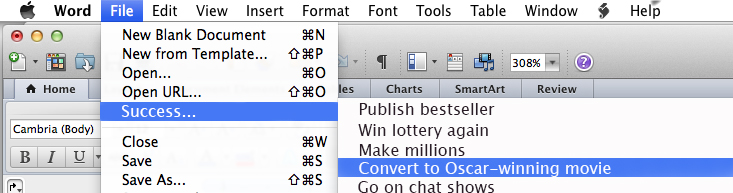
Exactly as I start writing to you, it pops into my head that ‘invisible characters’ is a term you get in Microsoft Word. There it means things like the return between paragraphs. Here I mean characters in drama and comedy that you never see but who are forever talked about. I’d like to now make some deeply philosophical connection between these meanings, maybe say that these drama invisible characters are never seen yet without them the rest would be a mess.

Instead, I’m going to say that I need to warn you: there will be spoilers a little ways down the road.

Because it used to be a rule that if you had invisible characters, you never turn that around and show them. As great as Waiting for Godot is, the one thing it doesn’t have for me is any tension that Godot will ever appear. After a beat, he was set up as so important that I knew this fella, he ain’t coming.

That’s usually the thing, that these invisibles are so important that no visible can live up to it. I remember the creators of Frasier saying that they hadn’t intended to make Niles’s wife Maris be invisible, they were just going to get to her in a few episodes. The first episode of Frasier – The Good Son by David Angell, Peter Casey and David Lee – is perhaps the finest piece of pilot writing on television. Seriously. Watch the episode or, here, read the draft script online, and you’ll just enjoy it. But without you being forced to be aware of it, this short script irrevocably changes Frasier Crane from a minor Cheers character to the lead of his own show, introduces four major series-long characters, a dog and two sits: the sitcom setting of a home in Frasier’s apartment and the other sitcom setting of a workplace.

Plus, famously, it’s the only sitcom pilot that includes a truly dramatic and raw argument between two main characters: usually we’re supposed to like everyone so pilots don’t risk any rows, but we get one here and it feels true.

If anything, the aired version is better still because it is trimmed back to get the show into its mandated 22-minute running time. Looking at the script now, the opening feels a bit flabby compared to the transmitted version because it is so spare that every syllable does at least two jobs. And what gets it this best-pilot-writing status in my mind is that you simply do not realise that any of it is doing any job at all. It’s just a funny show.

But I suspect Maris isn’t in it because that would just be one element too far. I don’t know, but it’s so superbly packed that one more piece would burst the lot.

So we get this:

NILES: I thought you liked Maris.

FRASIER: I do. I like her from a distance. You know, the way you like the sun. Maris is like the sun… except without the warmth.

She gets mentioned a lot in the opening episodes and that seemed to seal her fate: it was surely impossible to cast anyone to fill a part when we had begun to have an extremely detailed and, as it transpires, an increasingly strange mental image of her.

The one thing that makes me question that this happened with Maris is that there was another invisible wife on Frasier’s predecessor series, Cheers. Norm Peterson –

Norm!

– was married to Vera and we never quite saw her.

But it happens a lot. There are more invisible characters than I realised. And it’s a bit uncomfortable that so many of them are wives: Maris, Vera, Mrs Columbo. But then there is Stan Walker on Will & Grace.

I just looked into this. There’s also Enid Kelso on Scrubs. I don’t know if she’s a wife or not.

Juanita Beasley in The Andy Griffith Show. I’ve never seen her or The Andy Griffith Show.  Oh! Diane in Twin Peaks: Dale Cooper was forever recording messages to her for dictation about his business travels. Bob Sacamano in Seinfeld. Apparently The Gooch bullied little Arnold in Diff’rent Strokes. A lot.

There was also Ugly Naked Guy in the apartment across the street in Friends and there we did at least see his back, he was played by someone.

Charlie Brown features Miss Othmar but I can’t decide if she counts because we hear her speak, or at least we hear her make sounds. If you count her, do you also count Charlie as in Charlie’s Angels?

You can see more of these than you expect, and others too, on a Huffington Post video I just found.

That video is how I remember that we did see Vera, albeit with a pie on her face. And it’s reminded me that Mrs Columbo was always just out of shot, just in the next room, just coming in a moment in the Columbo episode Troubled Waters.

But Mrs Columbo is sort of proof that you must never show these invisible characters because she sort of got her own series. In 1979, there was a TV show called Mrs Columbo and the idea was that this time Lt Columbo would be the invisible character. It was a cute idea aka a cute business solution to the fact that they couldn’t afford to hire Peter Falk.

I think of all this as being only sort-of showing us his wife because the whole show was a series of business decisions. Of course people would tune in to see what his wife looked like: it was a guaranteed hit idea. But it’s also guaranteed that viewers like young, beautiful types so fine, Lt Columbo had married someone much younger than himself.  All we really knew about her was that she has a fantastically large family that is forever coming around but that means a big cast. Can’t have that. Forget that.

So Mrs Columbo is the wrong age and the show ditches the family. She really is just Mrs Columbo in name only. And she’s Kate Mulgrew, later to be better known for being the only good one in Star Trek Voyager. Have a look at her in the role in this fan-made compilation of Mrs Columbo clips.

Guaranteed successes are not guaranteed. Within seconds, the show called Mrs Columbo was being rejigged and renamed to Kate Columbo to see if more viewers liked that any better. No. Within seconds after that, it was renamed to drop the Columbo part entirely and becomes Kate the Detective before finally becoming Kate Loves a Mystery. Even within the show, she stopped being Kate Columbo and became Kate Callahan. Mrs Columbo got divorced? No idea. All that was skated over.

So I think of this as only sort-of showing us Mrs Columbo.

No other invisible character has got her or his own spin-off. No other invisible character has ever been seen except in that kind of pie-over-the-face or camera-over-the-shoulder shot. And the reason is that they cannot, they must not be shown. The Frasier producers were right about how they could never cast anyone to play Maris after they’d built her up so much and not only because what they built up was this barely human figure.

We yearn to see these invisibles but we don’t want to see them. The delight of that Troubled Waters is the tantalising thought that Mrs Columbo, the real Mrs Columbo, will walk in any moment but never does.

She cannot, she mustn’t, it cannot and it must not ever happen that we see an invisible character.

Except.

Here be spoilers.

If you haven’t seen the end of the eighth season of How I Met Your Mother, you’re more than smart enough to know where I’m going and so I’ve already spoilt it for you. Sorry. But the ruining gets much worse so perhaps now is time for the kettle.

A little ways down the road
How I Met Your Mother hasn’t been very good for a long time. The first four years are remarkable: very funny, very clever, terribly satisfyingly entertaining. After that, there’s the odd good episode but you keep watching because of the characters and their story. You’ve long given up hope that we’ll ever see the Mother of the title, she’s plainly a Godot invisible, but what else happens in the lives of this group of New Yorkers is always enough to keep you wanting to know more.

If you don’t know the show, it is ostensibly about Ted in the future telling his children the story of how he and their mother met. We get Old Ted narrating, we see younger Ted living this story. The delight for me has not been anything to do with the Mother, it has been in how Old Ted is an unreliable narrator and lies to us all the time. It’s delicious.

But over the years, there have been the odd glimpse of the Mother. We once saw her ankle as she walked into a bathroom, just before Ted passed by.

And often enough that it has become a leitmotif, we get to see a yellow umbrella. Because Old Ted is narrating, we know that it belongs to the Mother and it’s terribly, warmly satisfying as we see it crop up here and end up there. Ted actually has it for a time, not knowing whose it is, and I have no idea why that works so well.

A friend just mentioned the other week that he’d started watching How I Met Your Mother season 1 and much as he was enjoying it, he had a hunch we wouldn’t be seeing the mother for quite some time.

I couldn’t tell him. Couldn’t. The answer is eight years.

It’s the last episode of season eight and, again, it’s not been a brilliant year. It’s got so that the laugh track distracts me: previously I’d be laughing so much that I wouldn’t notice the track. Now I’m disappointed in them for turning up the laughs instead of turning up with better jokes. But, you know, again, there are flashes of brilliance and always all these characters we’ve come to know so well.

In the last moments of this last episode of the season, each character is beginning a journey. They’re going to a wedding weekend and some are driving from New York, some from elsewhere, everybody travelling. Fine. It has that end of season feel and also start of something new one. We know that the next season is going to be significant, we know it’ll be the last one ever, and we know that all these characters are heading somewhere significant. We even know where they’re heading.

And that’s it.

Except.

Here we go, here’s another shot of the Mother’s ankles.

And the yellow umbrella.

It’s funny and it’s right, it’s what we’ve seen before and it’s enjoyable to see it again.

Except.

There’s the Mother’s back. For the first time, we see an actual person instead of an umbrella or a body part. That was a jolt. That was an unexpected head-jerk-back surprise. You still know they’ll never show her, but wow, this is closer than any other invisible character has got and I was mentally processing this, thinking how well they’d done it –

– and then there she was.

The Mother is in How I Met Your Mother and she’s played by Cristin Milioti.

I tell you, I gasped. More than that, it brought a little tear: I’m not especially a soppy sort but when something difficult is done absolutely perfectly, it moves me. The episode was written by Carter Bays and Craig Thomas, the show’s creators, and directed by Pamela Fryman.

I knew they shouldn’t ever have shown her, I knew the next season couldn’t possibly work with her as a new regular character, but that reveal was exquisitely well done. I don’t know if this can work for you if you haven’t been following the show or if I’m spoiling the season’s end because you haven’t got there yet. And if you’ve seen it too, you’ve already seen it.

But I really want to show it to you so here it is. YouTube slaps an ad over it that’s hard to remove but it does go away before the key moment.

And smash out to end titles.

That doesn’t look like a four-camera sitcom to me, that looks a feature film. And the first time I ever saw How I Met Your Mother, that’s what I thought it was. Flicking channels on the TV in a Lake District B&B, coming across what looked like the end of a movie. Asking newsagents the next day if they still had that week’s Radio Times so I could find out what it was. (How did we live before iPhones?) It was a first-season episode called The Limo and I didn’t think other episodes could be as good so it took me a long time to watch more.

But – cue the show’s own phrase again – a little ways down the road, I got hooked. For four years, it was joyous. For the following four years, it had joyous moments at least.

I’m watching the final season now – it hasn’t aired yet in the UK but I have a US iTunes Store account – and, unbelievably, the Mother is the best element of it.

An invisible character has become visible and she has become key. The reason I’m writing this to you today is that there have now been a couple of episodes without her and I’m actually not enjoying them as much.

Never show invisible characters. Not ever. Except when you do.

Seriously, I did not write Wonderwall

I talked about this the other night at the Best of Tell Me on a Sunday but I didn’t get to say it to you. Not properly, not over a biscuit and a mug of tea. Not just us, you know?

So there’s this thing. It’s half extremely personal and it’s half a bit ordinary. But deciding to tell you about it has actually changed it. Thinking about it, pondering it all, I’ve just changed my mind about it and am now going to do things differently.

It’s about my name and the hot water it’s got me into. Literally my name: William Gallagher. And almost literally hot water. There has been water that was hot. There has also been a – no, we need a sec before I say that.

My name is quite ordinary. I mean, I like it, I secretly love seeing it written on books or in Radio Times or on Doctor Who websites – but it is just “William Gallagher”. Ordinary. Common. And that’s the problem.

There are a lot of me. A huge, gigantic number of William Gallaghers. Once I was invited to join a CompuServe group reserved for William Gallaghers. I refused because a) what would we talk about? And 2) How would we know who were talking about it to?

Nonetheless, many of these William Gallaghers have – well, it’s not that they’ve come in to contact themselves, it’s more that everybody else has. And they’ve confused us. A lot. I mean, a lot.

And that’s why I have a wee problem with the hot water. There are things I could tell you that are potentially just a bit on the libellous side and since this is about what all these people called William Gallagher have done over the years, it’s not as if I could change their names to protect the guilty. Allegedly guilty.

For instance, I can’t tell you about a place and time where I was regularly yanked into the office of, shall we say, someone in authority at a place of education. Now I think of it, I was accused so often that it was potentially just a bit on the slander side. Particularly the one time that police were waiting for me with him. 

So anyway, I’ve left that place of education and joined the BBC. When you join the BBC, you won’t be shocked to learn that you get a BBC email address. And that people email you there. So some time in the early 1990s, two young women from California – two girls, really – emailed me. “Are you Liam Gallagher?” they asked. “You can tell us, we won’t say, promise!”

I don’t know how I knew they were young girls but there was something giggly in that email and then when I replied saying I didn’t even know who he was, there was true teenage dismissal. “God!”

Funny thing, I am related to Liam Gallagher of Oasis. I really am. It’s pretty distant, but I’m genuinely related. Actually, you know how we have all this third-cousin-twice-removed stuff? Nobody ever thinks about where the line ends. There must be a point where you stop saying tenth-cousin-in-law. Got to be. Otherwise, we would all be related to each other and weddings would be murder to cater for. 

So there is a cutoff point between relative and stranger and I can tell you that it’s Noel Gallagher.

I am related to Liam Gallagher of Oasis – but not his brother Noel. 

More oddly, I’m also not related to William Gallagher. I’m a writer, I’m a journalist, I write about and for Doctor Who, and it turns out that there is a William Gallagher who is a journalist and Doctor Who fan who wrote Who magazines. I have never met him. Never even read a word he’s written, either. But…

I used to write for BBC News and BBC Ceefax. One day I did a piece that mentioned Doctor Who fans. This was before the show came back in all its glory and if you were still a fan, there was a chance you had a scarf and a certainty that you had an anorak. I had both. But that didn’t stop me describing Doctor Who fans as tending to be “warmly-dressed”. One fan went mad. He took to Usenet – do you even know Usenet now? – and posted my BBC email address, said he would be complaining about me and that every anorak-wearing Who fan should flood me with emails. 

None of them did. Not one. Not even he did.

I only ever found out because the BBC wanted to know why my name was giving their IT department such trouble.

Even though he didn’t email me, he’d put my address out there. If you list an email address on a comments board, it gets harvested by people who send spam. So the BBC had just switched on a whizzy new system for stopping spam emails and it was working for everybody in BBC News – except my department.

We looked into it and it was only then that I found this discussion about me. The thing with Usenet was that you only had a few days to reply to a comment. Google then archived off everything so you could always look it up, but you could only actually respond within a very few days. By the time we found it, that time was gone. So I sat there in a newsroom reading all this stuff about me – and then not about me. One guy said he had phoned me to discuss this anorak comment and said I had laughed at him. I don’t want to search the archive again and re-read all this unpleasant stuff so I may not be quite accurate here and I’m definitely flinging the word ‘allegedly’ at you a lot, but there was something about how this me on the phone had been all superior because he was the great BBC journalist earning a lot of money.

It’s very common to read sentences that include the words “BBC journalist earning a lot of money” but they’re sentences that usually pivot around the word ‘not’. 

The money bit was laughable but the allegedly alleged alleging of superiority stung more than even the nastier cracks. Am I superior? I have this thing that if I know something, I just assume you do too and that you also knew it long before me. I don’t quite understand how I can then equally find out something and run, run, run to tell you, run like an excited puppy. I think that can be quite irritating of me. Also, I can’t stop myself opening automatic doors with magic. I wave my hand to slide them open in the distance. Or if my hands are full, I’ve been known to blow on them. It is irksome, I know. But the doors always open.

Nearly always.

Anyway. My name is briefly mud in the BBC IT department for encouraging this spam-filter-breaking business. Don’t ever mess with BBC IT.

Except.

BBC IT turns out to be a group of purring pussycats next to the BBC payroll department.

It’s not been on for a few years now but there was a hit show called Lark Rise to Candleford and it was created by Bill Gallagher. During its run, every year when its new series would start airing, I’d get phone calls from people asking to work on it. I’d point out that it was on now, it was airing tonight, they filmed the summer bits back when it was summer, but still they’d come to me for recruitment. BBC payroll wasn’t amused.

Then it was seriously ticked off at me because there was an expense claim for a really big lunch at somewhere like the Ritz. To this day I don’t understand a single pixel of this because while Lark Rise was a BBC show, Bill Gallagher doesn’t work for the BBC. I don’t know how they got any kind of any sort of expense claim and actually I don’t think they did either, but they’d got it and they wanted me to justify it. Since I couldn’t, this dragged on. It dragged on over the end of a financial year.

Wow.

Never mess with BBC payroll.

Except.

It turns out that BBC payroll is a group of purring pussycats next to BBC Human Resources.

Apparently – and again, not a pixel of a clue about what caused this – there was someone working on the show as a freelancer and she’d been there too long. She’d crossed some BBC timescale line thing and now I had to make the decision over whether to let her go or whether to put her on staff. I can see me walking across a BBC Worldwide open plan office floor, having a chat about drama personnel with the BBC and wishing this was in any way really something to do with me and a hit show of my own.

I never found out what happened to her. I always meant to watch the show to see if she carried on in the credits.

All I know is that eventually BBC HR stopped calling me about it and that should’ve been the end of it. I admit that it is a little bit scary having BBC IT, payroll and HR glaring at you but ultimately I suppose it all works out and they’re all fine people.

Shortly afterwards I was made redundant from the BBC.

Do you know, it is only now, here, talking to you, that I have to wonder: was it me who was made redundant or was it another William Gallagher? 

Bugger.

But putting that aside, and forgetting the police at the place of education, the most you can really say about this torrent of William Gallaghers is that it was a torrent. Nothing was really all that bad, I think, and certainly I’m sure we’ve all had mis-addressed emails and calls. (Oh! God in heaven, a memory just slapped back into my head: working at a magazine and getting a voicemail that said “I know where you work, I know what you’ve been doing with my wife, I’m going to be outside your office tonight with a knife”. I have no idea who he was, who she was, and I don’t know what happened with the knife because I only got the message two days later. We did tell the police, just in case, but they only said “Oh, yes, are you the William Gallagher from that place of education or did you write Wonderwall?”)

The torrent is the problem. It’s happened three times in the last ten days, for instance. Unusually, all three people apologised and also said thanks for putting them right. That’s rare. That’s really, really rare. Before them, the one person who thanked me – curiously enough – was Lark Rise’s Bill Gallagher. 

Someone did email me once asking me to write a report about car emissions and some opportunity for new sales in the Middle East. I emailed back saying “Sorry, you’ve got the wrong guy” and I did get the loveliest reply. “No, no!” it said, “Of course you’re the right guy for the job! You can do it, William! Remember when we did that thing in Thailand? It’ll be just like that! Go us!”

They went silent after that. Oddly, everything went quiet for a bit then, I began to miss it. Until the invitations to Dr William Gallagher started to come in. Twice a year now. They ask if I can fit their medical conference into my very busy schedule and I write back and they ignore me and invite me again. This guy must be really good because they’ve now invited him seven times and he never goes.

But apart from that, it got quiet. Lark Rise had finished, for one thing.

Or so I thought.

I’ve had some nasty emails in my time. I’ve had some complaints. I’ve had some bad reviews. But the most deliciously bad one was an email from a woman who sounded like she was in her seventies. If I read you everything she said, you would picture her having written it in green ink on parchment rather than email. 

It was about Lark Rise to Candleford, she’d just seen it on DVD and she was spitting mad. It was one of those that begins “Mr Gallagher” and is full of bile. How dare I insult the world with this appalling drama? 

She had very specific criticisms. Lark Rise was a period piece. Gentle, Sunday-night BBC television drama, light and frothy, set back when it was always beautiful summer. It was fantasy. But that wasn’t good enough, apparently. “You’ve made the people look like fools!” They were fictional yet I was lambasted in this email for sullying the reputation of “the past lives of people in England”. 

She told me that it was obvious I didn’t do my homework researching the reality of this time. And – I have only ever seen this done as a joke before but she said it completely seriously: she signed off the email saying “Good day to you, sir!”

I replied. “Well, there’s irony for you. If you’d done your research and read all two of his names on screen, you’d know that Lark Rise was by *Bill* Gallagher. I didn’t write the show and, for future reference, I’m also not responsible for Wonderwall.”

“Wikipedia says you did!”

No, it doesn’t. 

“Well, can you pass it on to the right people then?”

I don’t quite know why she thought one William Gallagher must know all the others, unless she’d heard of the CompuServe group, but as it happens, yes, I could have passed it on to him. I didn’t.

And I realise now that this was a turning point for me. That email and this moment, talking to you, telling you all about it.

Remembering the place of education, the police, the IT, the payroll, the HR, the redundancy. And all the knife voicemail. Plus all the voicemails that go “William! I’m at Glasgow train station, can you pick me up?” Or the Skype message that went “I’m just getting on the plane now but when I’m in Boston, can we have lunch?”

I go a long way to help people find their real William Gallaghers and usually it’s ignored, rarely it’s thanked, once or twice I have been ripped to pieces for apparently pretending to be their William Gallagher.

So I’ve made this decision. 

No more.

No more stopping a meeting to reply to someone about this and putting them right, putting them in touch with the guy they want. 

If they’re not going to listen to me when I help them, I’m just.. going… to… say… yes.

Yes.

I’m William Gallagher.

Well, I am, aren’t I?

So a week on Thursday, I have a lunch meeting in Boston where I am going to discuss high heels.

On February 17, 2014, I will be in the Johnson Suite at the Hyatt Regency Hotel. Giving a talk about stem cell research. In Shanghai.

And today I’ve taken over some fella’s blog.

Dear diary…

Last night I ran a workshop on productivity for creative writers and one woman in the session spoke of how she used to do a Have Done kind of list because a To Do one was too daunting. So she’d do her tasks and then write them down when they were completed: it didn’t help her manage the work but that’s not why she did it. She did it because at the end of the day or the week or whatever, she had this list of what she’d done.

You know how good that kind of list would make you feel. And I also think that we let things go too easily, especially when we have a lot on. We don’t stop to make a note and instead we reach the end of the month or the year and aren’t entirely sure where it all went and what in the world we did.

So I like her idea a lot.  I’m having that.

Which means… listen, this is going to be a three-biscuit kind of chat.

Two weeks ago now, I wrote a blog about the 1970s/80s TV show Lou Grant and specifically how it is because of the writers and producers of this – and I named them – that I became a writer. Since then, two of the people I named have got in touch. April Smith and Seth Freeman. Names I know so well that I can picture the font used for them on the show back then, they are now names in my email inbox.

I told one of them: if I’d known back then that you would ever email me, I’d have written the blog sooner.

You write something here, just a small something, and it reaches out across the world. I know that’s obvious, I know you know that, but it makes me blink. I like that you and I get to talk, I don’t usually pay a lot of mind or attention to how many others are earwigging our chat. (Except when they drink all the tea.) But I admit I did look at the statistics over the Lou Grant post and they were more, there were considerably more people reading us for that one than usual.

For the whole week until the next Self Distract, the numbers kept going on up and I love that maybe, just possibly maybe, people who had not heard of Lou Grant might now find it.

But that was me writing about someone else’s show and the following week, last Friday now, I instead wrote about me and my book that had just come out: The Blank Screen – Productivity for Creative Writers. More people read that blog in the first day than Lou Grant got in the week.

You wrecked my productivity, mind. I’d intended to spend the whole day on a particular project and instead I nattered and blathered and yapped over Twitter and Facebook and Google+ and old-fashioned email. Got into such gorgeous chats, I didn’t want to go back to work. People saying hang on a sec, popping off to buy the book, and then coming back to continue the chat. (Which reminds me, I said somewhere that the iBooks version would be out soon and it is now: buy The Blank Screen on iBooks.)

For completeness, the Kindle one is here in the UK and there on Kindle in America while the gorgeous paperback is on these Amazon UK shelves and those Amazon American ones.

What I was supposed to be doing instead of nattering, by the way, was prepping for a Writing Squad that ran last Saturday. Do you know any kids aged 8 to 12-or-so who live in Burton on Trent? Nine are on this monthly Writing Squad now but there is room for maybe two or three more. If you know or indeed have school-age children anywhere in the West Midlands, there are Writing Squads all over the place. Have a look here at Writing West Midlands’ page about it all.

I had a blast that day. We all did, I think: myself, the kids and my assistant writer Justina Hart. I put a bag in the middle of the table and we discussed what might be in it. We wrote stories about what might be in it. And then the bag spoke. I’d hidden a bluetooth loudspeaker in it and cued a recording of me pleading to be let out. One kind child pointed out that there couldn’t be any air in the bag so I unzipped a corner – and yelped as this thing bit me.

“It’s a pixie!” Apparently pixies bite where fairies don’t. I did not know this. I love knowing this now. I love that these kids have this imagination and that they get to express it in writing. I wish there had been anything like the Writing Squads when I was a child.

If there had been, I’d have been writing professionally much earlier. Not that I do so much writing at the moment: once I left that Writing Squad on Saturday, I had to prepare for a spot talking at the Best of Tell Me on a Sunday.

Storyteller Cat Weatherill runs a regular series of events called Tell Me on a Sunday in which half a dozen or so speakers recount a tale. Usually there’s a theme, always the stories have to be true. I’d say that one of the best things that’s happened to me this year is to be invited to speak at one of these, then another of the best things is to be invited back, another is for that invitation to be to a Best of Tell Me on a Sunday event – and another best is that this time I got to speak first. So I could relax then and fully enjoy the rest of the storytellers. Very proud to have been on the same bill as them.

Tell Me on a Sunday returns for another run in January: keep an eye on Cat’s website, on the venue Ikon Gallery’s one or have a gander at the Facebook page for this month’s special.

Something else that was special about this one is that it was run specifically as part of the Birmingham Literature Festival. Me in a Birmingham Literature Festival.

Do you know the only thing better than being in the Birmingham Literature Festival?

It’s being in it twice.

You’ll never guess what night Tell Me on a Sunday was but then last night, Thursday 10 October, I did this workshop version of The Blank Screen. You’d have to ask the sell-out capacity crowd – oh, I so liked saying that to you, do you mind if I say it again? You’d have to ask the sell-out capacity crowd what they thought of it but they were great and I came away hoarse, croaking and happy after three hours or so of chatting.

I’m whacked today, though. And all of this stuff skips that I was filmed for a project on Tuesday – can’t tell you what, sorry – and that Angela and I were at a particularly good theatre discussion on Wednesday. That I finally got to have the most glorious hot chocolate at the pink-and-white-spotted Ruby Ru choccie shop in Moseley. That there’s more theatre tonight. And that The Blank Screen nattering has continued akimbo.

All of this has been in the works for a long time. Even the spontaneous hot chocolate drinking. So I’ve been looking forward to the week for months, I’ve been a bit scared of the week for months – much as I now relish presenting and speaking on stage I still get sick with nerves right up until the moment it starts – and it’s all been a candy mountain ahead of me.

I’ve a tickle of a memory in my head about an Alan Plater drama. I think it was one of his. I remember it having a notion – whatever the drama was, I remember it including the story of how someone like aborigine travellers would sometimes just stop. They’d sit down during some incredible migratory journey. And when asked why, they’d apparently explain that they’d walked so far, they needed time for their souls to catch up.

I like that. I’m going to give my soul another few minutes and an extra mug of tea.

Not sure what to do next.

But I am glad for this idea of taking a moment to write it down instead of just rushing on into the next crisis.

And you’ve listened very patiently, thank you. Here: I also bought some dark chocolate mints from Ruby Ru, you’ve earned one.

Self Distract book: get off your backside and write

Wait. Shouldn’t it be get on your backside? I hear of these writers who work standing up and I’ve even been hearing of ones who write at a stand-up desk while walking on a treadmill. I need to sit down.

Listen, so far this year I’ve written more than a quarter of a million words and they’ve all been published or are in the process of being published. I’m obviously a bit pleased with that because I can’t measure quality but I can feel the width. But in the middle of the very busiest point, I had an idea.

Saturday 25 May. I’m on the bus going over to see my mother. Slightly bleary, slightly dazed: I’m writing the biggest and most complex book I’ve ever done and I’ve just been doing a long Doctor Who script and a short Birmingham Rep one. I was noodling on how I wouldn’t have been able to do that before. Creatively, it was all new to me and I was reaching into new areas. But also just physically managing the volume of it all: that was new too. And I realised that there are things I’ve learnt about writing to deadlines and slicing your time up that had made this hectic time possible. Conceivable.

They’d also made it quite fun. Still daunting, but fun. I don’t think I would’ve been capable of enjoying it a few years ago.

“That’s a good idea for a book,” I thought.

“Pardon?” said a woman sitting next to me.

“There are so many books about creative writing,” I said. “Somebody should write one about doing it all productively, about the business of writing and of how to get things done without collapsing. Something about when you sit down at that glowing blank screen and don’t know what to write next or are having to clutch your chest with anxiety about a deadline.”

“I think this is my stop,” she said.

It is a good idea. I’d buy that book. I mean, obviously I couldn’t write it, I was far too busy.

But I did have my iPad with me on the bus.

So I wrote 1,000 words about the idea.

When I started writing there, it was meant to be a kind of prose sketch of the idea: a piece about what the book would be about, a piece that tested for me whether there was enough here to do a book. When I had reached my mother’s place, I’d ended up with a book introduction. I emailed the text to Angela and a wee while later, she emailed back saying she loved it but I did have a typo on line three. Praise, encouragement and an eagle eye. Fantastic.

Obviously I couldn’t write the book, I was far too busy.

Besides, if you’re going to write about being productive, I think you have to be productive. You’re rather beholden to that. You have to get on with it.

So.

Ninety-six days later, I had a proof paperback copy in my hands. “The Blank Screen: Productivity for Creative Writers”.

BBC journalist, Doctor Who radio writer and book author William Gallagher shows you how to make the very most of your limited creative time. Find out when you write best – and when you really don’t – plus how to remove many distractions and minimise all of them.

Learn how to get started when it’s the last thing you want to do but the deadlines won’t wait.

Turn email back into a genuine writer’s tool, make phone calls a little easier and a lot more useful. Make your To Do list something you enjoy instead of always avoid. See how to stay the creative writer you are yet also become the efficient person everyone turns to.

Includes how to get more out of your computer and your kettle.

Charlie Jordan, who’s interviewed me on BBC Radio and is a former Birmingham Poet Laureate whose work has choked me up , says:

“It has inspired me to look at my methods of writing more, and inspired me to attempt a few more ‘morning pages’ before the rest of the house wake up.”

Journalist, scriptwriter, novelist and blogger Jason Arnopp – he could write a bit more, couldn’t he? – proofread a copy, gave me loads of clever notes and concluded that the book has a lot of useful advice but:

“Jesus. I wonder if, at some point, you should somehow acknowledge that you are a DYNAMO and that most people don’t work this hard?  Maybe even shouldn’t!”

I have wanted to tell you about this book since about Sunday 26 May and actually I have leaked a few choice bits in blogs since then.

But I finally get to tell you about it properly today.

Because today “The Blank Screen” book goes on sale at the Birmingham Literature Festival.

I read the book now and it is like seeing the contents of my head on paper. Everything I do – everything I do that works, anyway – written out there in bouncy text. So my head is on sale at the most tremendous festival which is being held in my hometown and right at the new Library of Birmingham.

I’m going to try pausing the work for today to just enjoy this.

I’ll try, anyway.

If you can’t afford to stop working today, if you’re having a really pressing, anxious writing day, let me help you. Here’s a free PDF copy of The Blank Screen’s key chapter on Bad Days. I hope you like it.

And if you do, the book is also available away from the festival: it’s in paperback on Amazon UK and Amazon US, it’s on Kindle for UK and US. It’s actually available worldwide and an iBooks version is coming soon. I expect I’ll babble at you here when that comes out but you’ll definitely learn of it on the new website, theblankscreen.co.uk.

From my head and Birmingham’s Number 1 bus to the rest of the world. How does that happen? And what do I do next?