So you haven’t done what I told you, so what?

This has come up a couple of times recently. I have a natter with someone – because they asked, come on, I don’t accost people in the street with productivity advice – and it seems to go well.

I think they get a good idea of what’s really on their plate and which of it matters to them. There’s usually a new project that they want to do and after a hour or so with me, they tend to have a plan. And most importantly, I think, that new project has turned from a nebulous, unwieldy thing that’s overwhelming them into something they can do. And will do. Talking it through invariably leaves you physically no further forward yet in every other way extremely far down the line. The intangible is at least well on its way to tanging.

But.

What’s happened these couple of times is that armed with their own new plan and, I believe, fully enthused at what they’re going to do, they haven’t done it.

They tell me this with something approaching guilt and I feel terrible. I like people thinking of me as someone to account to if that is what helps them, I loathe it when they think I’m judging them, damning them.

So here’s the thing.

Bollocks to me and what you think I think of you. What I actually think has not changed at all: I think you had this great idea and it wasn’t working out but now you have a plan, now you know you can do it. Whether you do or not almost doesn’t matter.

I want you to do this thing: it is exciting and it’s you, only you can do this and I want to see how it turns out. But what I needed, if we’re to get all personal about this, was to help you go from this stage of it being a mountain ahead of you to your seeing the path you need to take.

I promise you that I will never think badly of you for not having started on your path yet. I’m struggling to think of a situation where I would think badly of you. Come on, it’s you. How could I think badly of you?

And here’s another thing.

That plan you came up with, that simple set of steps to get this project of yours started, it’s still there. You may have changed: your interest in it may vary, your ability to fit it in with everything else you’re doing may very well have varied, but the plan is true and you can start it any time.

And let’s have a mug of tea sometime.
MacPowerUsers on TextExpander

They beat me to it: I can tell you now that the productivity tip in this Friday’s The Blank Screen newsletter will be to do with TextExpander. But today the MacPowerUsers podcast released an entire 90-minute episode devoted to it.

Katie Floyd and David Price were the final straw for me, the final reason it took to get me to try this software that they – and everyone – claims speeds up your typing. I like typing and I’m fast, I don’t want or need speeding up. But I tried it a year or so ago and now I am everyone. You need this.

One example: I regularly get asked for a link to my The Blank Screen book and obviously I love that. But at first I would go to the Amazon page and copy the URL for whoever asked. Then I got smart and did a shorter one that didn’t break in their email. But that short one is this: http://amzn.to/1dO1nue.

That’s for the UK. If you were an American asking me for it, I should instead remember to give you http://amzn.to/1756A8y which I think you will agree is far easier to trip off the tongue.

But with TextExpander, I found the link once and now just have a little shortcode for it. If I type the following, without the quote marks, “;tbsauk” TextExpander instantly springs that out into the full link for The Blank Screen, Amazon UK edition. Or “;tbsaus” does the US one.

Full disclosure: I use that several times a week on my Mac and it is exactly as quick and deliciously handy as it sounds. But I’m writing this to you on my iPad and that is different. TextExpander needs to get its feet under the table to work and Apple doesn’t allow that on iOS. There are ways it can work on Macs so it does, but for iPhones and iPad, TextExpander only works if the app you’re using allows it. None of Apple’s do. But an increasing number are and there is also the iOS TextExpander app. That’s for organising the stuff, writing new snippets as they’re called, but it also expands this stuff for you.

So I did nip over to that app to expand the “;tbsauk” and “;tbsaus” snippets.

That’s not as lightspeed fast as it is on Macs and consequently I use far fewer TextExpander snippets on this iPad, but in this case it was still quicker and easier to do than to go research the full links from Amazon all over again.

Listen to much more, and I think rather better explained, on the latest MacPowerUsers podcast episode. And then get TextExpander from the maker’s official site.

What you, me and especially Microsoft could learn about writing

Earlier this week, Microsoft’s new head Satya Nadella sent out an email to all employees and, practically by natural extension, the world. I started to read it, wondering if I could find out something useful but I stopped when I realised I’d been thinking more about the cooking I had to do that night.

I did have one evil thought, which is that Nadella’s predecessor Steve Ballmer famously wrote a tortuous email like this not very long ago. I remember seeing the sheer length and the utter absence of any information and feeling that this summed up Microsoft. I believe the company is in a better state now with Nadella but I did do a quick word count. I expected Nadella to be quicker and to say at least some things more substantive but no and no.

I left it. But others have not and I think they make smarter points than I could have done. Specifically, Jean-Louise Gassée extrapolates from this one email what a bad situation Microsoft is in and he extrapolates lessons we could all learn in how to write betterer email things, like.

Clarity and ease are sorely missing from Satya Nadella’s 3,100 plodding words, which were supposed to paint a clear, motivating future for 127,000 Microsoftians anxious to know where the new boss is leading them.

Nadella is a repeat befuddler. His first email to employees, sent just after he assumed the CEO mantle on earlier this year, was filled with bombastic and false platitudes:

“We are the only ones who can harness the power of software and deliver it through devices and services that truly empower every individual and every organization. We are the only company with history and continued focus in building platforms and ecosystems that create broad opportunity.”

Microsoft’s new CEO needs an editor – Jean-Louis Gassée, Monday Note (undated but probably 14 July 2014)

That was shockingly bad: Nadella’s line about what only Microsoft can do is bad. I remember reading this on an Apple iPad. That would be a device that did everything Nadella says only Microsoft can do, but it would also be a device that Microsoft didn’t do and so far can’t come within sight of competing with. Gassée has some thoughts about this. But he also points with detail toward this core idea that I think, and he clearly thinks, is relevant to us all:

As I puzzled over the public email Microsoft’s new CEO sent to his troops, Nicolas Boileau’s immortal dictum came to mind:

Whatever is well conceived is clearly said,
And the words to say it flow with ease.

I’ll have that. Even though I know I ramble, I’ll keep focused and clear. In my head, anyway.

Gassé isn’t a fully uncontroversial figure but he’s been around the block in this industry for a long time and he writes this analysis well. He does include diagrams of how such emails should be written and I just naturally recoil from so much prescription but I have agree it makes sense. And that Nadella’s email truly lacks anything but a hip photo at the top.

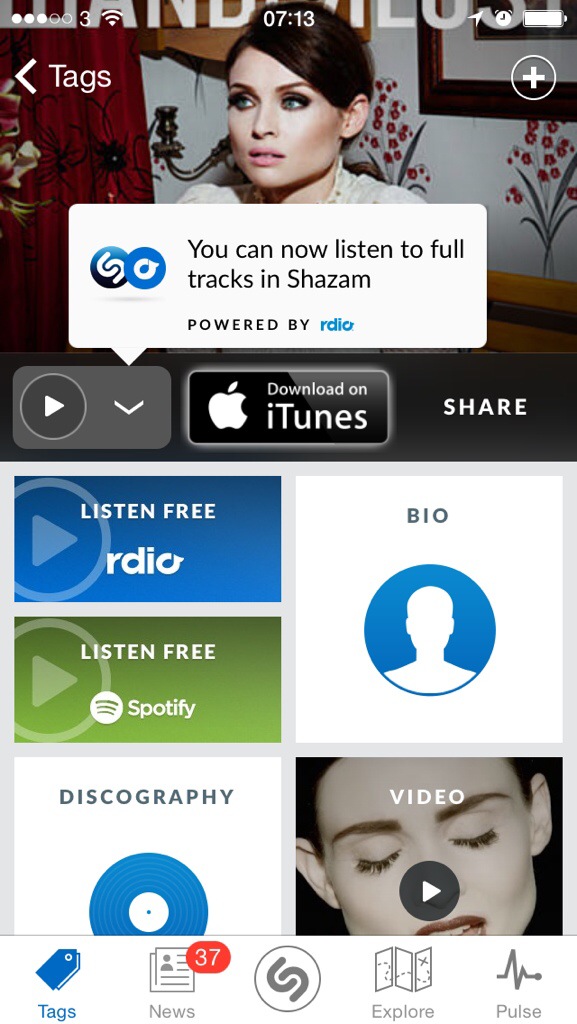
Shazam updated with Rdio playback

20140715-183707-67027567.jpgSeriously, you get something on your mind and then it is everywhere. I’ve been thinking a lot about streaming music lately and today Shazam updated to include some of that.

Shazam is the app by which you can hold your iPhone up toward a speaker playing music and it will tell you what that music is. You can probably find this app in the music section but I think it’s properly filed and catalogued under Alchemy.

What’s new today is that once you’ve heard some music and Shazam has told you what it is, it can now play you the whole thing via the Rdio streaming service. That is the specifically new thing in this latest update and it does require you to have an Rdio account.

But to try it out for you and also because I’d been meaning to try Rdio for myself anyway, I got such an account and then I checked Shazam.

It’s true. I went through all the previous songs I’d had Shazam identify in the bars and clubs of my exotic lifestyle and there was an Rdio button. But there was also a Spotify one. That’ll be because I have a free Spotify account.

So on the one hand, I caught the news about Rdio yet had missed the one about Spotify whenever that was added. And on the other hand, I went off trying Rdio all day. It has one advantage over Spotify: it lets you use all the premium features for 14 days so I was able to get it to play me entire albums in sequence. That’s as compared to Spotify’s free version only allowing shuffled songs and to iTunes Radio’s way of not necessarily playing you the album at all.

Travel advice: The Man in Seat 61

Flashback. Only to last night, I don’t flashback very far. A man I’m working with mentions how much better organised train travel is across mainland Europe compared to the UK. I find that a bit hard to believe because – flashback now to last year – I lost half a day just trying to book a series of trains across France.

He told me about a train travel website that would’ve done the job for me in seconds. Less than seconds. Moments. And it would’ve saved me the worry over whether I’d accounted for different time zones at different ends of the journey. And it would’ve probably meant I’d have had longer than six minutes to get across what turned out to be a very big station.

It might also have meant I didn’t get a few hours in Paris on the way there and back again, so that wouldn’t have been good.

But from now on, I’m using The Man in Seat 61. The man is Mark Smith and his site explains why it’s called what it’s called.

Dar Williams on productivity and creativity

I’ve said this before: I wouldn’t kill to write like songwriter Dar Williams, but I’d maim. She has a fine and long body of work, a now substantial discography but interestingly, she’s against being disciplined and productive. I’m obviously paying more attention and notice because I rate her so much but I think she makes these points particularly persuasively.

She makes them in an old interview on Songfacts where am unnamed interviewer presses on the point thisaway:

Songfacts: When you look at this collection, does it amaze you that you’ve accomplished what you have? I don’t want to ask you to brag, but there must be some moment of pride to be able to look at all these songs and re-visit some of your accomplishments over the years. How does it make you feel when you look at the songs that make up this collection?

Dar: Well, when I was in college, I put a stick-it on my computer, which was huge, that said, “Whatever you do is enough.” I had totally lost my mind, and I was coming back from that. So I would say to myself, you know, you’re supposed to do a ten-page paper, if you do one page you’ll get a D+. If you do two pages, you’ll get a C-, or if you do three pages you’ll get a C-. So that’s all better than an F, so why don’t you do a page?

And it was really, enormously helpful to me. And then a friend of mind was kind of coming back from her lost moment, and I put the stick-it on her computer, and she took a very playful approach to this paper, really appreciating the fact that she wasn’t writing about something very tangible, and just giving it a very playful approach. And she got an A. Her professor said he read it for his wife. It was like, by letting the pressure go and allowing herself to do what she could in that moment, she released a sort of joy in the meaning of the whole assignment.

So it’s like I have a little stick-it on my inner computer that says “Whatever you do is enough.” And I don’t force lines, and I don’t force myself to write every day, and somehow out of that came seven albums that don’t, to me, feel forced. And that’s the only thing I’ll boast about is that there’s nothing about it that to me sounds like I said, “I have to write for 2 hours a day,” with lines where there were no inspiration. I felt it when I wrote it. And I think that experience coming back from being totally insane and putting that stick-it on my computer was a good beginning to a less forced work ethic.

Dar Williams – Songfacts (3 November 2010)

Be sure to read the whole piece: this is all she says on productivity but it’s a wide-ranging interview and she’s smart across it all.

Thanks to @groggy for pointing me at this.

Concluding the streaming music debate – a bit

Previously… I write to music, always have done, I get into ferociously irritating habits of listening to exactly the same piece over and over again. I get a lot of headphones as Christmas presents. I resisted streaming music because I had what I feel is a big collection. But then I tried streaming.

Actually, just to break the Previously and tell you something new: I’ve realised why I tried. I said before that it was iTunes Radio and that’s true, I got access to that early and enjoyed hearing new music. I’ve steadily less enjoyed the steadily increasing number of ads on iTunes Radio but I’ve also realised that its way of playing you types of music rather than letting you specify artists or albums and hearing only those got a bit wearing.

And I heard a song.

I forgot that I could check back in iTunes history to see what it was and instead stupidly spent a while googling every lyric I could be fairly sure I remembered. And I found it.

It was Come to My Window by Melissa Etheridge. Love it.

And I love it enough that I once again tried Spotify. At least with Spotify, I thought, you could name a specific track and play that.

This is sort of true. And it’s also definitely true now that Spotify is free on iPhone and iPad – which is almost certainly true because of the competition from services such as iTunes Radio. Everybody wins, and it earns the artists nothing. Or very little, anyway.

Last time I mentioned this, it was because I’d found this article explaining all the various streaming services and I intended to investigate them. I intended to do this because I was sick of iTunes Radio – I’ve since come back around to it, it’s a mood thing with me – and because Spotify was irritating. I realise they want you to pay a subscription price and not only do I understand that but, spoiler alert, I’m now today thinking of it. But for trying out the service, I thought free was helpful.

But Spotify wouldn’t stick to the music I asked for, it would bound off places playing me other things that might be fine, yes, but I couldn’t stop them when I wanted to. In the end, I would just quit Spotify and force it to restart again. You can’t do that very easily while driving.

Only, today I tried it again. Instead of my usual beloved BBC Radio 4, I had Spotify and a playlist with about 25 songs on it. Including the Etheridge. For 170 miles driving, maybe 2 miles walking and for 90 minutes on buses today, I listen to those 25 songs. Over and over.

There were many, many interruptions for ads and it worries me a bit that most of them were what’s called a house ad: if you can’t sell an ad spot to someone, you use it yourself to advertise something of your business. You want to have some house ads, but you need the revenue from outside companies.

But apart from those understandable interruptions, Spotify played me those songs of mine for a not-very-understandably long time.

I’m a fan. I think. I’m going to play it a bit more to see if I go off it as I have at times with iTunes Radio. And I’m going to wait a bit to see when iTunes Radio officially launches in the UK because the price for it includes some extra benefits and is also substantially cheaper than Spotify. Both Spotify and iTunes Radio start at free but then to get the benefits of the paid-for services, it’s £9.99 UK or $9.99 US per month for Spotify and £21.99 or $24.00 US per year for iTunes Radio.

But for the meantime, I think I’m a convert. That’s a very strange feeling for a man who remembers vinyl, who remembers CD coming in, who lived through DVD coming in and then dying away. But it’s true: I had a very good time today with Spotify.

Using your travel time

It’s been a long time since I drove very much at all. There was a time where, for several years, I would drive from Birmingham to London and back on a day at least once a week. But that would be a three-hour drive in the morning, leaving around 5am, and a four-hour drive back in the evening.

Plus I’d do eight to ten hours work in the middle.

So that was, what, help me count here: up to 17 hours away from my home office. And all but a ten-minute lunch break of it spent working.

When I got my first book contract, it obviously came with a deadline and I could not afford to lose 17 hours on a London day each week. I also obviously couldn’t afford to walk away from the eight to ten hours paid work, even if I hadn’t enjoyed it. This was Radio Times, easily one of my favourite writing jobs in my career.

But I could reclaim at least some of the travel time. If I gave up driving and instead went by trains or coaches – very often coaches because, wow, the price of trains that early in the morning – I could write. Not all the time. Once or twice on a train coming back I’d take a look at the crowd with me and feel wee bit uncertain about getting out a couple of thousand pounds of computer equipment. And sometimes I’d just be too tired.

Quick aside? The train from London Euston to Birmingham New Street goes via Birmingham International where there is the airport and the National Exhibition Centre. Amongst very many other things, the NEC hosts rock concerts. One night, I fell asleep on the train and woke up with my face pressed against the window.

And on the other side of the glass were a group of AC/DC fans pressing back and grinning at me.

Anyway.

I forget how long this went on for but it was probably three months. The book was published in November 2012 – it’s BFI TV Classics: The Beiderbecke Affair and I am deeply proud of it, I feel honoured that I got to be the one to write about that – so this would be late 2011, maybe early 2012.

But what I remember with total clarity was that when it was done, when I had delivered the first draft and could go back to driving, I had saved slightly over a thousand pounds in petrol.

Now, that’s not an accurate figure for saving because it doesn’t account for all the money I spent on trains and coaches. But it was a shock of a figure. Shock enough that to this day I refuse to let myself think about all the months of petrol I’d paid up to then. At least ten years with at least once such drive per week. You add it up, I feel ill.

It was also shock enough that I could not go back to doing it again.

So from that day on, I stuck to trains and coaches for my London work. I sold the car, even.

We still have a car: Angela has one and I use it when necessary or when we’re both going somewhere, I will usually be the one who drives us. Gives her a break from all the driving she does in her work.

Today it was necessary. I dropped Angela off at a place this morning, drove to a couple of jobs, then to a Theatre Cuppa gathering in the early evening and back. Then Angela was off to a production meeting for her theatre work (you cannot believe how proud I am that I can say that to you, I just find the very words delicious) and I was off to a Writers’ Guild committee meeting.

My meeting was quite short but it then took me an hour and a half to get home by bus. I’d driven 170 miles in about six hours today, the last 10 miles were a 90-minute series of bus rides. And those bus rides had more adventure in them. I got to see stand up rows between passengers and drivers, I somehow got to see one woman passenger flash another one even as I actually couldn’t quite see why. The flasher was not complimenting the flashee.

But I missed a lot because I was writing. I wrote nothing all day except some notes at the various places I drove to so I was behind. But on these buses, while keeping an eye on timetable information through my various iOS travel apps, I got to write.

I didn’t enjoy that it was 90 minutes, I didn’t enjoy the drizzle as I got off the last bus. But I got things done and so instead of feeling knackered and pointless tonight, I feel I’ve got on with something and that I secretly deserve to watch the first episode of Community, Season Two, which the finest of fine people has just loaned me.

There are 24 episodes in this season. That’s my productivity destroyed for the rest of the week.

How to prepare yourself for maternity leave

I don’t have children: I’m a civilian. And in my ignorance, I think I rather assumed impending labour would drive all other thoughts from a mother’s mind. Mind you, I have always believed that there isn’t a man in the world who could survive labour pains.

Still , there’s also no man in the world who’d be daft enough to go through it twice.

But since we do seem to keep having children and our work isn’t always as accommodating as it might be, as our working and artistic needs and desires may not be replaced even by the overwhelming nature of parenthood, and as so much of what we do cannot survive a prolonged absence, you need to plan.

Harvard Business Review:

What the experts say
“Part of running a 21st-century company with a 21st-century work force is establishing systems that allow for women to go out and return from maternity leave with minimal impact on the company or on their careers,” says Joan Williams, founding director of the Center for WorkLife Law at the University of California’s Hastings College of the Law. Yet few organizations offer clear guidelines on the nuts-and-bolts of managing leave. Often, you’ll need to figure out how to prep colleagues, outsource work, stay in touch with the office, and re-enter with minimal disruption entirely on your own. It’s a challenge, particularly for the many women who start families at the same time they’re taking on greater professional and managerial responsibilities. But “planning for your maternity leave is an opportunity to demonstrate to everyone that you’re in the game,” says Carol Walker, president of the consulting firm Prepared to Lead, which trains young executives. Here’s how to take ownership of the process and ensure a smooth transfer of responsibilities before you leave, while you’re away, and when you come back.

How to Prepare for Maternity Leave – Julie Mosow (14 July 2014)

A lot of the detail of this piece is specific to US laws and practices but the issues are the same and it’s a useful read if your head isn’t already spinning.

Macworld’s pick of the best free iPhone apps

Some of these are free up to a point and then is worth your paying cash. But it is worth that. Macworld’s David Price has picked out a good set that I think is free of the biases one usually sees: it isn’t packed out with games, it isn’t a selection of deliberately obscure or geeky apps that are fun to fiddle with. Instead, it’s 42 apps that if you’re not already using, you could well find become deeply important to you.

Case in point: of this 42, I use 16 regularly, 5 of them many times today and overall I’ve tried out 28.

Have a look at the lot, would you?