Waiting for something you don’t want to do

I have a meeting in one minute's time. It's not a writing job, it's just a thing I need to get done and the fella is coming to my office so it's not like I've got to rush out. There's no reason to think he'll be late but equally no pressing reason to assume he'll necessarily be on time to the second. So right now, naturally, my mind is on that meeting and I am listening out for him.

But my mind has been on that meeting most of the day and I have been listening out for him since 5am. Even during a terribly entertaining tea room chat, I had it niggling away because I don't want to do it. Incidentally, no offense to him: I need him to do something, he's doing it, I'd just rather get on with other things.

There is always something you don't want to do and I am always losing a lot of time waiting for it. Waiting is death to me: I get nervous even when there is nothing to be nervous about. And I am sure those nerves then impede whatever it is I'm doing.

So today I've practiced doing something new. I'll have to build up for when I'm faced with things I really, really don't want to do. But today I wrote solidly for four hours and then went out to meet a pal for a coffee. And now I'm back, I'm writing again. My ear is out, I'm glancing at the window, but I'm also writing.

This, in fact. Specifically this. If you see a lot of pieces about writing a lot of pieces while waiting for people, it will be because I've somehow got a lot of these suddenly. I hope not.

But I'm distracted enough that I can't do much: I didn't think that I might be able to concentrate sufficiently to do anything at all. Yet here I am. So thanks for being my guinea pig and the next time you're doing something, have some small bits of other things to do as well. They take your mind off stuff and they also get done. He'll be gone in an hour and I'll have to race to catch up with work but if I can find a small short thing to do while I wait, that's something off the To Do list.

Some people included an anticipated duration for tasks on their To Do list: this is an all-day job, that is a five-minute one and so on. I never have and don't expect I ever will have the patience and dedication but finally I understand why they do it.
Kayak Pro airline travel app free for a week

Well, it's been made Apple's App of the Week for iOS and it's been made free: I'm guessing it'll return to its incredibly expensive 69p in about seven days' time. But grab it now. Even if you're not travelling much by air now, grab it, see what it's like, delete it if you want to, and always be able to get it back for free. That's even after the price goes back up.

Kayak Pro for iOS on the App Store here

Kayak Pro just looks for flights from here to there. You get all the ones there are and you get 'um arranged by price. (There are other ways of sorting the data but, come on, it's price and specifically low-to-high that you look for.)

It also does hotels, car hire and it can do combinations of all these. So can many other apps but I have kept coming back to Kayak because it does the job and I like it. I can't think of a better reason to recommend that. Though if the company ever wants to sponsor me for anything, I'll work on it.

In this week’s newsletter (16 May 2014)

As summer comes, we get to lighten up. A bit. As well as the productivity tip of the week, the latest email newsletter covers how to get more money at your current job – and how to get another job instead. Plus folding phones, an OmniFocus clone for Android and the first hints of sequels to The Blank Screen.

Read more in this week’s The Blank Screen email newsletter.

And sign up to get it emailed right to you every Friday.

Get the new Logacal app for free – for now

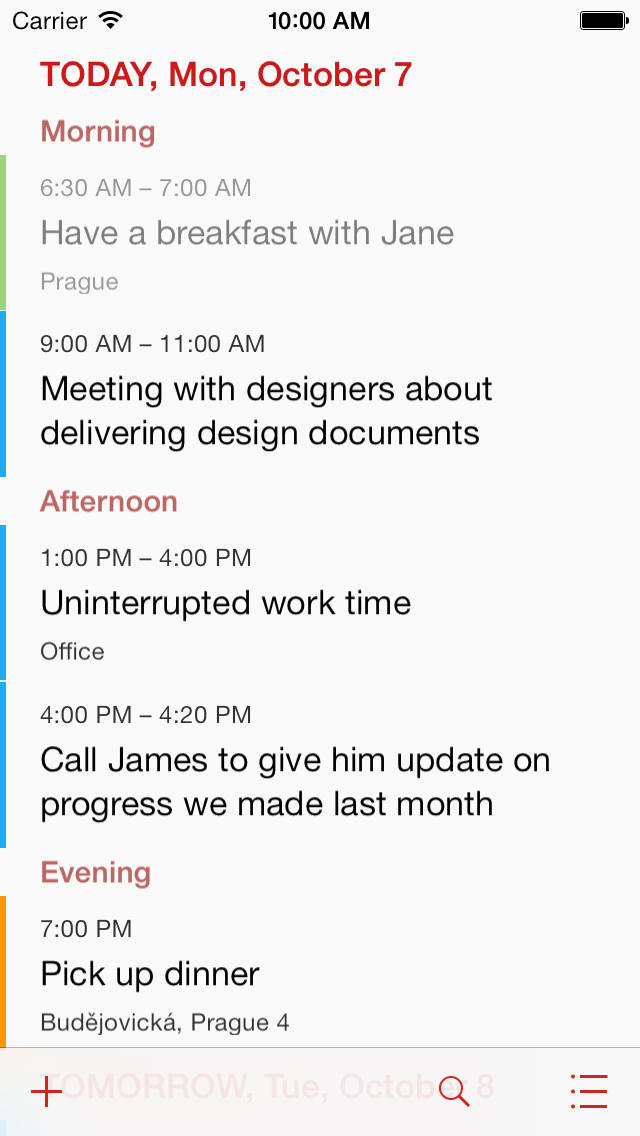
Oh, give me a break: it’s taken years upon years for me to move away from Apple’s own Calendar app on iPhone – I now use Fantastical 2 for iPhone and for iPad (they’re separate apps) – and here’s another alternative that looks rather good.

Logacal is temporarily free and I can’t tell when that will change. But even if it’s gone by the end of this sentence, the price will only have gone back up to £2.99 UK or $2.99 US. The price is not the reason to buy, the price is not what’s good about this app. This is:


screen1136x1136

That’s one of the makers’ provided screenshots: I can’t show you mine because it has oodles of detail that I shouldn’t show you but which I should show me. Look at that: nuts to monthly grids or daily hour lists, that’s what events are coming up that have to be dealt with.

That shot also shows many To Do tasks and I don’t like putting them on a calendar – so I don’t. But I have a recurring To Do task which is just “Check calendar for tomorrow and week ahead” and I can do that in a thrice with this app.

Get it from the iOS App Store.

Running iPhone apps on Android

It’ll never happen. Google wouldn’t give a monkey’s but Apple would. And I don’t know that I’d want it to happen anyway: it wouldn’t be much of a step from that to having every phone run the same software and then where would we be? I don’t like using Android phones but there’s no question that iPhone has benefited from there being competition. Though plainly Android took nothing from iPhone, nooooooooo.

Still, it could happen in theory – because it is happening today, it is just now just about possible to run an iPhone app on an Android phone:

…six Columbia University students have bridged the gap between the two platforms with something called Cider (via The Next Web). Not to be confused with the other Cider software (for OS X), the Android version of Cider essentially fools iOS applications into believing they’re running on an actual iPhone or iPad.

9to5 Mac

There’s work and there’s work. You would never use this in real life. And I have serious questions about the smartness of university students who don’t know the difference between portrait and landscape: have a look at their video about all this.

There’s more to negotiation than money

If you’ve got a meeting with someone, they want to work with you. Or at least they want to want to work with you. Make the most of that meeting, get what you can and remember that the ideal is that you will be working with these people so let’s leave everyone happy. And at some point money is going to come into it but money is not all.

It’s a lot. Let’s not be daft.

But:

Have more items than they have. Let’s say you are negotiating a book advance. They offer a $10,000 advance and they can’t budge higher.

That’s fine. Now make your list of other things: how much social media marketing will they do, what bookstores will they get you into, who has control over book design, what percentage of foreign rights, of digital rights, you can get. Do royalties go up after a certain number of copies are sold, will they pay for better book placement in key stores, will they hire a publicist? And so on.

Before every negotiation. Make a list. Make the list as long as possible. If your list is bigger than theirs (size matters) then you can give up “the nickels for the dimes”.

This is not just about negotiation. This is to make sure that later you are not disappointed because there is something you forgot. Always prepare. Then you can have faith that because you prepared well, the outcome will also go well.

The Ultimate Cheat Sheet to Become a Great Negotiator – The Altucher Confidential


Be smarter: don’t apply for jobs when they’re advertised

It can’t always be a good idea, but when it’s right, this could work well for you:

Introduce Yourself When They Aren’t Looking

What if you saw an ad for a job where you knew there was a fair amount of turnover. To add to this, let’s assume you are not desperate and unemployed. Wouldn’t it make sense, then, to allow the ad to run its course and send a letter a few weeks later to make it appear your interest in the company was genuine and not an opportunistic spur of the moment decision made because there was an enticing ad that sparked your interest? The point here is to get yourself noticed when they aren’t looking — and when there aren’t a hundred other candidates seeking their attention all at once.

8 Ways to Get Noticed During a Job Search – Wisebread (2 May 2014)

The other seven ways are pretty good too: read the full list. (And a nod of the hat brim to Lifehacker for spotting this.)

Being conscientious. If you can fake that, you’ve made it

I automatically resist claims that there is, for instance, one single thing that makes people successful/rich/attractive* (*delete as applicable) because there isn’t. But the Inc website makes such a claim (via Lifehacker) and it is persuasive. I’m sure there is more to it but I could be convinced that this one thing is an essential part of being successful:

The only major personality trait that consistently leads to success is conscientiousness.

This is the Personality Trait That Most Often Predicts Success – Inc

Besides, I like it. I like that this is successful trait. Read on for some statistical research and more detail.

But then when you’ve got a raise…

You’ve negotiated for a raise, you’ve got some extra cash, all is well and right or at least better with the world. And then it goes wrong:

It seems like common sense: a larger reward encourages a greater effort. So if you need to inspire a person or team to strive harder, an obvious tactic is to offer more money. Reality, however, is not that simple.

Even the mere mention of money can be enough to change our mindset: It has the power to make us more selfish and competitive, while also putting some useful social contracts on hold. Meanwhile, large financial rewards transfer challenges that would have been pursued for passion or creativity’s sake into emotionless financial exchanges.

The Unpredictable Consequences of Using Money as an Incentive – 99U

Recently I’ve seen several times when an article has been published under one title and then changed – but either they forget to change the web address or their system won’t let them. Here’s the address in full for that article:

http://99u.com/articles/26185/how-money-makes-us-lazy

So the original headline was How Money Makes Us Lazy and I think that’s a better one.

The rest of the piece goes into specifics and is interesting.

Get a raise

Here’s some smart advice from Time magazine about how to negotiate getting more money at work. But first, its opening lines made me laugh:

A new survey finds that what makes us satisfied at work isn’t what’s in our hearts; it’s what’s in our wallets. According to the Society for Human Resource Management, 60% of American workers surveyed last year said pay/compensation was “very important” to them, making it the top-ranked priority.

Some things do not need surveys.

But the rest of the article is very good about whether you actually deserve a raise and only then how you ask for one. Plus it covers exactly what you’ve just thought about: what happens when you then don’t get it. Have a read of the full piece while I go talk to my boss about paying me more.

UPDATE: I am my own boss and he says no.