Time and pace

I’ve a video coming out, possibly next week, which opens with a slow pan from left to right, taking you from a pub sign and across a lawn to the pub itself. There’s a title overlaid for bit, but roughly speaking, the sequence lasts for seventeen thousand million hours.

Okay, Final Cut Pro says 11 seconds. But it has taken effort for me to not slice it down to a fifth of its current length. Somehow there is a part of me that likes this opening, that thinks it’s the right one for this video, but there is a bigger part of me that thinks I risk boring you with it.

I need to work on this, I know. I need to let there be a breath from time to time, I need for there to be quiet parts of videos or low key parts of any writing I do, and if for no other reason, to give the busier scenes more punch by comparison.

I am too quick to move on to the next thing, like I think if I don’t keep constantly showing you something different, something changing, you’ll lose interest. Truly, I was born for TikTok generation.

But I was actually born in the last broadcast television generation instead, and I know that slow can be immensely absorbing. For instance, the opening to the BBC’s version of Tinker, Tailor, Soldier, Spy is a quite mesmerising scene just showing various people arriving for a meeting. No one says anything, they barely look at each other, but then minutes into it, the leader of the meeting says something like “Let’s begin.” Smash cut to main titles. I could applaud.

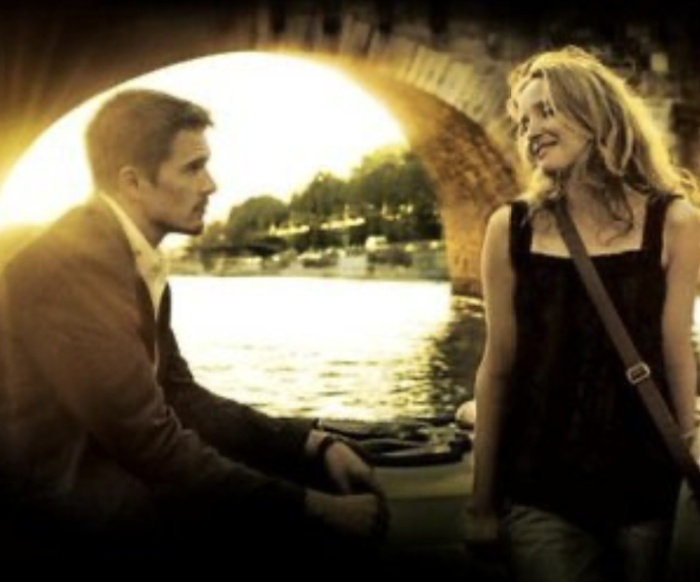
Or last night I read the script to Before Sunset, and the evening before I watched the film. The three Before movies — if you haven’t seen them, Before Sunset is the second — are as quiet and calm and uneventful and packed with drama and noisy and uncomfortable as I remember.

 Yet this second film opens with a visual echo of the end of the previous one, Before Sunrise. That first film, as I very well noticed, concludes with a series of silent shots of various locations early in the morning. There are no people in sight, but it’s an irresistible look back at when the two lead characters were there.

Before Sunset opens with the same thing. It’s a different city — it’s Paris — but the series of unidentified locations, just one after another, is special. It’s a low key equivalent of a teaser. And I don’t remember what I thought when I first saw it, but watching again this week I realised that of course every shot was of a location we would soon see the lead characters in.

I also realised that this may have just been production practicality. The script says to open with some nice shots of Paris locations, you’re filming in Paris, give yourself a mo to take some extra shots.

Yet to me, the idea is just as fascinating as the closing moments of the first film. In both, I think you marvel at how different a city looks when the people are gone, and in both I think you see this world as a stage set.

What you definitely see is that this takes time and does so in every sense: it takes its time and you’re with it to the end.

I really need to be better at letting something breathe and not be forever cutting to the next thing and the next. Anyway, good talking to you, must dash.
Tapped out

“The Naked Gun” and “Spinal Tap II”. Two films, both alike in indignity, on a cinema screen near you, where we lay our scene — and where one I’m ignoring, one I’m waiting for.

I am just fascinated by this: I may be a little wary of the Spinal Tap sequel, but there is not one pixel of a chance that I’ll go see the Naked Gun in cinemas, specifically because of how they’ve been marketed. Sometimes it feels as if you have a film and you have the marketing campaign, which are two separate things, and other times the pair work together well.

So for instance, I am certain that a reason I went to see “Barbie” was because of its absolutely applause-worthy billboard that was simply solid pink, no images, and just the release date in the corner. Because it was precisely the right pink you instantly recognised what it was advertising and that poster fitted with both the rest of the campaign and the somehow joyous feel of the film. Utterly perfect marketing, I think.

With Spinal Tap and The Naked Gun, they’re both based on 1980s films. They’re both being made so that they come out at a time when enough of the original audience is feeling nostalgic, or at least enough of them haven’t died yet. They of course want a new and young audience, but they’re trading on the familiarity, the popularity of their original versions.

Now, it seems to me that The Naked Gun is solely doing that. There doesn’t seem to be any in-story reason for it existing. Whereas with Spinal Tap, the conceit is that if this rock band does not perform again, they will lose the rights to their material. It’s nice gag that plays to the age of the group, and so to the age of the audience, and if it’s surely as contrived as The Naked Gun revival, it’s very well contrived.

So that was the first word of the Tap sequel, although it followed years of really tremendous wish-I’d-thought-of-it jokes. Such as in 2009 when Tap performed a one-night-only World Tour. Or in that same event, they appeared as their own support act, in the guise of The Folksmen from another of the team’s films, A Mighty Wind.

The Naked Gun has had nothing except for continual posting to YouTube of clips from the original TV show it was based on, Police Squad! Those clips convey the silliness of the first show, but also some exceptional writing. The interview of Sally Decker, for instance. To this day, if anyone speaks about having filled in for someone, I’m left thinking “Phil Din? He’s the night watchman, Frank.”

Or the precision of the overlapping conversation as a suspect is interrogated in the foreground while in the background an officer brings in lunch.

And to this day, decades later, if I’m in a conversation where someone goes, I don’t know, “Let’s say you knew all about it.” When that happens, it takes enormous, just enormous physical effort for me not to turn to an imaginary camera and say “You knew all about it.”

I think it’s interesting that Police Squad! keeps circulating on YouTube and, in what the algorithm shows me anyway, there isn’t so much from The Naked Gun films. 

Until recently, when the trailer for the new film came out and to my mind, it’s a trailer for the wrong film. I’ve seen clips since that seem better, but the tone of the trailer, the jokes it shows, it’s peurile. I question how young you have to be, how easy an audience you have to be, to find Liam Neeson wearing spotted underware to be hilarious.

Whereas in the last week or so, the trailer for Spinal Tap II dropped and I’m in. It’s new and I don’t think it’s just a repeat of the original, the way that Star Wars films do. Yet the flavour of the trailer is right, the tone of it is right.

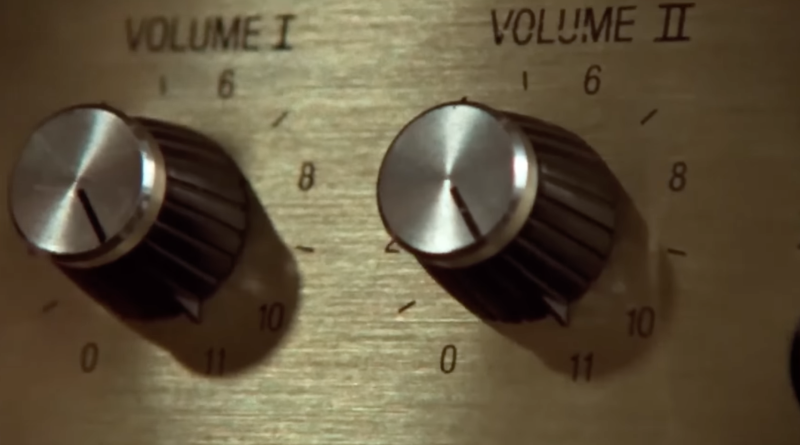
Spinal Tap II could be dreadful. The Naked Gun could be brilliant. But the perception their marketing has given me is so different. One of these films seems certain to be a two-star movie at best, while the other feels like it has a chance to go to 11.

Rating audiences

So just now, I was watching an interview with Warren Littlefield, a particularly well known US TV executive who was talking about the development of “Family Ties”. If you know it. it’s the 1980s sitcom starring Michael J Fox, and if you don’t know it, er, it’s still the 1980s sitcom starring Michael J Fox.

Anyway. Littlefield was praising writer Gary David Goldberg — and when a TV executive has even heard of the writer, they rise in my opinion — but specifically about how he was able to listen to what the audience wanted to see and where the audience wanted to go.

Television is a commercial enterprise, 1980s television was an extremely profitable one, and “Family Ties” is very good. So I can’t disagree.

And I don’t, really, except I realise that I want to. There is something about making a show to suit the audience that feels somehow wrong. It’s not like I’m against audiences, but I am against things like those choose-your-own-adventure books where the reader decides when to kill the monster. You can spin me as much bollocks about interactive storytelling as you want, there has to be a story to be told. And if you are expecting the audience to tell it, I see no reason why they should tell it in front of you.

Plus there is also the fan effect. The point where your show was so good and fresh that it got actual fans, but now things have tipped over an edge and all you want to do is please those fans.

With fans of any show, and really I think audiences of any show, what they will tell you they want will always boil down to more of the same. I’ve thought this before, we want to see something again but for the first time. We want to recapture how we were when we first saw it, and despite that being impossible, we can end up criticising a show for moving on.

No TV executive will ever agree with me, and I will never say they’re wrong, yet I think you have to write whatever it is that you want to write and hope that an audience comes along.

In other words, my Jane Austen week on 58keys was the most superb fun to make and though it didn’t do brilliantly in my viewing figures, I would do it again in an instant. I’d do it again for me and the fun, and I’d do it again for what great reactions I got.

It can’t always be about big numbers. Although maybe that’s just a failure of imagination on my part.

Learning the tropes

I’m not going to admit that I’m a bit confused this week, because you’d hear me. But something I have believed pretty stridently has been called into question — and it was called into question by me. I should never listen to me.

Here’s the belief. You cannot use a familiar idea, a trope, in drama and say that it’s fine because the audience doesn’t know it. That the audience is not as familiar with it as you are, that you are involved in drama so you know these things. I think that’s a bit grandiose on the part of the writer, and damn patronising about the audience.

I once refused to take a suggestion on a script because it was an idea I had seen something close to eleventy-billion times in other dramas. “Doesn’t matter,” said the suggester, “the audience hasn’t seen it before.”

I believe I managed to avoid saying “bullshit”, but the fella didn’t press the point so I suspect I at least oozed quiet anger.

And then there’s this week. I can’t tell you exactly what happened, partly because I’m not allowed to, mostly because I’m clearly an arse who wants to sound exciting and important. But during the course of this thing which did matter to me but otherwise isn’t worth your wondering about, I got into a discussion about a particular recent drama.

Actually, a couple of them. But one of the people I was talking with disliked a certain show because, as she said, it was all very familiar stuff with the same police tropes. I can’t disagree, she was factually correct, and yet I wanted to disagree because I really liked it.

Trying to vocalise this then, and trying to be clearer now, I think the issue was for me that this time I believed the tropes. In any police procedural drama there are going to be the same steps in an investigation and I’m accepting that as accuracy rather than repetition, I’m accepting it as authenticity.

Around those points, though, characters were reacting in the same ways that all characters do in these shows, and that was my colleague’s issue. Yet in this one case, I believed them. I felt the pain and the anxiety.

So I am demonstrably wrong. You can write what audiences are already familiar with and it can work.

I think this is just yet another case of how the answer is that you simply have to write it brilliantly.

In which case, sod it, I can’t tell you what I was doing this week, but I must tell you that the show is “Catch Me a Killer” and while the series main writer is Amy Jephta, the episode I wats talking about was by Oliver Frampton. In the UK, it airs on U&Alibi.

Happy bonnets

One thing I can’t bear is when a series contorts itself into doing some kind of special. So anyway, next week is Jane Austen week on my 58keys YouTube channel. That would include the OG Wednesday 58keys which is specifically for writers who use and write on Macs, iPhones and iPads.

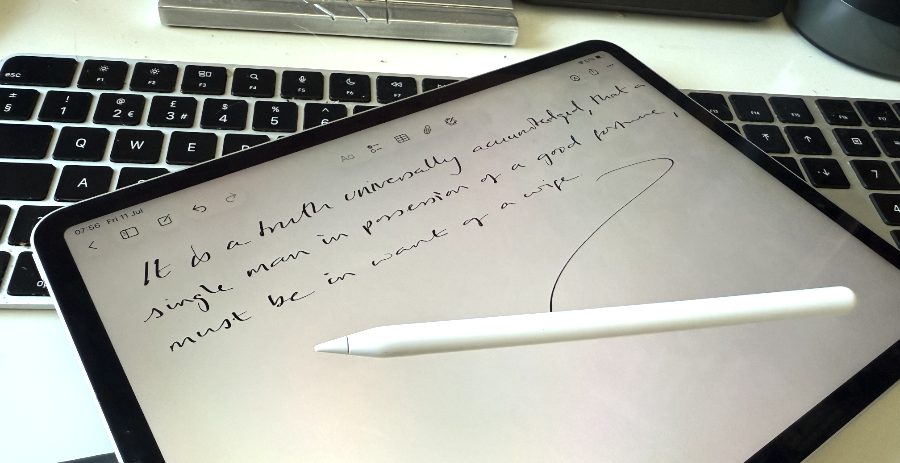
To the best of my knowledge, Jane Austen never wrote a word on 128GB iPad mini with A17 processor.

That’s what 58keys has been about now for some years, using this type of technology to type on. You can call it a way of putting off writing by over-thinking which word processor to use, and you can call it over-obsessing with tools like the To Do app OmniFocus, without which I would not have a writing business juggling all that I do.

But last year I added a second weekly video, specifically about writing itself. Each Monday, I tell you how I happen to write something, and I ask that you please disagree with me in the comments. I do not ever kid about this: I cannot see any value in my just telling you what I think, it’s only useful if you and I talk about the topic afterwards, if I can steal from you afterwards.

Then this year, 58keys Patreon member Mark Horton — take a look at his blog — suggested I do a 58keys book club in an exclusive YouTube Membership series. I turned it into a script and screenplay club instead, and YouTube Membership turned it into a dud. But since scripts are another obsession, just finding out that anyone at all was up for discussing them with me was addictive and so now I’ve made it a completely free video every Friday.

Next Friday’s is about Emma Thompson’s glorious screenplay version of Jane Austen’s “Sense and Sensibility”. Next Monday’s workshop is about writing lessons I think I’ve learned from Jane Austen, and I’ll be asking you to tell me in the comments whether I’ve totally misunderstood her.

It’s the Wednesday technology one that’s giving me pause. She wrote with a quill, not an Apple Pencil. Although maybe Cassandra Austen couldn’t have destroyed so many of her letters if Jane Austen had only used an iCloud backup.

There is the fact, truly, that the first time I read a Jane Austen novel, it was on my iPhone. I can see me on holiday in the late 2000s, reading Pride and Prejudice on this thing, having to swipe to the next screenful every couple of paragraphs. And being so into it that I never noticed I was swiping.

And then there’s also this, which to my mind makes it right to celebrate Jane Austen even if it takes a little contrivance. This year is her 250th anniversary.

The actual 250th is in December, as it’s of her birth. But she died on July 18, 1817. Every year at this time, significant anniversary or not, Katie Lumsden runs Jane Austen month on her Books and Things channel on YouTube, and I’ve stolen the idea from her. Well, I’ve stolen a quarter of it: if I tried to do a whole Jane Austen month on 58keys, we’d soon be down to which colour iPhone might she have preferred.

It might be worth it. I keep thinking how I’m writing to you on a simply preposterously over-powerful Mac Studio which probably cost more than Pemberley did in her day, and that I’m using a ridiculously wide monitor that’s at least the price of a barouche and horses.

She just had paper and a quill.

And forget swiping every few paragraphs, she had to keep breaking off writing to dip that quill in ink.

Yet look what she wrote. True, there are people who’ve vaguely glanced at TV versions of her work and think it’s about young women with nothing in their heads but marriage, and nothing on their heads but happy bonnets. And truly, she’s really writing about women struggling to simply survive. Truly she is capable of being vicious at the same time as being laugh-aloud funny, but okay, there is also the odd bonnet.

I am re-reading and relishing the work of a woman who wrote a quarter of a millennium ago. Myself, I’d be pleased if I ever thought my writing would be remembered in a quarter of an hour.

Rabbiting on

Not to say that my mind is all over the place but before I get serious about desks, there’s a story from childhood we need to half remember. I want to say that it’s from Br’er Rabbit but given my age that would mean I got it from Disney’s “Song of the South” and you and I are not going there today, so we’ll forget half of this and remember just the bit about how the rabbit does something bad. He’s done whatever it is, someone is going to tell on him, but he gets to put his spin first and so he’s fine.

The first version you hear is the one you believe, the one you prefer.

And quite rigidly so. I had to talk with a rabid Trump supporter the other day and she insisted, insisted, insisted on how everyone should check their sources and they must, must, must seek out all opposing points of view throughout Fox News.

Anyway.

For reasons I cannot tell you — and that you would not give one pixel of a toss about if I could — I’ve been required this week to watch a couple of episodes of “Patience”. I’ve seen several before, though as it happens not these two, and it’s a good show. Except since I saw it before, I’ve been watching the original French series it’s based on. If you don’t happen to know it, its “Astrid et Raphaelle” but streams in the UK on Channel 4 under the title “Astrid: Murder in Paris”.

It’s excellent. I was recently invited onto a radio show to recommend TV shows to binge on and I immediately wanted Astrid to be the series I enthuse about — but I’d been beaten to it by at least one person before me. I felt robbed.

Both these French and British shows are police procedurals in which an autistic woman working in a police criminal records department helps solve crimes. As ever with pitch lines, it doesn’t sound great and it does sound contrived. It sounds like the way Quincy was a medical examiner but he would go out on cases because that’s where the cameras were. Or how Charlie’s Angels would fight any crime, but preferred ones involving going undercover in bikini fashion shows. Someone’s got to do it.

No question, Astrid and Patience are contrived. The original eventually addresses this at length and turns it into a problem for the characters instead of for us as viewers. And the English-language version actually comments on it very early on. The core problem is that this lead woman is a civilian and there have to be regulations and laws and procedures that she violates by becoming part of the various investigations. If that sounds like nitpicking, like I know my Police and Criminal Evidence Act (1984), then follow: Astrid/Patience have difficulty crossing a police line because only authorised people can. The two versions of this character stand there at the tape, unable to move until specifically authorised. You really feel for her, this difficulty is very well conveyed and that’s what makes these shows compelling, but it also means that whether I care about detail or not, they do, so skipping around the issue is TV logic.

Although, okay, you’re still thinking I nitpick because I knew that PACE act was 1984. In which case, let me pick: one episode of Patience I watched this week opens with a woman listening to her huge smartphone over wired headphones and it made me grumble. There’s no law that says a character has to have a new phone, but it was such a big one that it seemed new, seemed to be one of the more recent large-screen models. Yet it’s nine years since iPhones had a headphone jack and five since Samsung removed them too.

I can say this to you and I can say that the French original of this same episode did not have the same mistake in its version of the same scene, the same story. But then there are things I prefer in the British version, others I prefer in the French, and it’s all bits and things. I’d like to know why certain key decisions were made that make the stories different, but I can’t say one choice is better than another and normally I feel I can. I don’t mean I’m right or that you’d agree with me, I mean I can’t think of another example where I haven’t got both an very definite preference and reasons I think back it up.

For instance, this week I was also listening to Sheryl Crow’s version of Mississippi, a song I only recently learned was written by Bob Dylan. Then I listened to Dylan’s version. It’s so different as be practically laughable: it’s fine, it isn’t funny really, but it’s so dour and miserable compared to Crow’s version that it sounds like it was deliberately intended to sound miserable.

So in that case, easy. I prefer Crow’s take. But then I heard hers first. Just as I heard her version of “Sweet Child O’Mine” first and like it enormously, while people who first heard the original Guns N’ Roses version apparently do not.

Everybody prefers the first Doctor they saw in Doctor Who. Strictly Come Dancing is better made than Dancing with the Stars, if you see them that way around. The Princess Bride is an incredibly better novel than it is a film, unless you saw the film first and now entirely incorrectly believe that the novel is a shrug in comparison.

It’s not like either you or I sit here making up star ratings for things, but almost as if it’s a rule, I think there tends to be one version you like and one I think is at best an interesting copy.

I prefer “Astrid: Murder in Paris” to “Patience”.

Yet if all you can possibly get from this mess in my head is that I’m recommending Astrid, I am also recommending Patience. Perhaps if you’ve read this far, that’s what you need.

I’m just fascinated by two versions of anything and what sticks with you, what seems to land. During this week’s viewing, for instance, I kept being struck by how the lead detective’s desk is in the wrong place.

That’s the lesson here, as a viewer, as a recovering TV critic, as a writer. It is vital for drama that you arrange the furniture correctly.

And you thought the headphones thing was weird.

Picking at threads

I want you to picture what I actually can’t quite remember, it was so long ago. But whenever it was, 16th or 17th century, I’m in a meeting at BBC Radio WM. I am so young that I’m probably only in the meeting because I’m too shy to get out of the room. I’m as of little use or significance to the discussion as the free copies of Radio Times you used to get on staff back then, and which may actually be why I went in there at all.

But they’re discussing Christmas schedules and staff rotas, and the issue I remember is how annoyed the programme director and the station manager were about a show. To my mind, it was a gift: BBC Radio WM had the rights to repeat a series from BBC Radio 4, a documentary series about the station’s home turf in West Midlands. To my mind, this was a show that was already made, and it wasn’t as if anyone was unhappy about paying a repeat fee. If there were a repeat fee, it so little concerned anyone that the subject didn’t come up.

To everyone’s mind, it was a first-class show, too. It was called “Teachers” and I think if it hadn’t already won awards, everyone who heard it knew it would. So quality wasn’t an issue, any costs weren’t an issue.

What was an issue was that each episode was half an hour long and the station wanted to run it in 15 minute chunks — and couldn’t. Specifically, it could not do this because the show itself just physically couldn’t be split in two. There was no break point you could make in the middle, there was no break point anywhere.

To my mind, that was a perfect half hour show, then. An absolutely perfect edit where every second was used, nothing was flab, you were carried along for the whole duration and no further edit was possible.

Unfortunately I don’t remember what happened next. I think they ran it in its intended half-hour lengths, but that may be wishful thinking. I’ve half a memory of being the person who played the tape out that Christmas but, as I say, it was so long ago that chocolate hadn’t been invented yet.

But I’m minded of this all week because I’ve had occasion to re-read a radio play of mine that didn’t get anywhere and I may be able to make an opportunity for it. I think I can say to you that it has the same tight editing in the writing, that each bit perfectly fits in with — and really even demands — the next part. Tight in structure, bound together by some gags that only work when they are slammed up next to one another, the comedy of counterpoint.

But the reason I feel I can say to you that this is a perfect piece of work is because it’s too bloody short. I need to find 10 to 12 minutes more material and so I’ve been looking at this sodding thing, completely unable to find where I can split it apart and add something new in.

I do see writing as knitting together a story, and so I do see making big changes like this as requiring you to first unstitch the piece. I’m not 100% sure now how similar knitting and stitching is, I may be mangling a metaphor. And if I’m not then, I am now: I picture myself holding the two unstitched ends up in the air, trying not to let them drop until I’ve got the new bit in and the concrete has set.

It’s a nice problem to have. It entails, for me, reading and re-reading the script, weighing each piece and spending a stupid amount of time just sitting and thinking. I don’t take a lot of time to just think so being forced to in order to achieve what I’m after, it’s practically refreshing.

And it’s good to be in that world again, it’s good to be with these characters. It’s even impressive — obviously just to me — how it’s so tight that there are exchanges of dialogue that are not remotely funny, except that they are because of precisely when they come and who says them.

It actually feels like proper writing. I hope I can get it away this time.

A parallax view

We have a new couch. If I sit on one end of it, then out of our living room window I can see a tree. It’s up on a hill about four streets away and I don’t really know exactly where it is, but I think it’s in summer.

If I sit on the other end of the couch, I can’t see the tree. The sky that takes up that whole view is clearer for this arboreal absence, but it’s all lessened somehow, as if its blueness has had to be diluted to cover the same area.

Secretly, I am convinced that the tree knows I look at it and moves away because it’s shy.

I realise, just as of course you do, it’s just the different angle I’m looking at that makes this difference, but I’m startled by how much that difference is and I think you might be as well.

Whereas you’d be less startled — if we’ve ever talked above a single minute before — that there is part of me that wants to now make a writing point. I didn’t set out to, I’ve just genuinely been thinking about you and about that tree, and specifically about why it puts me in mind not only of summer, but specifically of summer when I was a child.

Anyway. As I started to write this to you, I got a notification of a comment on a video I’ve made. I can’t quote it to you exactly because that would mean asking you to wait while I went to look up the full text, but it caught my eye both because I read very quickly, and because it said something nice.

“For a writer, you have a great grasp of technology,” it said, or something similar. I’ll go read it properly when we’re done, but I know that was the gist.

Now, the message could be right or wrong about me and if you disagree with it then I wouldn’t dream of arguing with you. But for me, the pleasure of it was this view of me. It’s been a while now, but over the years I’ve been equally pleased to have had other comments like this from audiences or even editors who have been surprised by finding out something about me.

Usually it’s like this message, that someone sees me as a writer and now gets to watch me in a seemingly different field. Previously it’s been people who know me as a technology writer being surprised at my drama or television history work. And vice versa.

I don’t know why I like this or why I suddenly feel as shy as a tree saying it to you, but I think each of these people have chiefly been surprised for the same reason. It’s not that I happen to do two things, say, it’s more that they saw me as this one thing and that was complete, it was enough to convey my character to them. That was a life. And now here was this entire other side.

‘Course, it would be so much better and dramatic if this other side me turned out to be one of wild abandon and high-stakes criminal activity but look at me, look at the way I dress. I may like to think I am these two or more different peoples, but in truth whatever way you look at it, I just spend all my time typing.

It depends how you look at it.

The words you use and the words you don’t

I have a feeling that I’m heading toward a criticism of how AI tries to write, but really what’s on my mind is how stories are more than plot — and the examples I’m thinking of were entirely human-written.

Follow. Earlier this week my friend Mark Braxton on Radio Times mentioned that 2025 is the 40th anniversary of “Edge of Darkness” by Troy Kennedy Martin. It’s a six-part BBC television drama that, if you had to tell someone who hadn’t heard of it, you’d probably say was about a police officer trying to find out who murdered his daughter.

But if you know the show, what you’re thinking as you’re saying all of this is that it’s actually about a detective who nearly becomes a tree.

Look at that difference, right there. First it sounds like an ordinary thriller, then it sounds insane. The truth of “Edge of Darkness” is that it’s somewhere between the two, especially since Troy Kennedy Martin was talked out of the whole arboreal ending, but also because the series is much richer than a police procedural.

The thing is, you can prove that. It’s demonstrable, because the story has been told twice, to very different effect, and that difference is all in the telling.

For the 1985 TV series starring Bob Peck was remade in 2010 as a film starring Mel Gibson. Okay, yes. But the TV series had music, in part, by Eric Clapton. So nothing’s safe. That said, Clapton’s theme music was exceptional and Gibson’s acting, in my opinion, was functional.

The two productions are the same story and, curiously, they’re both directed by Martin Campbell.

Mark tells me, though, that Campbell has said he doesn’t think the film works. There are specific story points and particular characters from the original that are not in the film, but overall it is really that there is just a functional feel to it.

The film is about who killed this woman.

The TV show is about Knights Templar and the Teutonic knights of the Marches and a battle waged over hundreds of years, now being played out against 1980s Thatcherism, Reaganism and the proliferation of nuclear weapons.

The thing is, only that last bit about nuclear weapons is on the surface of “Edge of Darkness”. Yet that, plus all of the rest, informs the characters and what happens to them, it informs how things happen, and it truly informs the drama.

Now, I have a slight problem in that I loved the TV show. (I skipped out of revising for exams in order to see Troy Kennedy Martin at a day-long screening of the whole series in a cinema.) I loved it so much that I could not make myself watch the film.

But.

When Mark said this about the anniversary, I wanted to re-read the show’s scripts and couldn’t because my copy is in a box somewhere in the debris of my office. So instead, I braved it and I read the script of the film — because you can now find online.

It’s fine. Screenwriters William Monahan and Andrew Bovell have written a thriller that works fine.

Unfortunately for them, it turns out that Troy Kennedy Martin’s published script book is available to read online in the Internet Archive.

I read the the whole series scripts, then I watched the start of the film and the first episode of the TV show.

Same characters. Same plot. But the film is a puzzle, the TV series is a story.

And in both cases they are what they are because of the words that were used and the words that were not used — but which inform the show and are absent from the film.

Gunning for Blake’s 47

Okay, I’m just going to dive in since it’s solely you and me here, and if I think this is the only time I’m going to embarrass myself, I have several more thinks coming and possibly daily.

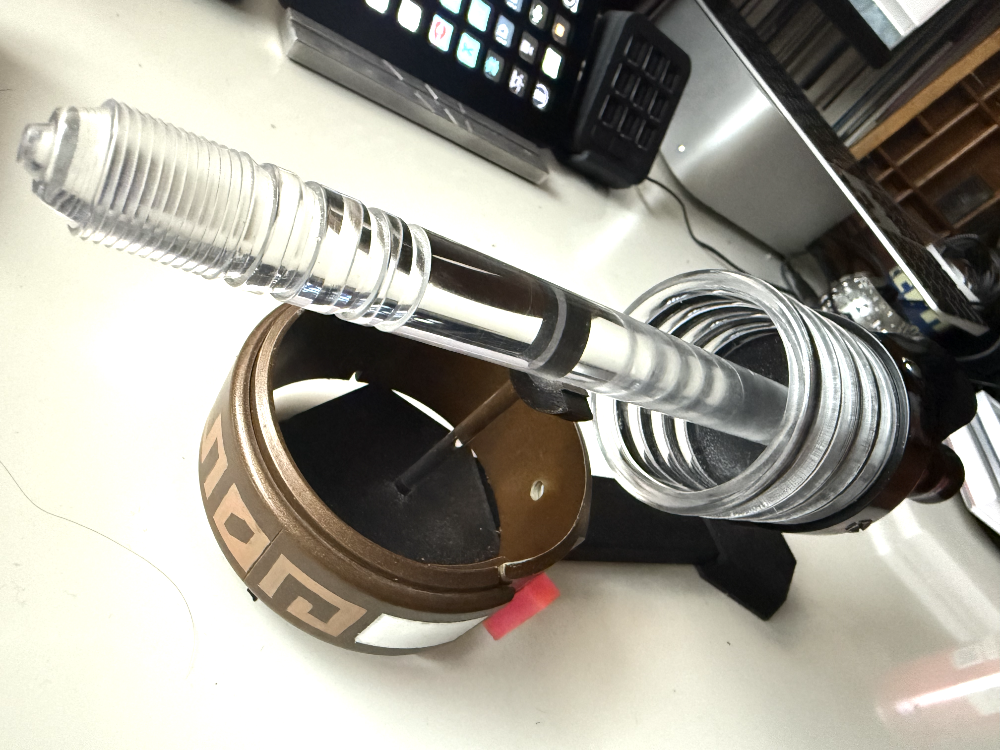
But in the first three seasons of Blake’s 7, back in 1978 when I promise you I was minus 30, the characters had a certain type of gun. To some people then, they looked like toothpicks, and to others now they look like children’s toys. But to me then and even to me right now, they look great and I want one.

Somehow around then, I mean right back then, I got a Blake’s 7 teleport bracelet — if you know, you know — and while not screen-used, I have this memory that it was made by the same people who did the ones on the show, and at the same time. That bracelet has been on every desk of mine ever since.

But somewhere between 1978 and 2025, somewhere closer to my being embarrassingly young, Blake was cancelled. I can’t remember now whether I sent a letter asking to buy the prop guns or just wrote it, but I know I wrote it. It’s long gone, hopefully into a bin instead of a postbox, but I can still see it. I must’ve been in my early teens, maybe middle teens, but my handwriting then looked like it was that of a four-year-old.

So very many things have changed about me over this time, but one is that my handwriting is still that profoundly shockingly bad, and the other is that I want one of these toothpick child’s toy Blake’s 7 guns.

And as of last Tuesday, I’ve got one.

A UK firm called Mooncrest Models makes these and countless other prop replicas from TV shows. I say countless, I mean I’ve not bothered to count. But they made this and they made it very well. I’ve seen replicas that were immediately, obviously wrong and to my mind quite ugly. And I’ve held one of the original screen-used guns from the show: special effects creator Mat Irvine once let me see one up close. So I know what feels right as well as looks right, and this does.

Well, it doesn’t light up the way the show’s ones did. And it doesn’t come with the holster, the cabling and the external battery of the original.

But I have spent days zapping people through my office window and don’t appear able to stop. I’ve also now ordered a stand from Mooncrest Models, so shortly my Blake’s 7 gun will be mounted alongside my Blake’s 7 teleport bracelet.

It’s taken 47 years. But two items a writer came up with and a design team created and actors used are now on my desk at so very long last.