Author: William Gallagher
A few thrilling moments… 2025 edition
Skip this, please. Normally I just write here because I like talking with you, although admittedly it’s been a while since you got a word in. But this time, I’m simply noodling about the last year and yet once more, if I cannot count quality, I can’t half measure numbers, and I appear to need to.
So this is what I did in 2025 and I do not for one pixel of an instant think it could be interesting. But some bits did surprise me as I looked back so if you don’t mind seeing this as a note to myself and popping off to read something more useful, I’d be grateful.
2025
Elections won: 1
I was re-elected to the role of Deputy Chair of the Writers’ Guild of Great Britain. You can imagine how much that means to me, except you should double that. This was in fact the first time I have ever been in an election. That’s despite being re-elected: this was the first time the post I was going for contested.
Words written: 800,876 plus whatever this is
Videos produced: 137
Podcasts produced: approximately 100
Interviewed on podcasts: 1
Interviewed on TV: 1
Interviewed on radio: approximately 25
Workshops run: 14
Webinars/online sessions: 3
Writing Sprint Zoom sessions: approximately 45
Books written: 1
Theatre programme articles written: 2
Self Distract blogs written: 50
Patreon tip articles written: 52
Writing retreats in Paris: 1
Countries visited: 5
UK schools visited: 1
Overseas schools visited: 1
TV awards judged: 2
Magazines and publications produced: 6
Scripts read: 481
Books read: 82
A reason for concentrating on numbers might be that it’s now 1 year since my mom died. I’m not handling it well, but then I don’t suppose anyone does.
On the anniversary, I drove over to her old flat. I don’t know why. I don’t even know what I did when I was there. But there is a lot of construction work going on around the block where she lived and I was amused at how I’m sure it would have been the major topic of conversation for a long time.
Anyway, since I appear to hide in numbers like this a lot, I do note that this year I wrote 95,438 more words than in 2024. It’d be good to hit the million in 2026, although that’s good in no earthly useful sense.
Or maybe 2026 will finally be the year when focus on what I write instead of how much I type.
It does seem unlikely.
Top 10 scripts of 2025
Short Version: I read at least one script every day and have done since late 2017. Once a year I go back through and pick out my favourites to enthuse at you about.
But.
They are always scripts I’ve read in this year, yet that almost never means they were actually made or written in the preceding 12 months. I read them as I find them, or as they’re sent to me, and I read them usually because I just fancy it. Sometimes I’m involved in awards reading, though not this year.
All of which means a) my short version is turning out pretty long and 2) there is absolutely not one single statistical or other calculable benefit you can conceivably get from reading my list.
What you may get — what I hope you’ll get — is a list of ten scripts that are just glorious reads. I’d say I envy you if you haven’t read these yet, but that brings me to the Slightly Longer Version.
Slightly Longer Version: for some reason this year, I have been re-reading an enormous number of old favourites. I do this all the time, I have no qualms about re-reading something great, but this did somehow overwhelm 2025. And I know why. I know whose fault it is.
Well, mine, clearly, but also very specifically Star Trek: Deep Space Nine. I tell you, do not ever recommend one script from this show and then foolishly re-read it. Because twice — once now in 2025 but also back in 2023 — I have proven incapable of reading only one of the scripts. I keep reading the entire seven years of the show. As I write this, that’s yet again what I’m reading and today’s script, my 473rd of the year, is my 88th DS9 of 2025.
It is such a good series on the page, maybe even more so than it is on the screen. But since DS9 now represents some 18.6% of all the scripts I’ve read this year, I’m allowing myself only one in my top ten.
Although I would fully understand by here you’d forgotten that this was about a top ten. Let me get on with it.
10. Star Trek: Deep Space Nine: In the Pale Moonlight
One thing to note about this and several other scripts that you can read on the TV Writing website. There’s something up with the site that means you may get a “you have been blocked” message if you try to follow a link directly a particular script. If that happens, go to the front page of tvwriting.co.uk and do a search.
“In the Pale Moonlight” (story by Peter Allan Fields, teleplay by Michael Taylor), takes that idea you have of Star Trek really being about American boy scouts in space and smashes it up. Good people do bad things. This is actually a recurring thing in Deep Space Nine, the idea that the paradise all the other Star Trek shows seem to live in comes at a price.
I now do a weekly script club on YouTube – it’s a book club, but it’s about scripts — and I recommended this on an edition of that a few weeks ago. Hence my subsequent reading of 80 more, and the certainty that I will now read up to the end of the 176th and final script.
9. Edge of Darkness: Compassionate Leave
The link in the title takes you to a copy of the published scripts on the Internet Archive, which is where I read the whole series because I cannot find my copy. But do search out the paperback on Amazon UK or Amazon US.
Back in the 1980s, I took a day off revising for my exams in order to watch all six episodes of this in a cinema — with writer Troy Kennedy Martin there to talk about it.
If you’re a writer, this is a fascinating tale because exactly the same story was told in this BBC television series and then a 2010 film. Both were directed by the same man, too. But where the film is a simple, even simplistic thriller, the series throbs with an undertow about grief, world politics, nuclear terror — and the Knights Templar.
Let me tell you, if you didn’t already know, that the film version starred Mel Gibson. Now, take a guess whether it’s the TV or the movie that was originally intended to see its star character end up by becoming a tree.
8. Sense and Sensibility (Emma Thompson)
I’ve admired Emma Thompson since she starred in “Fortunes of War” and, practically simultaneously, “Tutti Frutti” and it was impossible to accept that this was the same woman. Then she went and wrote this, which is a perfect dramatisation of Jane Austen’s novel.
This is another case where you could click the link in the title to read the script online, but there’s a published version that — if you can find the one with Emma Thompson’s diaries in it — is better. Amazon UK. Amazon US
7. The Simpsons: So It’s Come to This: A Simpsons Clip Show
There are now something like 40 scripts from The Simpsons available online, and the majority appeared this year. I’ve read them all, and practically every one of them is superb, but I particularly enjoyed this by Jon Vitti.
Just to pick one joke, Lisa Simpson begins telling a story and we cut to the events she’s describing. Then we come out of that story, but it’s Homer telling it. Simply mucking about with your expectations of television storytelling, it’s a treat.
6. Before (aka Winston): Pilot
I’ve really got to watch this Apple TV series because I keep hearing criticisms of it, yet this pilot script by Sarah Thorp is an excellent read. Billy Crystal stars in a serious role as a child psychiatrist who is recently widowed and now faces a mysterious new patient.
Really any episode of this series by James Wood is good. It’s a comedy about a vicar, but instead of the 1970s-style of whoops-where’s-my-trousers kind of sitcom, in its small way, this is actually dramatic. Very funny, and considering that I am entirely without faith, I found it surprisingly moving.
This by Richard Linklater, Julie Delpy and Ethan Hawke (based on characters by Linklater and Kim Krizan) may always have been among my top one films. It’s one of those where you start watching or you start reading, you cannot stop.
It’s also the second in a trilogy, following on from Before Sunrise, and I defy you to find a better “previously on…” recap of a preceding film.
Follow. The three movies are about a couple, Celine (Delpy) and Jesse (Hawke), and the second and third are each set — and made — nine years apart. As Before Sunset opens, Jesse has written a book about the events we saw in Before Sunrise and it’s perfect. He’s being interviewed on a book tour, so he’s naturally recounting certain key points, and we are not remotely surprised that as he talks, we see flashbacks to the first film.
Only, as well as being short and deftly written, the sequence lulls you into a rhythm so that you just know when we’ll see the next clip from Before Sunrise. Until there’s a moment when instead of a clip like we expect, there isn’t one. There is a cutaway from Jesse, but it isn’t another clip, isn’t another flashback, it’s a cut to another part of the room he’s in now — and Celine is there.
I tell you, on the page and on the screen, it’s a little gasp. Fantastic.
3. Back to Life: series 1, episode 1
Written by series star Daisy Haggard and the superb Laura Solon, this is another one where I’d recommend all of the scripts. There were two series with a total of 12 episodes and my only criticism is that the finale script of series 1 offers alternative endings — none of which are then how season 2 starts.
It’s about Miri Matteson, who has served 18 years in prison for a crime the show takes its sweet time telling us about. Miri was a teenager when she was jailed and now she’s returned to her home village. She’s there because she has nowhere else to go, but that entire village hates her for what she’s done.
And she did do it. There’s no cop out, no happy misunderstanding. There is much more to it than we or the village first know, but she did it.
All of which sounds very serious, and this is very serious, but it’s actually a comedy and if it had continued past its two series, I’d still be reading it.
2. Clare in the Community: Name Calling
There are twelve series of this BBC Radio 4 comedy and it is both brilliant that two of its scripts are online — but criminal that none of the rest are. I’ve listened to this show a lot over the years, but a few weeks ago I bought the lot through Apple Books. (It’s a radio comedy, not an audiobook, but Apple sells it the same way as if it were just one person reading. I can’t complain, plenty of places list my Doctor Who radio dramas as audiobooks for some reason.)
Every episode is by Harry Venning and David Ramsden, and I suppose its 72 episodes all follow a pretty tight format. Claire Barker (Sally Phillips) is a social worker who is profoundly, shockingly, staggeringly self-centred and self-righteous. It’s amazing how many different ways the show can convey her total self-interest, and as it happens, this particular script includes one of my favourites.
By this stage in the show, Claire and her downtrodden wimp of a husband, Brian (Alex Lowe), have a child. And along with baby Thomas Paine Barker, they have a nanny called Nali (Nina Conti). Cue my favourite line in the series:
NALI: Come along Thomas Paine Barker, bedtime. Say goodnight to Mummy. Mummy is the lady on the left.
Considering that this romantic comedy script by series creator Erin Foster is my favourite of the year, I am still compelled to tell you that I think the final aired version is better than this draft. Just in small ways, tighter lines, a couple of smarter jokes, but better.
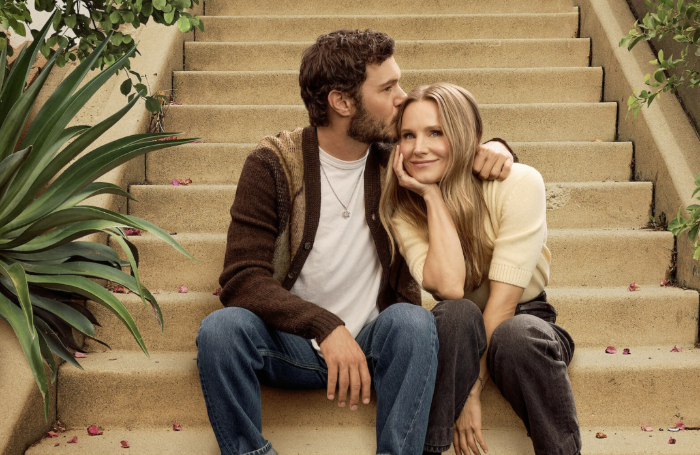
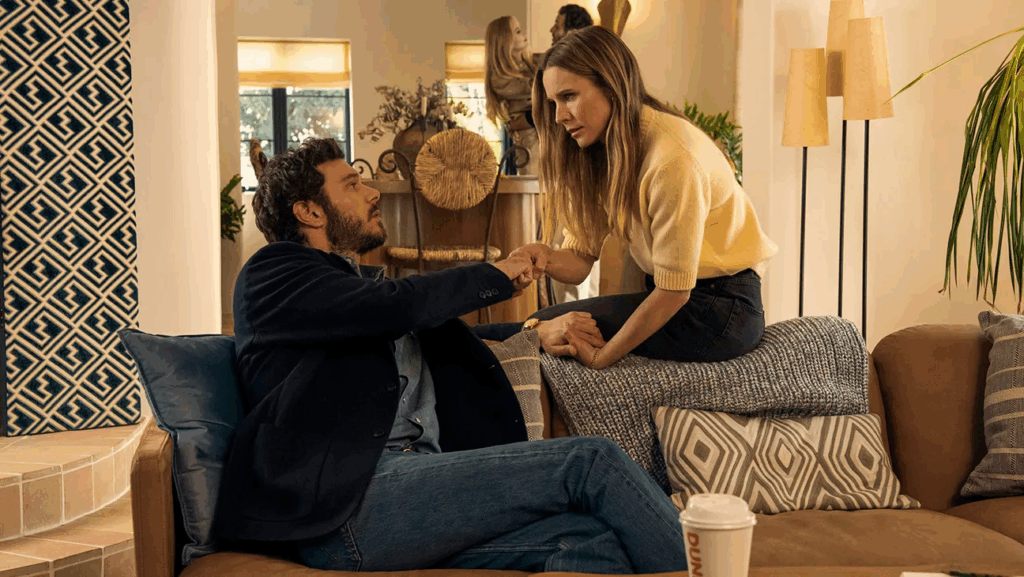
Still, the core is the same: Joanne (Kristen Bell) is an outspoken extrovert podcaster and Noah (Adam Brody) is a rabbi. Since this is a romcom, you know that they get together, and they do — plus you immediately, just immediately want them to.
That is damn hard to write.
I suppose any one element of the show is familiar, maybe even so much so as be borderline cliché: their families and friends are against this match, for instance. They have good reasons as well as bad, though, and the mix makes the whole thing have an air of realism even as it’s all heightened romance.
Absolutely brilliantly, you can easily make yourself believe this isn’t going to work out — and toward the very end of the first season, you can genuinely believe it hasn’t. No suspension of disbelief, you believe it and you care.
Maybe even more impressively, though, those family and friends, everyone in the entire story feels real. No one is there to set up punchlines, though they all do, and none of them are there to create obstacles for the drama, though they all do.
It takes more than this first script, but not much more, and so very soon into the run you are also rooting for another couple in the run, and feeling for just about everyone.
I wish more of the ten episode first season scripts were available, but there are two. Once you’ve read this, go straight to the other one — which is episode ten, Bat Mitzvah Crashers, by Craig DiGregorio.
And if this isn’t enough to give you a delicious time reading, or if there’s still anything left in that mug of tea you’re holding, do take a look at the previous years of this utterly pointless annual list I relish bringing to you.
And the blog post that started all of this, 2018’s My 10 Lessons from Reading 620 Scripts.
Keys to success
Don’t ask me why – well, you can ask, but I haven’t a clue why I’ve done it, or at least why I’ve done it now — but I’ve this minute taken a bunch of keys off my keyring.
And it was a tiny but shocking.
Presumably I’ve always thought of my keyring as a single object instead of a collection of them. I remember adding an AirTag once. I remember very proudly adding a Ceefax keyring thing to my keyring, a little thing that was given out at a BBC reunion. And I added a rechargable Apple Watch charger, which has proved very useful. Plus I remember taking my car keys off because with that key in the ignition, this jailer-like mass of keys would keep slapping against my knee.
But otherwise, and for who knows how long, it’s been the one bunch of keys and I grab them in the morning, I put them away at night.
There were keys on here that I have not one single thin clue what they could ever have been more.
And I just said I couldn’t conceive how long I’ve had this set, but I found a very big clue.
I was actually carrying around the keys to the flat I lived in 25 years ago. I hope they haven’t been robbed in the last quarter century because if they have, I urgently need an alibi.
I wonder what the code is for the block’s outer door is…
Anyway. Those keys are now gone and put beyond use, officer.
Whereas I’ve left on a small metal sign labelled “Concord Ignition Key. If found, please return to British Airways.” I think it was funny when I bought it or was given it or possibly found it, this was an extraordinarily long time ago. I think it’s fair to say it’s no longer funny, but I keep it around because it’s familiar.
Look, I’m talking about that part of the keyring, I’m not describing myself. Sheesh.
I’m 60. On the outside.
As I write this to you, I’ve now been knocking around for six decades and you’d think it was about time I actually got on and did anything. But I’m always thinking that, so instead I want to try something else today. I figure that after all this time, I am stuck with me and anything I don’t like is never going to change now. So I want to talk to you of the other stuff, I want to talk about the things about me that I like.
Chocolate.
Wait. I may have misunderstood the brief.
Okay, no, things about me that I like, got it.
Um.
Er.
Give me a minute.
Quick thinking. That’s it, I’m quick thinking.
That’s actually a joke of mine that I like very much but have yet to get into a script. It doesn’t work so much in straight text — I mean, you got it, but it wasn’t hysterical — yet in the right circumstances it would be a good line. Say someone asks you what you like about yourself, or they ask you to describe yourself, something like that. You then give them the wide-eyed, panicked, not-one-single-clue look and then if you can time it absolutely precisely, you come in with that quick-thinking line a pixel before they try moving to the next question.
Timing is crucial, but if you get it spot on, it’s a good gag. Plus it’s a bit meta: in order to slowly come to the answer that you’re quick thinking, you have to have thought of it right at the start so that you could time everything well. So you are quick thinking, it’s true.
You also over-analyse lines.
Which reminds me that I have one more line of mine which I really like and I remember it now both because I just said “over-analyse” to you, and because the other day I had to read a podcast advert for an online therapy firm.”Years and years ago now, my therapist told me that I overthink things,” I say. Er, to you, I say it to you, not in the advert. Anyway. I say that, then wait for exactly the right length beat pause before continuing: “To this day I wonder what she really meant.”
I think that works, I think it works in part because you know it’s true, you somehow know that there really was a she and that I do really wonder about this. But it’s also a fairly tight, short line, which is very important in writing because it means you don’t have to type much.
Actually, that is something I do like about me. I type well. I know I used to be 120 words per minute and I’ve slowed down a huge amount. But still, typing speed tests measure only copy typing, how fast you can enter a given series of words. They’re not about writing. So you might well beat me on how fast you press the keys, but for writing and typing combined, I think I could take you.
Oh! I have another one, I’d forgotten this. Someone once told me that they were lesbian.
“Oh, yes?” I said. “I think I’m Sagittarius.”
I think that’s funny, and of course you can easily disagree, but it was also a line that was accepting. Even welcoming.
There you go. Three written jokes in sixty years.
I’ll take that.
Funny. I’m thinking back over sixty years and usually I abhor that, but today it’s like the sixty years have been telling me to pay some attention. Just in the smallest, most unimportant ways. Like right now, this moment, I’m officially in the Commodore Lounge of the Queen Victoria cruise ship, docked in Tromso, Norway, and listening to a singer and pianist. But that singer has just finished a Diane Warren song and I’ve long deeply admired her writing. And I said I was officially in the Commodore Lounge, but I am certain that it’s only called that because of copyright reasons.
For the Commodore Lounge is on deck ten. It’s at the front of the ship. Every deck plan calls this the forward section. So I’m really sitting in Ten Forward and even the design of the windows is like those in this same bar on the starship Enterprise.
Mind you, the Enterprise has better WiFi. I’ve been without internet for the giant majority of the week and will be again in just a couple of hours. I can’t decide what I think about that, but I have now read ten novels and a non-fiction book this week so I grant you that maybe being without WiFi has its benefits.
The finest compliment
I’ve had a lot of compliments this week and as ever, you understand why — nobody is ever going say at an event that they couldn’t get who they wanted so here’s this guy instead, good luck. (Although I cherish having once been introduced as the finest writer available in our price bracket. God, I loved that.)
So anyway, it’s obviously very nice to hear great things said of you, although when they say it at the start you then rather have to live up to the billing. Consequently I can later on very easily dismiss the compliment as promotion or just the people being particularly nice, but in the moment it’s worrying. Challenging. Daunting.
Except one of the compliments this week was said straight, it was simple factual, and it was said to me practically in an aside while discussing many things. I was told I was a safe pair of hands.
It’s been days now and I can’t dismiss it, can’t excuse it away, and definitely can’t explain why I think that is a spectacular thing to say to someone.
Although I’m just after saying I can’t explain it and you know I’m going to try.
What they meant was that once I’d been booked, they could forget about me, knowing that this segment was covered. I’m not saying they mean they expect it to go brilliantly, but it won’t go wrong, there won’t be a problem. And in any project there are plenty of things going wrong so knowing one part is tied off is a relief. It’s a relief I recognise because I’ve been on both sides of this.
I get how good it is to know you simply don’t have to think about a certain part or a certain element. I know that, so I know what it meant for me to be that for someone, and I cherished it.
Plus I then did the event and of the three hosts producing it, none of them stayed in the room to watch me. You could take that as a bad thing, but it was absolutely the opposite. There was no need to watch, no need to look after me, and invariably there are other things on that day or other projects coming up that are problematic.
I took them leaving me there to be the same great compliment as the safe pair of hands line.
For once, I could really only be at this event for my segment of it so maybe they didn’t watch anyone’s, but you’re rotten for thinking of that and bursting my bubble.
Topping and Tailing
I admit to you that I’m finding getting older difficult. Well, really it’s easy because you just sort of hang about and it happens. But regardless of that, I am now and always will be grateful that I did the work that I’ve done at the precise time I did it.
This is not remotely going to be something about how the past was better. I don’t really care about the past and I actually resent the time I’m spending if I’m thinking of something I’ve done before when I could be doing something new.
Instead, this is about how things are different for the physical work in media. Things are better now, in fact, and pretty much infinitely so. For instance, just in the last hour before you and I started talking, I topped and tailed eight videos on my iPad. If you don’t happen to know the term, topping and tailing is putting something at the start and the end, and often removing something from there. All I’ve just now done is put the title sequences around some prepared footage. Very quick, very simple, and I’m doing it on an iPad, a thin sheet of glass, sitting on my couch.
I adore this stuff. Right now someone else is editing this week’s AppleInsider Podcast instead of me and I’m a bit jealous: being deep into an audio, nudging sentences around, prepping different versions, it’s mechanical but creative work and if I am good at it, I know that it is explicitly because I was taught on physical media.
The short version of that is to do with making decisions and making mistakes. When you’ve got five strips of tape around your neck and are using a razor blade to slice through a sixth while biting on a chinagraph pencil because you’ve nowhere else to put it, you have to keep track of this, you have to make the cut in the right place. And always you were doing it on deadline so it had to be right and it had to be now.
So being able to swipe my finger across an audio track on an iPad or to just undo every cut I’ve made in the whole session, it is ridiculously simple. But I also do fewer swipes, I undo much less than I might, because I’m used to being quick and decisive.
Only in this, I wouldn’t claim to be either in any other way.
But, look. Physical tape. An iPad. Nostalgia. Aging. These have all come to a point for me this week because of something that also is a point: I am the deputy chair of the Writers’ Guild of Great Britain and I will stand on tables shouting when writers are denied their dues, in every sense of that. (Apple is currently pissing me off, for instance, because they’re running a campaign celebrating creatives and they never, repeat never, name the poor sods who write this stuff for them. I have pressed.)
So all of this is going on in my head and yet here I am watching “Thin Air” on YouTube. It should not be there. It is a 1980s BBC drama serial and the writers are not being paid for this, no one on the show is. In every way, it is wrong and bad that it is available and so much so that I could well have to switch to past tense, it’s that likely to be removed.
But Thin Air has never been released commercially. It cannot be streamed. I don’t believe it has ever been repeated since its first airing in 1988. I do have a copy of it, but it’s on VHS and it must be twenty years since I’ve been able to play VHS.
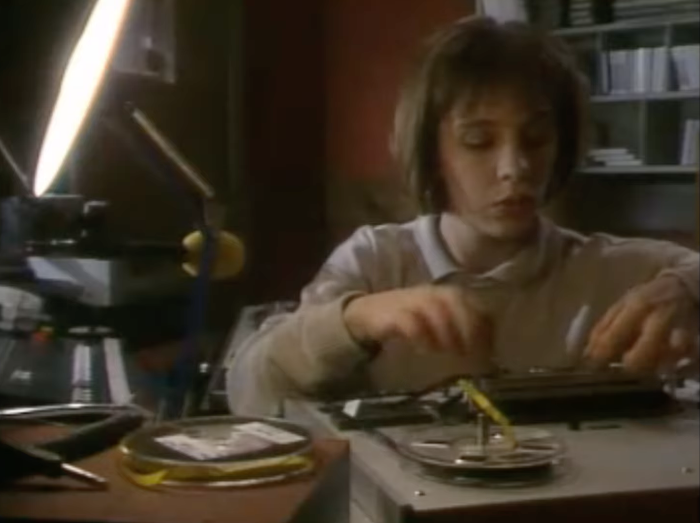
Yet watching it now, I am just agog at it. Written by Sarah Dunant and Peter Busby, it’s set in a commercial radio station in London. It’s a thriller, I am once again into it, but I’m also riveted by how it’s a commercial radio station in the 1980s. All my work was in BBC local radio but here’s the lead character, Rachel (Kate Hardie) with five strips of tape around her neck. Here’s a standing reel to reel tape machine. Here’s the chinagraph pencil for making edit marks, here’s the blade for cutting it.
And here’s this lead character, holding a strip of tape and running it across that machine’s playhead to check what it is.
It is prehistoric. And quite wonderful.
I once told Sarah Dunant that I wanted to be Rachel Hamilton from this show. I watch this now and I wouldn’t want to be in the 1980s, I wouldn’t want to go back, and yet I do also want to be Rachel in that station at that time.
That character is at the beginning of her career and I’m trying not to think about mine because I simply haven’t started yet. But I look at this show, I look at the fact I am watching it on an iPad, this glass that would have been unimaginable in the 1980s and is barely imaginable now. It’s hard not to think about then and now, it’s very hard not think about how my career will be topped and tailed.
But I tell you, for the present, I am done with the past. There’s no future in it.
Funny characters: Ho, Ho, Ho
The first time I heard of Slow Horses was a year or so before it began airing, when a TV company wanted to talk with me because a script of mine was like it. Quite possibly they just meant the subject matter was, but I took it at the time to be a compliment and of course having now seen the show, I’m taking it as an even greater one.
But there is one thing about the writing of this show. It is a dramatisation of Mick Herron’s novels and with a vague sense of due diligence, after I met with that company, I read the first one. I don’t think I can claim that it was then with an abundance of due diligence that I went on to read every novel in this Slough House series back to back, but that’s what I did.
And there is this one thing about the TV version. The novels are very visual, I could see how I’d have had a go at dramatising them, except for this one thing that, no question, would be beyond me and is beyond me.
Roddy Ho.
If you know the show or the novels, you relish this character, and if you don’t, I envy you having him to look forward to. He is a staggeringly annoying computer guy, more arrogant than the sun and I don’t know why I just said it that way, except he also as absolutely wrong in his view of the world as The Sun.
But here’s the thing. The utter joy of Ho in the novels is that every now and again, Mick Herron writes a chapter from Ho’s point of view. I suppose it’s the same joke every time, but it’s a scream. How he sees the world and how through this lens, we see what is really happening. (In the latest Slough House novel, Clown Town, Ho overhears a barista talking about him to a colleague. He swaggers because of the impact he’s clearly had on her, just the latest example that morning of his raw sexuality. But what she’s muttered is “big cock”.)
Roddy Ho is a tremendous creation and I could not fathom how a TV show was going to convey him when there couldn’t be this view from inside, this internal and borderline deranged first-person monologue.
This would now be a good point to say that, five series in, the show does it marvellously. The show does it marvellously. But this would also be a good point for me to say how it’s done this and, swear to god, I still don’t know. There isn’t a beat I remember from the novels that isn’t played in the series, but if you asked me to write a scene, this would block me.
It’s a failure of imagination on my part, I know. But I’d rather just say that Mick Herron writes Ho superbly, and so now do the TV show’s writers, Morwenna Banks, Mark Denton, Jonny Stockwood, Sean Gray, Edward Docx and lead writer Will Smith.
Tragedy plus time equals success
I loathe looking back at whatever tiny things I’ve done in my life: I want to be doing new tiny things. But this week I was — I want to say forced but that’s too much. I was enabled. Encouraged. Actually, I was just asked.
And the thing is, recounting a certain thing in a new context has somehow changed my memory of it. Not really, not completely, but some of the wiring in my head has been nudged into a better place.
Follow. This is the true version: I wrote on the 2001 television revival of Crossroads and it was a profoundly bad experience. I was fired from it.
Okay, I didn’t do it well enough, I didn’t write well enough. And actually I was so damaged by this apparent proof that I was a failure as a writer that for five years afterwards, I was doing all the usual things of pursuing writing work, even getting a lot of it in some fields, but it was like I was pretending. I knew I couldn’t write: it had been proven.
I remember that this period was five years because then I somehow earned a place on a writing masterclass kind of thing. We had workshops on radio, theatre, something else I’ve forgotten, and television. I only went to the TV one because otherwise I’d be wasting a space someone else, an actual writer, could have used. And it was like that anvil was lifted because it was there that I learned everyone got fired from that show. And it was there that I learned I had done close to everything the way I should have done. Not the writing, clearly, but how I took it, what I did, I was pretty close to good.
Truly, I felt lighter leaving that room. But if it helped me simply gigantically, that day didn’t change that I had been fired, it didn’t change how bad an experience it had all been.
Fast forward to this week when Crossroads star Tony Adams died. I was asked to talk about Crossroads on BBC CWR who somehow remembered that I’d written for the show. BBC Radio WM didn’t know that and were audibly delighted when I explained why, yes, I did know something about it.
Naturally, the point of talking on these two stations was Tony Adams, it was hardly going to be me, and of course neither show I was on had time to be a therapy session.
So I’m on there, talking enthusiastically about the series and — true — how impressed I was when I was given the original brief about what was going to be done with Adams’s character. I had a good time on the radio, I think I did it well, I enjoyed myself hugely.
I enjoyed talking about Crossroads.
For twenty years it’s been a pain point. For about six minutes this week, it was fun.
And I swear to you those few minutes have changed me. I can now look back — well, not happily, but I can look back.
Romancing the stony-faced
Last Saturday, I was running a Spark Young Writers’ workshop for Writing West Midlands and blathering on about genre, as you might. The trick of it was ultimately that I was going to get these teenagers to write half a story in a particular genre, pretending that we were taking it halfway just because we — truthfully — don’t get much time together.
And then of course I had them finish the story — in a different genre.
But to get this all set up nicely, I needed to have them vote on which genres they liked. Whenever possible, make it so that something is their fault rather than yours. Plausible deniability, it’s a skill.
For no very good reason whatsoever, though, I counted the votes in front of them and declared that there had been seven for horror and — quite remarkably given that there were eight people in the room — exactly 403 for romance.
Their faces. Their groans.
I didn’t put them through writing romance, but we did briefly talk about it. And as I did with them, I will maintain with you that romance is the hardest genre to write.
But this is again and again on my mind, and especially so this week, regardless of that workshop. For one thing, I’ve just ludicrously over-spent on a particular new iPad whose screen is so fantastic that it’s making me re-watch all of my favourite films because they look incredible. And first on the list were ones like Man Up, Kissing Jessica Stein and The Bourne Identity. Okay, the last is a thriller but I will stand on a high hill and say forever that thrillers and romances are the same thing. Or they can be, anyway.
But then there’s also this. On Wednesday, I read a review of the new, second season of the romantic comedy “Nobody Wants This.” on Netflix. (The full stop is important.) Without spoiling the show or, I suppose, spoiling the whole review, it rather criticised the second season for being like the first. This was meant as a criticism. My fully worked out, carefully considered response as someone who has been a professional TV critic — professional as in paid to do it, I’m not claiming anything more than that — and as someone who has both seen the first season and read the couple of scripts available online, was oh, for fuck’s sake.
If the reviewer is really just telling me that they didn’t like the first season, then I’m surprised at them but each to their own — and I don’t know why I should read their review of the second. If they said it has improved, that can really only mean that it has changed to suit their tastes. If they say it’s worse, I don’t know whether to think that means I’ll find it even better than the first.
Since I believe that the function of a critic — at least when I do it — is to alert you to shows you may like yet miss in the flood of them all, I’m not interested in someone’s opinion of what a show should or should not do in order to improve. You see a lot of this with online criticism, unprofessional criticism in every sense, where someone will declare how a series should not do X and absolutely must do Y. And it’s usually that the reviewer has been thinking about this for the 30-minute running time of an episode, where the writer, producer and all others involved in the show have been spending 70 hours a week for a year on it and may just possibly have thought of that same brilliant thing — and then of why it couldn’t be done.
Ah, let me be a TV critic again. Just for a moment. “Nobody Wants This.” by Erin Foster on Netflix has a superb first season. When I got to my desk at 5am yesterday, I checked whether the second season had dropped. I was that keen. (It hadn’t. Looks like Netflix launches shows at 08:00 BST or then 09:00 GMT depending. I did not know this.)
By the time the episodes were available, I was deep into the day’s work and couldn’t watch. I’ve now seen just the first of the new ten episodes. And I am immediately back in that world, with these characters, and completely, instantly invested in them all.
Obviously I don’t know if I’ll like the remaining nine. But I’ll tell you, I was a little worried going in. For the first season is a pretty complete romance story, if there hadn’t been anymore I’d have actually been upset but it would still have worked as it was. That means coming in to a second season, Foster and her writing team have to pick up the story anew and launch us into something that will last over ten episodes.
I think she’s done it. I know for certain that it is INCREDIBLY HARD not to WATCH THE ENTIRE THING RIGHT NOW.